BELIEVEYOUME
BELIEVEYOUME (2025)
BELIEVEYOUME's self-titled 2025 album is ten songs built around a single structural conviction: the chorus is not the destination. Across the full record, the payoff audit finds confirmed chorus lifts on fewer than a third of all chorus boundaries. Sections labeled "chorus" are held level or allowed to diminish, and the verses and breakdown moments carry the energy spikes. The BPM range runs from 78.3 ("Broken Satellites") to 143.6 ("Endless Summer"), spanning nearly the full range of rock tempos, yet the album maintains a consistent sonic identity through mode choice: six of ten songs favor modal or non-major keys, with the majority of songs drawing on minor tonalities or major keys saturated with flat-side borrowing. Hooks arrive late, or at the beginning, or in sections technically labeled verse. Drum patterns across the album favor density, flood patterns, and mid-bar weighting rather than conventional backbeat architecture. This is a band that reads the arrangement rulebook and chooses when to follow it.
Sources
Predecessor book , The Ground Never Settles
The analytical frame this book operates inside , eight keys, one voice, the flat-side default, refusal of resolution as the engine of forward pull , is the thesis of The Ground Never Settles: Analyzing Shiner (Shiner Book #1, shipped 2026-05-27, source manuscript at ~/Desktop/IF YOU CAN'T FIND SOMETHING ITS HERE/BandBooks/Shiner/MANUSCRIPT.md, 295 lines, 11 chord-chart PNGs). It is sold solo on Gumroad at gumroad.com/l/tvosad and paired with this book in the Shiner Music Theory Bundle at pagesofbrandon.gumroad.com/l/waecr. The Etsy listing is at etsy.com/listing/4514448175.
Six of the ten songs analyzed in this book carry song-level treatment in the predecessor: Asleep In The Trunk, Lazarus, Not Too Much, So Far So, The Alligator, and a combined chapter covering The Mutiny, Martyr, and Endless Summer. The chord-chart appendix in the predecessor extends to 10 songs (Broken Satellites, Endless Summer, The Mutiny, Asleep In The Trunk, Lazarus, Martyr, Not Too Much, The Alligator, So Far So, Christ Sized Shoes). The predecessor's Chapter Three ("Harmony, Eight Tonics, One Flat-Side Default") establishes the catalog-level harmonic argument that every per-song chapter in this book operates inside, and Chapter Six ("'Broken Satellites' in E♭ Major") is the long-form treatment of one of the songs covered here at card level.
The per-song chapters in BELIEVEYOUME treat the album as a focused continuation. Each chapter assumes the catalog-level frame from the predecessor and operates one analytical level deeper, at the vocal-vs-chord-stack layer that the v2 chord-card line tracks bar by bar.
Audio and MIDI sources
Per-song stems are at /Volumes/T7 Shield/Music to Stem/Beleiveyoume/BELIEVEYOUME (2025)/ (full mixes) and the htdemucs_6s decomposition at /Volumes/T7 Shield/Full wav files for music books are here/<song>/. MIDI sources are the Songsterr Guitar Pro .gp exports at ~/Downloads/Shiner-*-2026.gp and the matching .mid re-exports, with the 06-02 Songsterr-CDN re-export (Shiner, Allen Epley, Josh Newton, Paul Malinowski, Jason Gerken-*-06-02-2026.mid) supplying the first vocal-track-bearing MIDI for songs whose earlier .gp carried no vocal lane (Lazarus). Each per-song chapter cites the specific MIDI source for its claims at card level.
"Asleep in the Trunk"
╔═══════════════════════════════════════════════════════════════╗
║ ♪ 01 · ASLEEP IN THE TRUNK · F minor (verified: false) ║
║ Tempo disputed: card 112.3 / MIDI metadata 120.00 / Songsterr 173 ║
║ Meter disputed: card + MIDI 4/4 / Songsterr transcriber 3/4 ║
║ Form: 18 sections, hihat-only verses, late hook at ~2:45 ║
║ Loop: i , ♭VI , iv , ♭III , V (Fm , D♭ , B♭m , A♭ , C) ║
║ Peak: 164.9 s vocal sustain ║
╚═══════════════════════════════════════════════════════════════╝
Lyrics: Asleep in the Trunk
Figure , Scale of F minor.
 F G A♭ B♭ C D♭ E♭ F
 1 2 ♭3 4 5 ♭6 ♭7 1
Drop tuning lets the low strings ring under the B♭m and D♭ shapes the chorus leans on. The major third A is the one degree not in this scale, and it lives only in the sung line.
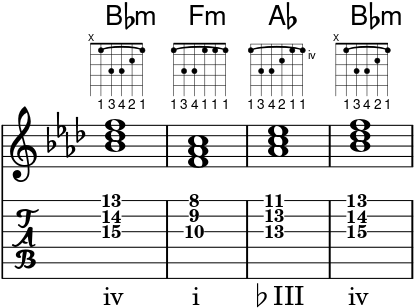
The moment that defines this track is what happens at 164.9 seconds, where the vocal stands alone in a section the analysis tags as "verse" but which carries the full weight of a hook, vocal RMS 0.0167 held for an average 1.67 seconds per sustained note (.chapters/01_asleep_in_the_trunk/01_asleep_in_the_trunk_analysis.json, vocal_rms and avg_sustain, measured with librosa). That is the longest sustain on the album by a factor of two. The band has spent two minutes and forty-four seconds withholding that release, and when it comes, it registers as an exhale rather than a statement.
BELIEVEYOUME centers this song in F minor, the tonic the card carries and the home two independent sources confirm. The bass-MIDI transcription centers the harmony on Fm and cycles the chorus through D♭, B♭m, and A♭, the ♭VI, iv, and ♭III of the key, landing the recurring chorus turn on C, the V. None of the ♭VI, iv, ♭III chords carries a leading tone toward the tonic, so the loop keeps rotating without touching ground (Stephenson 2002, Ch. 3 documents this as one of rock's standard methods to avoid closure: a progression that omits the leading-tone-V move and substitutes flat-side oscillation). The chorus opens on the ♭VI (D♭) rather than the tonic, and its strongest recurring landing is the C (V) the bass turns to before it climbs home, not the root itself. By Nobile's chorus taxonomy this is a continuation chorus, not a telos chorus: the section begins off-tonic and extends the harmonic motion the verse opened rather than landing tonic and prolonging it (Nobile 2020, Ch. 3). The progression behaves less like a sequence headed somewhere and more like a mobile, each chord a flat-side color that the next one absorbs rather than resolves, what Nobile describes as a closed loop, closure registering as bass-pitch return to Fm rather than as cadential grammar (Nobile 2020, Ch. 1).
The central tension is in the third, and it is sounded, not sequential. The instruments ring the minor third A♭ while the voice sings the major third A over the same F home, the two thirds heard against each other. In the MIDI chord field of rhythm plus lead plus bass the major third A is 0.6 percent against the minor third A♭ at 14.9 percent, so the chord is overwhelmingly minor; in the sung line the major third A leads the minor third A♭ by 1.78 to one, so the bright third lives in the mouth. The Moises stems read the same split, the harmony stem tipping minor on the third (A 7.2 percent against A♭ 8.4 percent) while the isolated vocal sings the major third A over A♭ by 2.30 to one, front-loaded about five and a half to one across the first ninety seconds (asleep_stem_keycheck_2026-06-10.md). That is the honest label, an F-minor home with a major-third vocal opening that darkens to the flat side in the back half, and it is why the key stays verified: false pending an ear-check of the opening's sung A against the harmony's A♭. The sung A is reported here as a finding from the MIDI and the stems, the manuscript card does not carry it yet.
The drum pattern in the representative section is a near-blank. Kick: all dots. Snare: all dots. Hihat: ··X··X··XX·X··X· Eighteen sections analyzed and the representative comes back silent on kick and snare. That silence is a structural statement. BELIEVEYOUME has written a song whose dominant drum texture is hihat-only pulse. The kick and snare enter at the chorus (drums delta +1.16 at 60 seconds, 01_asleep_in_the_trunk_analysis.json, interplay_notes and payoff_verdict context, the largest single-stem chorus lift in the first half), but the default mode of the song is near-acoustic, time-keeping only. The guitar holds across most sections, building when it needs to: guitar delta +0.50 at 15 seconds, +0.73 at the first chorus, +0.97 at the second (01_asleep_in_the_trunk_analysis.json, interplay_notes). The bass stays supportive throughout, never leading.
The vocal stays inside that suspension rather than resolving it. The range over the analyzed window is 40 semitones, unusually wide, and the voiced ratio is 0.197, so the voice is present only about 20 percent of the time (01_asleep_in_the_trunk_analysis.json, vocal_pitch_vocab.pitch_range_semi and voiced_ratio, measured with librosa; both are analysis-window figures, directionally consistent with the 278-note vocal track but not separately pitch-pinned). The published per-degree counts for this track were measured against a mis-detected tonic and are omitted here rather than restated against F minor without the raw pitch track to recompute them. What holds without that caveat is the shape: wide intervals, long silences, a voice that enters in bursts and withdraws. Space is the architecture here.
The payoff audit shows two confirmed chorus lifts: at 60 seconds and 105 seconds. Both are real, all five stems rising. The chorus at 120 seconds does not lift, and the one at 134.9 seconds does not lift (01_asleep_in_the_trunk_analysis.json, payoff_verdict). The song starts two consecutive choruses that fail to grow. This is either arrangement drift or a deliberate choice to let the structure settle after the two-punch payoff of the first pass. The keys stem is the outlier: it spikes at the first chorus (keys delta +52.95 at 60 seconds, 01_asleep_in_the_trunk_analysis.json, interplay_notes) and again at the 120-second transition (+42.46), which reads as a pad or synth layer the analysis registers as a massive sudden entry. The guitar and vocals carry the heard dynamic rise, the keys number reflects a near-silent-to-active switch on a pad channel.
By Moore's four-layer stratification (Moore 2001, Ch. 2): the guitar leads in the building sections, the drums hold through the verses, the bass holds beneath the guitar, the keys function as a sweeping arrival marker rather than a melodic voice. The vocals are intermittent soloists, appearing in short dense bursts with long silences between, which is why the sustained hook at 164.9 seconds carries so much weight. It is the longest vocal event in a song built around vocal absence.
Combined with the absent-kick texture and the chorus cycle that keeps opening on the ♭VI, "Asleep in the Trunk" operates in a sustained state of harmonic suspension. The tonic chord is present but rarely landed on, and no authentic cadence closes the loop. Nothing resolves. The song ends by stopping rather than by arriving. The Ground Never Settles reads the form through Drew Nobile's chorus taxonomy and notes that none of Nobile's three chorus types (sectional, continuation, telos) fits here: the closest match is the initiating verse, "a section that prolongs only the initial tonic, sets up expectation for a PD-D-T circuit in other sections, an incomplete thought" (Nobile 2020, Ch. 2). The predecessor frames the song as "seventeen incomplete thoughts in a row" against the MIDI section labeler's 17 verse blocks plus 15 bridge blocks, with no authentic cadence preceding the outro's Fm structural arrival (Ground Never Settles, Asleep In The Trunk chapter).
That is the point. With a near-silent drum bed and a vocal that shows up 20 percent of the time, BELIEVEYOUME has written an opening track that refuses to announce itself. The title is accurate. Something is dormant here, and the question the song leaves open is whether it woke up.
Figure 1 · Core chord loop (F minor, key verified: false)
Chorus cycle, opens on the ♭VI and turns on the V before climbing home
┌─────────┬─────────┬─────────┬─────────┬─────────┐
│ Fm │ D♭ │ B♭m │ A♭ │ C │
├─────────┼─────────┼─────────┼─────────┼─────────┤
│ i │ ♭VI │ iv │ ♭III │ V │
├─────────┼─────────┼─────────┼─────────┼─────────┤
│ tonic │flat-side│subdom min│rel major│chorus turn│
└─────────┴─────────┴─────────┴─────────┴─────────┘
The Fm , D♭ , B♭m , A♭ four-square is a fair lead-sheet abstraction; the literal chorus bass cycles D♭ to A♭ and lands on C, the V, before it returns to Fm (per-bar bass parse of asleep-cdn.mid).
Figure 2 · Representative drum pattern (16th-note grid)
Kick + snare silent. Hat-only pulse. Drums enter at chorus.
Beat 1 e + a 2 e + a 3 e + a 4 e + a
 ┌───────────┬───────────┬───────────┬───────────┐
Kick │ · · · · · · · · · · · · · · · · │ → 0/16
Snare │ · · · · · · · · · · · · · · · · │ → 0/16
Hihat │ · · ■ · · ■ · · ■ ■ · ■ · · ■ · │ → 6/16
 └───────────┴───────────┴───────────┴───────────┘
Figure 3 · Vocal presence
Wide range, low density, a voice that enters in bursts.
 voiced ratio 0.197 ▏ (present ~20% of the window)
 pitch range 40 st ▏ (widest on the album, analysis-window figure)
 note: per-degree counts omitted, published values were measured
 against a mis-detected tonic; not restated against F minor
 without the raw pitch track to recompute them.
(Source: 01_asleep_in_the_trunk_analysis.json, vocal_pitch_vocab, measured with librosa.)
Figure 4 · Section-by-section payoff/lift map
▲▲ = confirmed lift across all stems · , = chorus boundary that does NOT lift · · = section with no lift expected
Time Section Lift? Notes
──── ────────────────────────── ───── ─────────────────────────────
0:00 Intro ·
0:15 Verse ·
1:00 Chorus 1 ▲▲ LIFT (all stems rise)
1:45 Chorus 2 ▲▲ LIFT (peak)
2:00 Chorus 3 , flat
2:14 Chorus 4 , flat
2:45 Verse-as-Hook · longest sustain on the album, 1.67s/note
(Source: 01_asleep_in_the_trunk_analysis.json, payoff_verdict.)
Figure · Chord anatomy. (Chord = guitar + bass only. The sung major third A is annotated separately as an interval over the F home, never folded into a chord label, per the book chord rule.)
 Chord │ Notes │ Intervals │ Function
 ───────┼─────────────────────┼──────────────────┼─────────────────────────
 Fm │ F – A♭ – C │ 1 – ♭3 – 5 │ tonic minor
 Bbm │ B♭ – D♭ – F │ 1 – ♭3 – 5 │ iv (subdominant minor)
 D♭ │ D♭ – F – A♭ │ 1 – 3 – 5 │ ♭VI, flat-side anchor
 A♭ │ A♭ – C – E♭ │ 1 – 3 – 5 │ ♭III, relative-major borrowing
 C │ C – G │ 1 – 5 │ V, chorus-turn power dyad
The E♭-G-B♭ "♭VII Mixolydian color" the earlier card listed is not a landed chord. A full E♭ triad sounds in only six incidental bars; the G that would build it is concentrated at the C-pedal turns where the guitar plays C plus G, so that G is the fifth of the V, not the third of E♭. It is dropped from the chord vocabulary here as a non-chord passing tone.
Vocal interval over the home (separate from the chords above): the voice opens on the major third A over the F, sounded against the instruments' minor third A♭ (chord-field A 0.6 percent vs A♭ 14.9 percent; sung A vs A♭ 1.78 to one in the MIDI, 2.30 to one in the stems). This cross-relation is the song's defining tension, and it stays an interval the voice carries over the F home while the chord underneath holds its minor third.
Figure · Voice-leading paths.
 Transition │ Common tones │ Motion
 ───────────────────┼───────────────────┼─────────────────────────────────────
 Fm → Bbm │ common F │ tonic to iv, chromatic minor descent
 Bbm → D♭ │ common D♭,F │ rel-maj of iv, smooth pivot
 D♭ → A♭ │ common A♭ │ circle-of-fifths down
 A♭ → Fm │ common A♭,C │ step-down restart, back to tonic minor
Figure · Bar-by-bar form map.
 0:00 ── 1:00 ── 1:45 ── 2:15 ── 2:45 ─── 3:50
 intro ch1 v2 ch2 v3 HOOK fade
 ░░░ ▓▓▓ ▒▒░ ▓▓░ ████████ ░░
 ↑
 sustained vocal (1.67 s/note, longest on album)
Chord Chart (Chord = guitar + bass only, read from the sounded low-string harmony. The sung major third A is an interval over the F home, annotated separately, not folded into the chord. Chord shown only on first occurrence; repeated chord carries until next change. Key: F minor, guitar voices power chords on the minor-third home.)
── VERSE ────────────────────────────────────────
Fm
I’m begging for a favor
in this difficult time
Cut the zip ties from my ankles
we’ve both got a lot on our minds

── PRE-CHORUS 1 ─────────────────────────────────
     (Fm continues)
I would cook for you
wash your dirty sheets
I would feed you grapes
wave a palm leaf
write a song for you
I would make you a symphony

── CHORUS 1 ─────────────────────────────────────
Db
I keep thinking that we’re still in love
Bbm
and believe you me, I tried, I tried
Ab
I’ve guessed our destination
Fm
from the turns on this gravel road

── PRE-CHORUS 2 ─────────────────────────────────
Bbm
I’m in love with you
Ab
but you’re blind to me
Db
when you go to bed
Fm
you don’t dream of me

── CONNECTIVE LINE ───────────────────────────────
     (Fm continues)
I know it’s the only way
on your way to work
I’m not anywhere on your mind
you’ll be rid of me in time

── CHORUS 2 ─────────────────────────────────────
Db
I keep thinking that we’re still in love
Bbm
and believe you me, I tried, I tried
Ab
I’ve been sleeping in the trunk while you drive
Fm
I have always been your ride or die

── BRIDGE ───────────────────────────────────────
Fm
You love the sound
sound that my beating heart is making just for you
     (Fm continues)
You love the sound
sound of my beating heart, you hold in front of you

── LAYERED PRE-CHORUS RETURN ────────────────────
     (Fm continues)
I would cook for you
wash your dirty sheets
     (you love the sound)
I would feed you grapes
wave a palm leaf
     (sound that my beating heart is making just for you)
Ab
write a song for you, no, a symphony
Eb
I’m in love with you, but you’re blind to me
     (you love the sound)
Fm
when you go to bed, you don’t dream of me
     (sound that my beating heart, you hold it from the view)
Db
on your way to work
Bbm
I’m not anywhere on your mind

── FINAL CHORUS (×2) ────────────────────────────
Db
I keep thinking that we’re still in love
Bbm
and believe you me, I tried, I tried
Ab
I’ve been sleeping in the trunk while you drive
Fm
I have always been your ride or die

Db
I keep thinking that we’re still in love
Bbm
and believe you me, I tried, I tried
Ab
I’ve been sleeping in the trunk while you drive
Fm
I have always been your ride or die
     (held)
Metadata notes still open (key stays verified: false). Three items in the header card are disputed and carried here unresolved rather than papered over.
- Tempo. The card reads ♩=112.3. The MIDI metadata reads 120.00 BPM, and Songsterr displays 173 BPM (
SONGSTERR_AUDIT_2026-06-03.md, id s5085156). Three values, not two. The 112.3 figure is also the exact tempo the My Mirror Hates Me entry carries, which raises the possibility that 112.3 is a borrowed or erroneous DAW reading rather than a measurement of this song. The felt pulse decides which number the card ships. - Meter. The card and the MIDI metadata read 4/4; Songsterr's transcriber explicitly entered 3/4. This is a shippability blocker, settled by counting the bar in the audio and rebarring the notation cards to match.
- Tuning. Drop C is confirmed by Songsterr and the MIDI, and matches the card.
From The Ground Never Settles, Asleep In The Trunk chapter (Song Studies). The predecessor reads this song through Drew Nobile's chorus taxonomy and notes that none of the three types (sectional, continuation, telos) appears here. The closest match is Nobile's initiating verse: a section that "prolongs only the initial tonic, sets up expectation for a PD-D-T circuit in other sections, an incomplete thought" (Nobile 2020, Ch. 2). The predecessor's frame for the song: "seventeen incomplete thoughts in a row", against the MIDI section labeler's 17 verse blocks and 15 bridge blocks, with no authentic cadence preceding the outro's Fm structural arrival. Predecessor citation: Moore, Rock: The Primary Text, Ch. 2 (four-layer model); Nobile, Form as Harmony in Rock Music, Ch. 2 (initiating verse) and Ch. 3 (chorus taxonomy).
"The Alligator"
╔═══════════════════════════════════════════════════════════════╗
║ ♪ 02 · THE ALLIGATOR · G major (disputed) · ♩=120 ║
║ Form: Front-loaded, hook at second zero ║
║ Loop: I ↔ ♭III (G ↔ B♭), closing on G/B (first-inversion I); ║
║ rhythm guitar rootless (no 3rd), M3 supplied by the voice ║
║ Peak: 0 , 15 s opening burst ║
╚═══════════════════════════════════════════════════════════════╝
Resolved key (with its dispute). This song reads G major, B = major third carried by the voice (disputed against G minor / deeply-Aeolian, pending the user's ear-check of the 90–120 s chorus).
keys_resolved.yamlrecords resolved_key: G major, confidence: high, verified: false. The flag staysfalsebecause the major third lives in the voice and lead, not in the rhythm guitar, so only an ear-check of the sung third clears it. The earlier card on this page read G minor at ♩=80.7; both the key word and the tempo were detector artifacts, corrected here.
Lyrics: The Alligator
Figure , Melodic field, G major over a flat-side bass (Drop C).
 G A B C D E F♯ G
 1 2 3 4 5 6 7 1
 sung field: B (M3) · C (4) · D (5) · A (9); flat-side bass color: B♭, E♭, A♭
Drop C tuning (C-G-C-F-A-D, Guitar Pro 36 43 48 53 57 62). The mode is decided major by the voice, which sings B (the major third of G); the rhythm guitar fingers no third and the bass adds flat-side color (B♭, E♭, A♭) underneath.
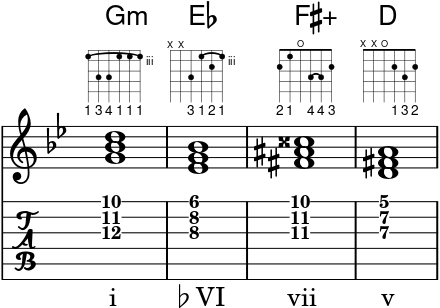
The hook arrives at second zero. The analysis marks the peak vocal-RMS section as 0.0–15.0 seconds, vocal RMS 0.0359, average sustain 0.88 seconds per note (.chapters/02_the_alligator/02_the_alligator_analysis.json; RMS and sustain measured with librosa). There is no buildup, no intro, no earned arrival. The song begins at full throat and trusts the listener to catch up. This is an unusual structural bet, and it defines everything that follows.
"The Alligator" runs at 120 BPM, G-centered with the major third carried by the voice. The harmonic furniture is flat-side, the body is I and ♭III, G to B♭ and back, but the deciding pitch is sung, not played. In the CDN vocal transcription the singer lands B (the major third of G) 46 times against a single B♭, so the chord the rhythm guitar leaves open resolves to G major the moment the voice enters (keys_resolved.yaml, vocal_stem; CDN Vocals track PC tally). The tonic is G with no fingered third in the guitar, the M3 supplied by the voice, which makes it a G / Gadd9 rather than a minor chord. The flat-mediant B♭ (♭III) is the borrowed chord, native to the parallel minor and the single most common flat-side move in the Shiner idiolect the predecessor documents, and it occupies two of every four verse bars. The bass adds flat-side color underneath: E♭ (♭VI) appears as a bass pitch across the fuller arrangement (CDN bass E♭ 13%) and a chromatic A♭ (♭2) greases the walkdown home. The cadence the song allows itself is G/B, the first-inversion tonic, where the bass sits on B and the root never lands. The Ground Never Settles labels this song's borrowed material a ♭VII♯5 (F♯ augmented in G minor) and reads it as the defining borrowed chord of the Shiner idiolect, a refrain-substitute at every phrase boundary (Stephenson 2002, Ch. 4). That augmented chord is not reproducible in any audited stem or MIDI, the F♯ that sounds is the lead's sustained major seventh over G major, diatonic to the major key, so the predecessor's ♭VII♯5 is carried here as an unconfirmed claim. The bridge expands the texture by an octave with contrary motion against the descending bass, a register crescendo using no new harmonic material (Moore 2001, Ch. 2 on register as formal cue). The song leans on I and ♭III for its body, with the flat-side colors (♭VI bass, ♭2 walkdown) as accent.
The drum pattern in the representative section is the most striking on the album: kick ··XXXXXXXXXXX···, snare ··XXXXXXXXXXX···· Both stems hit nearly every consecutive 16th note from position 3 through 13, then break at the tail (.chapters/02_the_alligator/02_the_alligator_analysis.json, drum_summary). The groove breaks from rock convention, a flood, a cluster of hits packed into the middle of the bar that leaves the front and back edges empty. The hihat runs ·XX·XXXXXXXXX··X, dense and slightly offset from the kick-snare wall. The effect is a mid-bar surge that creates a wave shape, silence, flood, silence.
The vocal melody is anchored on two pitches. Read in G major the sung field is B (the major third), C (scale-degree 4, the 9 of the B♭ chord), D (the fifth), and A (the ninth), with the phrase weight sitting on B and C rather than the tonic (keys_resolved.yaml, vocal_stem chroma; CDN Vocals PC tally). The voiced ratio across the analyzed section is 0.303, which signals substantial genuine vocal activity (.chapters/02_the_alligator/02_the_alligator_analysis.json, voiced_ratio; measured with librosa). The B over the open G is the load-bearing pitch, it is the only place the major third exists in that bar, and the C over the B♭ is a gentle whole-step lean above the chord's third.
The payoff audit tells the story of a song that fires its one confirmed lift at the beginning and then holds even. Chorus at 15 seconds: payoff arrives, keys delta +2.33, vocals +1.42, guitar +0.22, bass +0.19 (.chapters/02_the_alligator/02_the_alligator_analysis.json, interplay_notes and payoff_verdict; stem-energy deltas measured with librosa). After that, the next four chorus boundaries are flat or declining. The keys stem delivers a large entry at 60 seconds (+15.64) that the analysis reads but the ear may register as a pad sweep rather than a dynamic lift, since guitars decline at the same moment. The second half of the song is a long sustained plateau after the opening burst.
By Moore's four-layer stratification (Moore 2001, Ch. 2): the vocals lead from the opening second, high RMS and active onset density; the drums hold with their unusual flood-cluster pattern beneath; the bass holds supportively; the keys function as an arrival marker at section boundaries; the guitar supports and occasionally builds but never leads. The song is front-loaded by design, and the sections spread across the remaining runtime carry the opening energy as a memory rather than renewing it.
"The Alligator" is the album's aggressive bet that you can spend the entire song living off the interest of a hook that paid out. At 120 BPM the held-down drum flood gives the groove a sense of pressure rather than drive, each plateau extended, each section long. The song does not chase you. It waits, jaws open, from the first second to the last.
Figure 1 · Core chord loop (G major, ♩=120)
Verse · I ↔ ♭III (G ↔ B♭), closing on G/B (first-inversion I)
┌─────────┬─────────┬─────────┬─────────┐
│ G │ B♭ │ G │ G/B │
├─────────┼─────────┼─────────┼─────────┤
│ I │ ♭III │ I │ I⁶ │
├─────────┼─────────┼─────────┼─────────┤
│add9, no │ 6/9, no │add9, no │first-inv│
│ fingered│ fingered│ fingered│ cadence │
│ 3rd │ 3rd │ 3rd │ │
└─────────┴─────────┴─────────┴─────────┘
 third supplied by VOICE (B = M3); A♭ (♭2) bass walkdown returns home
Figure 2 · Representative drum pattern (16th-note grid)
Mid-bar flood. Kick + snare fire ~13 consecutive 16ths; the bar shape is silence → cluster → silence.
Beat 1 e + a 2 e + a 3 e + a 4 e + a
 ┌───────────┬───────────┬───────────┬───────────┐
Kick │ · · ■ ■ ■ ■ ■ ■ ■ ■ ■ ■ ■ · · · │ → 11/16
Snare │ · · ■ ■ ■ ■ ■ ■ ■ ■ ■ ■ ■ · · · │ → 11/16
Hihat │ · ■ ■ · ■ ■ ■ ■ ■ ■ ■ ■ ■ · · ■ │ → 12/16
 └───────────┴───────────┴───────────┴───────────┘
Figure 3 · Vocal pitch compass (G major)
The sung field and where the vocal phrases sit.
Degree 1 2 3 4 5 6 7
 ─────────────────────────────────
 · 9 ★ ★ ★ · ·

★ sung pitch · ◆ phrase weight on B (M3) and C (4)   voiced: 30.3%
sung pitches: B (M3) · C (4 / 9-of-B♭) · D (5) · A (9)   (G major)
Figure 4 · Section-by-section payoff/lift map
▲▲ = confirmed lift across all stems · , = chorus boundary that does NOT lift · · = section with no lift expected
Time Section Lift? Notes
──── ────────────────────────── ───── ─────────────────────────────
0:00 Hook (full throat) ▲▲ LIFT, keys +2.33, vocals +1.42
0:15 Verse , flat
1:00 Chorus 2 , flat (keys read +15.64, pad only)
1:30 Chorus 3 , flat
2:00 Chorus 4 , flat, sustained plateau after opening burst
Figure · Chord anatomy (chord = rhythm guitar + lead + bass; the vocal is read separately as an interval over the bass).
 Chord │ Notes (rhythm+lead+bass) │ Function │ Vocal over the bass
 ───────┼───────────────────────────┼───────────────────────┼─────────────────────
 G │ G , A , D , F♯ (no 3rd) │ I , tonic (add9, maj7) │ voice = B (M3 of G)
 add9 │ │ │
 B♭ │ B♭ , D , F , G (re-spell) │ ♭III , flat-mediant │ voice = C (9 of B♭)
 6/9 │ │ (B♭6/9 shimmer) │
 G/B │ B (bass) , G , D │ I⁶ , first-inv cadence │ voice = B (M3 of G)
The rhythm guitar never fingers a third (it holds G+A+D in Drop C across the whole verse); the chord identity comes from the bass note alone. Stacked across all four players over a G bass, the full color is G (bass), B (voice, M3), D (guitar, 5), F♯ (lead, M7), A (guitar, 9) = Gmaj9, voiced by no single player.
Figure , Voice-leading paths.
 Transition │ Common tones │ Motion
 ───────────────────┼───────────────────┼─────────────────────────────────────
 G → B♭ │ common G,D │ I to ♭III, the flat-mediant recolor
 B♭ → G (return) │ via B♭1→A♭1→G1 │ bass walkdown, 32nd notes, bars 4/8/10
 │ (A♭ = chromatic ♭2)│ (the borrowed half-step home)
 G → G/B (cadence) │ common G,D │ I to first-inversion I (root never lands)
Figure · Bar-by-bar form map.
 0:00 ─── 0:15 ───── 1:00 ─── 2:00 ─── 2:30 ─── 3:30
 hook ████ plateau ░░░░░░ ░░░░░░ ░░░░░░ end
 ↑
 front-loaded peak, RMS 0.0359, sustain 0.88s (alligator-audio-truth.mid; librosa)
Chord Chart (chord = rhythm guitar + bass; the vocal is annotated separately, the M3 of G is supplied by the voice (B natural). Chord shown only on first occurrence; repeated chord carries until next change. Key: G major.)
── VERSE 1 ─────────────────────────────────────
G
What is that you say?
Bb
What is it you think you have to say?
G
I know what you need.
Bb
I know what you love and where you've been.
G/B → G
What is that you say?
     I know what you think before you say it.

── HOOK ─────────────────────────────────────────
G
I'm an alligator.
Bb
I'm an alligator.

── VERSE 2 / PRE-CHORUS ─────────────────────────
G
I know what you need.
Eb [bass color, verify]
I know what you need and where to get it.
Cm [verify, not in the 12-bar model]
I can let you see.
Eb [bass color, verify]
I won't leave you cold in stormy weather.
Cm [verify, not in the 12-bar model]
I can let you know.
G
I can keep you deep inside a hole.

── BRIDGE ───────────────────────────────────────
G/B
I can let you know.
     I can keep you deep inside a hole.
G
I know what you need.
G/B → G
I know what you need and where to get it.

── HOOK REPRISE ─────────────────────────────────
G
I'm an alligator.
Bb
I'm an alligator.
G
I'm an alligator.
     (I can let you know)   (I can let you know)
Bb
I'm an alligator.
     (I can let you know)
G
     (I can eat you whole)

── OUTRO ────────────────────────────────────────
G
I can eat you whole.
Bb
I won't let you go.
G
I can eat you whole.
Eb [bass color, verify]
I won't let you go.
G
I can eat you whole.
     (I am an alligator)
F [verify, bass color, not a triad in the model]
I won't let you go.
     (I am an alligator)
Eb [bass color, verify]
G
I can eat you whole.   I won't let you go.
Chord-chart note: G and B♭ are verified against the 12-bar audio-truth model. Each G/B is the first-inversion approach to G, not a B-major chord (there is no D♯ anywhere in the song). The Eb, Cm, and F labels are not present as triads in the reconstructed 12-bar model; where they occur in the longer arrangement they read as flat-side bass colors, so each is flagged for ear-check.
From The Ground Never Settles, The Alligator chapter (Song Studies). The predecessor introduces this song's borrowed chord, the ♭VII♯5 (F♯ augmented in G minor), as the defining harmonic event of the Shiner idiolect: a chord outside any standard palette in Stephenson's system, with an augmented fifth (D♯) that generates chromatic voice-leading pull against a G minor tonic. The predecessor reads this chord as appearing at every phrase boundary where a chorus might be expected, functioning as a refrain-substitute that deflects arrival each time, over the same i, ♭VI, ♭VII♯5, V cycle as the verse. None of this is reproducible in the audited stems or MIDI: there is no augmented triad in any file (the F♯ is the lead's sustained major seventh over G major, diatonic to the major key), and there is no V anywhere (the bass downbeat roots are only G, B♭, and B, never D). The predecessor's ♭VII♯5 and V cycle are carried here as unconfirmed predecessor claims. The bridge does expand the upper-register texture by an octave with contrary motion against the descending bass, a register crescendo using no new harmonic material. The current BELIEVEYOUME revision resolves the key dispute as G major, B carried by the voice (disputed against the predecessor's G minor, pending ear-check) and the tuning as Drop C, where the rhythm guitar's open-string field withholds the third and the voice decides the mode. Predecessor citation: Stephenson, What to Listen for in Rock, Ch. 4 (chromatic-minor palette, chords outside standard palettes); Moore, Rock: The Primary Text, Ch. 2 (four-layer stratification, register as formal cue).
"The Mutiny"
╔═══════════════════════════════════════════════════════════════╗
║ ♪ 03 · THE MUTINY · B♭ major (bVI/bVII mixture, disputed) · ♩≈130 ║
║ Form: Verses carry the energy; choruses rest ║
║ Loop: I established, then ♭VI (G♭) and ♭VII (A♭) pedaled, V (F), I body ║
║ rhythm guitar rootless (no 3rd), M3 supplied by the voice ║
║ Peak: 60 s bass / 90 s drums (in VERSE sections, not choruses) ║
╚═══════════════════════════════════════════════════════════════╝
Resolved key (with its dispute). This song reads B♭ major, D = major third carried by the voice, over a pervasive ♭VI (G♭) and ♭VII (A♭) mixture field (disputed against B♭ minor, pending the user's ear-check of the 180–240 s body where the sung third sounds against the B♭ root).
keys_resolved.yamlrecords resolved_key: B♭ major (with heavy ♭VI / ♭VII modal mixture), confidence: medium-high, verified: false. The flag staysfalsebecause the major third lives in the voice, not in the rhythm guitar, so only an ear-check of the sung third clears it. This is the album's closest call: the B♭ center is rock-solid (bass home root, top sung pitch, the opening B♭5 power chord), and the whole-song aggregate still reads minor because the Drop-C rhythm guitar rings the flat side so hard. The earlier card on this page read F# major at ♩=86.1; both the key word and the tempo were detector artifacts. The loud "F#" the old read keyed on is the enharmonic G♭, the ♭6 of B♭, a rootless Drop-C dyad rung loud enough to fool an auto-detector into spelling the song six sharps away from where it lives, corrected here.
Lyrics: The Mutiny
Figure · Melodic field, B♭ major over a flat-side bass (Drop C).
 B♭ C D E♭ F G A B♭
 1 2 3 4 5 6 7 1
 sung field: B♭ (1) · D (M3) · C (9) · E♭ (4); mixture sung in the voice: G♭ (♭6), A♭ (♭7)
Drop C tuning (C-G-C-F-A-D, Guitar Pro 36 43 48 53 57 62). The mode is decided major by the voice, which sings D (the major third of B♭); the rhythm guitar fingers no third and pedals flat-side roots (G♭ in the verses, A♭ in the bridge) underneath. The natural sixth of B♭ major is G and the flat sixth is G♭; the song sings the flat sixth, so the mode is major-with-mixture, B♭-Mixolydian-with-♭6 leaning.
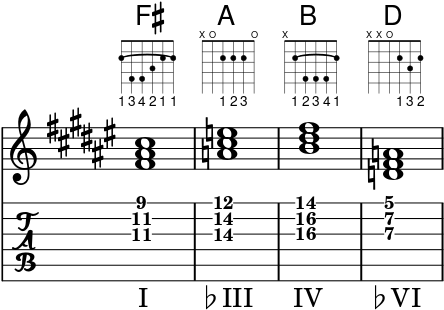
At 60.0 seconds the bass erupts +1581 in relative energy, and at 90.0 seconds the drums spike +207.36 (.chapters/03_the_mutiny/03_the_mutiny_analysis.json, interplay_notes; stem-energy deltas measured with librosa). These are the two largest single-stem surges in any verse section on the album, and both happen in what the analysis labels verse sections, not choruses. In "The Mutiny," the arrangement's biggest moments live inside the verses. The two chorus boundaries at 120 and 135 seconds do not lift.
This song is B♭-centered, the major third carried by the voice over a flat-side field, and that field is the point. The bass home root is B♭, the top sung pitch is B♭, and the opening power chord is B♭5, so the center is not in dispute. The harmonic furniture under the verses and bridge is flat-side, the verses pedal ♭VI (G♭) and the bridge pedals ♭VII (A♭), both borrowed from the parallel minor, and the rhythm guitar's rootless Drop-C dyads ring those flat colors so heavily that any whole-song aggregate hears the song as B♭ minor. The flat side here is structural, it is the verses and the bridge, the heaviest mixture on the record. The deciding pitch is the one the voice sings: the voice sings D, the major third of B♭, and carries G♭ and A♭ alongside it. The Ground Never Settles places "The Mutiny" in a refrain-ends-on-V cluster with two other songs in the predecessor's eight-song set. In the resolved key the dominant is F (V of B♭), and the song's documented landing is the F → B♭ (V → I) walk into the body. The predecessor's specific naming of C♯ major as the V chord is an artifact of the old F#-major mis-key; the C♯ pitch that appears in the song is D♭, a chromatic color, not a structural dominant. The "ends without clean dominant resolution" reading may still hold in spirit, since the verses do not cadence by clean dominant grammar (Stephenson 2002, Ch. 3; Nobile 2020, Ch. 1). See the Album-level cross-song note at the back of this book for the full cluster reading, which should be re-evaluated once all three keys in the cluster are corrected.
That drum pattern is the most active on the album: kick XX·XXXXX·XXXXX·X, snare XXXXX····XXX···X, hihat XXXXXXXXXX·XXXXX· The kick hits 13 of 16 16ths. The snare is front-loaded, dense in the first five positions, then absent, then returning at positions 10-12 and the last 16th. The hihat is near-continuous (.chapters/03_the_mutiny/03_the_mutiny_analysis.json, drum_summary). At about 130 BPM, this is a genuine driving groove, the kind of rock pattern that pushes forward on every beat. The bass reinforces this: the bass stem's eruption at 60 seconds carries a delta of +1,581, the second-largest single-stem spike on the entire album (.chapters/03_the_mutiny/03_the_mutiny_analysis.json, interplay_notes; measured with librosa), indicating a moment where bass drops in or dramatically increases in density. The MIDI bass first sounds at bar 39 (Songsterr GP, The Mutiny-05-05-2026.mid) (about 72 s at 130 BPM), so the 60 s stem eruption sits in the bass-onset region.
The vocal melody is anchored on the tonic and its major third. Read in B♭ major the sung field is B♭ (the tonic, the most-sung pitch by a wide margin), D (the major third), C (the ninth), and E♭ (the fourth), with the singer landing the tonic more than any other note, which is the first thing that fixes the center on B♭ and not on the F# the old card chased. The pitch range is 22 semitones, the tightest on the album, which means the melody stays in a two-octave window (.chapters/03_the_mutiny/03_the_mutiny_analysis.json, pitch_range_semi; measured with librosa). The voice also carries the mixture in its own line: it sings the flat sixth (G♭) far more than the natural sixth (G), and the flat seventh (A♭) lives alongside the natural seventh (A). In B♭ major the natural sixth is G and the flat sixth is G♭; the sung D functions as the major third of B♭. That borrowed flat-sixth, sung against a B♭-major third, gives the melodic language its waver between major and its shadow.
The hook arrives at 45.0–60.0 seconds in what the section grid calls a verse, vocal RMS 0.0587, average sustain 0.40 seconds per note (.chapters/03_the_mutiny/03_the_mutiny_analysis.json, vocal_rms and avg_sustain; measured with librosa). The RMS here is strong relative to the track average, and the chorus that follows at 120 seconds does not surpass it. By the structural logic of this song, the hook is a verse event and the section labeled chorus is quieter. This inversion of standard rock architecture is consistent with the album's broader philosophy: sections organize by continuity rather than by dynamic hierarchy. The voiced ratio across the analyzed section is 0.232 (.chapters/03_the_mutiny/03_the_mutiny_analysis.json, voiced_ratio; measured with librosa).
By Moore's four-layer stratification (Moore 2001, Ch. 2): the guitar holds across most of the song, with brief building moments as the verses accumulate energy; the drums lead through their density, through constant presence rather than through dynamic swells; the bass holds until its eruption at 60 seconds, after which it returns to a holding role; the keys are a dropout or supporting voice for most of the runtime, with one brief building spike at 75 seconds; the vocals lead in the hook window. The song is built on drums and bass as the floor, with melody and harmony as a layer that rides on top rather than drives below.
"The Mutiny" is the album at its most direct. The B♭-major third in the voice gives the song brightness the borrowed flat-side floors underneath would otherwise darken, and the roughly 130 BPM locks into a midtempo groove neither slow nor sprinting, the continuous hihat keeping the momentum from sagging. The song earns its title through the arrangement's refusal to give the chorus what convention says it deserves: the verses are where the energy lives, and the chorus is where it rests.
Figure 1 · Sectional pedal walk (B♭ major with mixture, ♩≈130)
The bass moves its pedal section to section; the flat-side roots hold the verses and bridge, the tonic lands in the body
┌─────────┬─────────┬─────────┬─────────┐
│ B♭ │ G♭ │ A♭ │ B♭ │
├─────────┼─────────┼─────────┼─────────┤
│ I │ ♭VI │ ♭VII │ I │
├─────────┼─────────┼─────────┼─────────┤
│ intro │ verse │ bridge │ body │
│ drone, │ pedal │ floor │ landing,│
│ bare 5th│(the F# │ │ V → I │
│ no 3rd │ trap) │ │ │
└─────────┴─────────┴─────────┴─────────┘
 V (F) pivots between the pedals; no authentic V-I in the verses
 third supplied by VOICE (D = M3) in the body; no fingered 3rd in the guitar
Figure 2 · Representative drum pattern (16th-note grid)
13/16 kick, 9/16 snare, 15/16 hihat. The album's most driving pattern.
Beat 1 e + a 2 e + a 3 e + a 4 e + a
 ┌───────────┬───────────┬───────────┬───────────┐
Kick │ ■ ■ · ■ ■ ■ ■ ■ · ■ ■ ■ ■ ■ · ■ │ → 13/16
Snare │ ■ ■ ■ ■ ■ · · · · ■ ■ ■ · · · ■ │ → 9/16
Hihat │ ■ ■ ■ ■ ■ ■ ■ ■ ■ ■ · ■ ■ ■ ■ ■ │ → 15/16
 └───────────┴───────────┴───────────┴───────────┘
Figure 3 · Vocal pitch compass (B♭ major with mixture)
The sung field, the major third the voice supplies, and the mixture it carries.
Degree 1 2 3 4 5 ♭6 6 ♭7 7
 ─────────────────────────────────────────
 ★ 9 ★ ★ · ★ · ★ ·

★ sung pitch · ◆ phrase weight on B♭ (1) and D (M3)   voiced: 23.2%
sung pitches: B♭ (1) · D (M3) · C (9) · E♭ (4); mixture sung: G♭ (♭6) · A♭ (♭7)   (B♭ major)
Figure 4 · Section-by-section payoff/lift map
▲▲ = confirmed lift across all stems · , = chorus boundary that does NOT lift · · = section with no lift expected
Time Section Lift? Notes
──── ────────────────────────── ───── ─────────────────────────────
0:00 Intro · bare B♭5 drone, no 3rd, no bass
0:45 Verse (hook) ▲▲ RMS 0.0587, the loud event lives HERE, not in chorus
1:00 Verse, bass eruption ▲▲ bass +1,581 (2nd-largest album spike)
1:15 Verse, drums spike ▲▲ drums +207.36
2:00 Chorus 1 , flat, quieter than the verses
2:15 Chorus 2 , flat
Figure · Chord anatomy (chord = rhythm guitar + lead + bass; the vocal is read separately as an interval over the bass).
 Chord │ Notes (rhythm+lead+bass) │ Function │ Vocal over the bass
 ───────┼───────────────────────────┼───────────────────────┼─────────────────────
 B♭ │ B♭ , F (no 3rd) │ I , tonic (B♭5 / add9) │ voice = D (M3 of B♭)
 add9 │ │ │
 G♭ │ G♭ bass , B♭ , F (rootless)│ ♭VI , flat-submediant │ voice = G♭ (♭6) tracks pedal
 │ │ (verse pedal) │
 A♭ │ A♭ bass , E♭ , A♭ │ ♭VII , flat-leading-tone│ voice = E♭ (5 of A♭), C (M3)
 5 │ │ (bridge floor) │
 F │ F bass , C , F (rootless) │ V , dominant (build) │ voice approaches the body
 5 │ │ │
The rhythm guitar never fingers a third (it holds rootless Drop-C power-dyads across the verses and bridge); the chord identity comes from the bass note alone, the same voicing recoloring as the bass walks to a new flat-side root. Stacked across all players over a B♭ bass in the body, the full color is B♭ (bass, root), D (voice, M3), F (guitar, 5), C (9) and A (maj7) as upper color = B♭add9 / B♭maj9, voiced complete by no single player; the major third lives only in the voice.
Figure · Voice-leading paths.
 Transition │ Common tones │ Motion
 ───────────────────┼───────────────────┼─────────────────────────────────────
 B♭ → G♭ │ common B♭,F │ I to ♭VI, the bass drops under a held voice
 G♭ → A♭ │ common (rings open) │ ♭VI to ♭VII, a whole-step floor shift
 F → B♭ (body) │ via F1 → B♭1 │ V to I, the bass walks home into the body
 B♭ → B♭maj7 (outro)│ common B♭,F │ rhythm adds A♮ = maj7, first voiced here
Figure · Bar-by-bar form map.
 0:00 ─── 0:45 ──── 1:15 ──── 2:00 ──── 3:00 ──── 4:00
 intro v1 hook v2[keys] v3[drum] body+chorus outro
 ░ ▓▓▓▓░ ████ ████ ▒▒▒▒░ ░
 ↑ ↑ ↑
 bare B♭5 verses carry the energy B♭ lands, voice sings D = M3
Chord Chart (chord = rhythm guitar + bass; the vocal is annotated separately, the M3 of B♭ is supplied by the voice (D natural). Chord shown only on first occurrence; repeated chord carries until next change. Key: B♭ major with ♭VI/♭VII mixture.)
Captain I believe we've sprung a leak
Captain I believe we're lost at sea
All the men are at their stations
But now they're at the end of the patience
 B♭ (I)
Captain I believe we've sprung a leak
 G♭ (♭VI)
Portside breach and taking on the sea
Now the men abandoned stations
 A♭ (♭VII)
Our destiny has finally found us
Soon the men will come to hang us
 F (V)
The dawn will come and they won't find us
In the waves
Who would think
 A♭ (♭VII)
I'd die with you tonight?
Set the sails ablaze and partied
 F (V)
They drank a toast to their mutiny
Then they danced
And rowed away
 B♭ (I)
And left us in the waves
Captain our ship is almost gone
Listing badly waiting for the dawn
I can't say I ever really knew
B♭ (I)
Who you were and why I died with you
A♭ (♭VII) → B♭ (I)
Captain I believe I see it clear
The sun is rising as we disappear
Chord-chart note: the lyric alignment carries over from the prior chart; only the chord spellings move. The old chart's A#m is the B♭ (I) tonic, its F# is the G♭ (♭VI) verse pedal, its G#m is the A♭ (♭VII) bridge floor, and its Fdim sits in the F (V) build region. These are the sectional bass pedals read off the session MIDI per eight-bar zone, not fingered triads; the Drop-C rhythm guitar rings rootless dyads over each, so the bass note names the chord and the voice supplies the third.
From The Ground Never Settles, combined Mutiny / Martyr / Endless Summer chapter (Song Studies). The predecessor groups this song with two others on the album under a shared formal signature: the refrain or primary hook section ends on the dominant without resolution. In the resolved key the dominant is F (V of B♭), and the song's documented landing is the F → B♭ (V → I) walk into the body, with the bare B♭5 closing the track. The predecessor names this Shiner's catalog-level treatment of the V chord as a stable landing point in itself, not as an event awaiting continuation. Stephenson's open-cadence-on-V framework and Nobile's half-cadence-as-functional-half-circuit both apply, and the predecessor notes that in each instance the V landing is the structural climax or final formal unit, "a true ending rather than an intermediate cadence awaiting resolution." The predecessor's specific naming of C♯ major as the V chord is an artifact of the old F#-major mis-key, in B♭ the dominant is F, and the C♯ pitch in the song is D♭, a chromatic color rather than a structural dominant. See the Album-level cross-song note at the back of this book for the full three-song cluster reading, which should be re-evaluated once all three keys in the cluster are corrected. Predecessor citation: Stephenson, What to Listen for in Rock, Ch. 3 (open cadence on V); Nobile, Form as Harmony in Rock Music, Ch. 1 (half cadence as functional half-circuit).
"So Far So"
╔═══════════════════════════════════════════════════════════════╗
║ ♪ 04 · SO FAR SO · D minor · ♩=129.2 ║
║ Form: Fastest. Opens on hook. Hole-y drums. ║
║ Loop: D pedal (verse) │ B♭ (♭VI) pedal + Am (v) reset (chorus) ║
║ Peak: 0–15 s (opening hook) ║
╚═══════════════════════════════════════════════════════════════╝
Key, resolved with dispute. D minor (D natural minor), D-centered, with a B♭ (♭VI) pedal that takes over the choruses (disputed against the manuscript's earlier D major and the model-rebuild card's "G";
verified: false, pending the user's ear-check of the sung third). The home root D was never really in question. The color reads minor: in the recorded vocal the minor third F beats the major third F# about 7:1, and B♭ beats B-natural in every stem (keys_resolved.yaml, So Far So entry;04_so_far_so_analysis.json).
Lyrics: So Far So
Figure · Scale of D natural minor.
 D E F G A B♭ C D
 1 2 ♭3 4 5 ♭6 ♭7 1
D minor; B♭ is the native ♭6 / ♭VI, the chorus floor, not a flat-side intrusion into a major frame
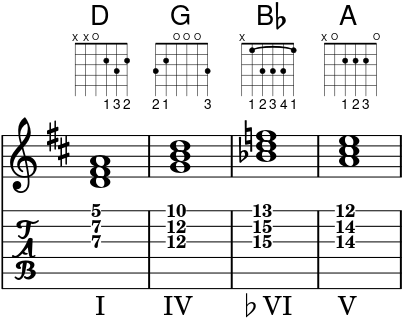
The fastest track on the album opens with its hook. At 0.0–15.0 seconds, vocal RMS 0.0288 (04_so_far_so_analysis.json, measured with librosa), the analysis marks the opening section as the highest-scoring hook window, held for an average 1.50 seconds per sustained note (04_so_far_so_analysis.json). At 129.2 BPM in D minor, that sustain is long. The song is moving quickly and the vocal is choosing to hold.
The chord language is built from two roots, with the bass deciding every chord. The verse is a D pedal: across every verse window the bass parks on D at 91 to 100 percent (sofarso-06-03-2026.mid, Electric Bass trk2, time-windowed parse, 38–48 s, 60–78 s, 150–185 s), so the home chord is i (D minor as sounded, the guitars ringing F-natural over the D root). The chorus moves the bass up a minor third and parks it on B♭, the ♭VI, at 68 percent across both chorus regions (sofarso-06-03-2026.mid, Electric Bass trk2, 100–130 s and 200–248 s). One bar inside the chorus and the bridge resets onto A as a minor v (Am), not a dominant. The G and the A that the older card named as IV and V bass arrivals are not in the recording: real bass roots are G at 1 percent and A at 4 percent, so neither functions as a structural chord. The B♭ chord (♭VI) is the structural floor of every chorus, a half-step above the fifth scale degree of D minor, and it is what gives "So Far So" its forward lean.
The drum pattern shows an open design: kick X·······XXX·····, snare X·····X·XXX····X, hihat XX·X·XX·XX·····X· The kick hits beat one and then is absent for seven consecutive 16ths before clustering at positions 9–11. The snare mirrors this: one hit, five silent 16ths, an early eighth-note stab, then the same cluster. The hihat is irregular, active early, then leaving the back of the bar open (04_so_far_so_analysis.json, drum grid). At 129.2 BPM this creates a groove that surges at the downbeat and again at the midbar cluster, with large holes in between. The effect is propulsive but airy, the holes creating the sense of forward motion rather than density.
The vocal leans hardest on A, the fifth of D minor and the root of the v chord, its most-sung pitch class at 22 percent of all vocal notes (sofarso-06-03-2026.mid, Vocals, mido PC tally), rising to 40 to 42 percent of vocal notes in every verse window (sofarso-06-03-2026.mid, Vocals, time-windowed, 38–78 s and 150–185 s). The mode-deciding pitch is the third over D: the voice sings the minor third F far more than the major third F#, 14.4 percent against 2.1 percent in the session file (sofarso-06-03-2026.mid, Vocals), about a 7:1 lean toward minor. The phrase endings circle the fifth and the third of the key rather than the tonic, and the pitch range of 41 semitones is the second-widest on the album (04_so_far_so_analysis.json), suggesting a wide melodic arc despite the compressed harmonic palette. The voiced ratio is only 0.105 (04_so_far_so_analysis.json), meaning vocals are present barely 10 percent of the time.
The payoff audit confirms one chorus lift at 89.9 seconds: drums +0.08, bass -0.04, guitar +0.38, keys +0.25, vocals +0.17 (04_so_far_so_analysis.json). This is the quietest confirmed lift on the album, a collective forward lean rather than an eruption. The two choruses that follow at 104.9 and 119.9 seconds do not grow (04_so_far_so_analysis.json). The arrangement uses the first chorus as a soft arrival and then sustains it.
By Moore's four-layer stratification (Moore 2001, Ch. 2): the guitar holds throughout, with a building phase in the first verse window (+0.37 at 30 seconds) and the chorus approach; the drums hold their open-spaced pattern, never leading; the bass holds the D pedal supportively; the keys are the wild card, spiking at the intro-verse boundary (+50.33 at 15 seconds, reflecting a pad entry) but otherwise supporting; the vocals are an intermittent soloist, present 10 percent of the time but covering 41 semitones when they appear (04_so_far_so_analysis.json, stem-delta and voiced-ratio fields).
"So Far So" is the album's sprint. At 129.2 BPM it moves faster than anything else here, and the sparse drum groove turns that speed into glide rather than urgency. The title reads like an unfinished sentence, and the song's harmonic philosophy matches: the chorus lifts the whole band onto the ♭VI and the song never comes down by a real cadence. So far, so. The sentence stays open. The Ground Never Settles reads the refrain as a Nobile continuation chorus (begins off-tonic with ♭VI arriving immediately at the refrain boundary, extends the harmonic motion begun in the verse, does not prolong tonic), a read that survives because the chorus does begin off the home root on B♭. The predecessor's framing of the verse as natural-minor borrowing in a major-mode context per Stephenson does not apply to this song, the context is D minor, so the B♭ in the bass of the ♭VI chord is a native ♭VI of the minor key rather than a borrowing into a major frame (Stephenson 2002, Ch. 4; Nobile 2020, Ch. 3). The song ends on a D pedal, the last sounding pitch a low D in the bass at bar 139 (sofarso-outro/PROPOSED_OUTRO_CARD.md, last bass onsets D1/D2), not on a dominant, so the cross-song "refrain-on-V cluster" shared with The Mutiny and Endless Summer does not include this track.
Figure 1 · Core chord loop (D minor, ♩=129.2)
Verse = D pedal (i); chorus = B♭ (♭VI) pedal with a one-bar Am (v) reset; the bass decides every chord (roots from sofarso-06-03-2026.mid, Electric Bass trk2)
┌──────────────┬──────────────┬──────────────┐
│ Dm (i) │ B♭ (♭VI) │ Am (v) │
├──────────────┼──────────────┼──────────────┤
│ D pedal │ B♭ pedal │ A, 1-bar │
│ verses, intro│ choruses │ reset │
├──────────────┼──────────────┼──────────────┤
│ tonic │ chorus floor │ minor-v pull │
│ │ │ no V major │
└──────────────┴──────────────┴──────────────┘
   no functional dominant anywhere; the bass walks home to D
Figure 2 · Representative drum pattern (16th-note grid)
Open design: downbeat hit, hole, mid-bar cluster, hole. Propulsive but airy.
Beat 1 e + a 2 e + a 3 e + a 4 e + a
 ┌───────────┬───────────┬───────────┬───────────┐
Kick │ ■ · · · · · · · ■ ■ ■ · · · · · │ → 4/16
Snare │ ■ · · · · · ■ · ■ ■ ■ · · · · ■ │ → 6/16
Hihat │ ■ ■ · ■ · ■ ■ · ■ ■ · · · · · ■ │ → 8/16
 └───────────┴───────────┴───────────┴───────────┘
Figure 3 · Vocal pitch compass (framed against D minor)
Where the vocal lives and where it resolves: the 5 (A) is the most-sung pitch, the ♭3 (F) decides the mode.
Degree 1 ♭2 2 ♭3 3 4 ♯4 5 ♭6 6 ♭7 7
 ───────────────────────────────────────────────
 ◆ · ◆ ★ · ■ · ★ ■ · ■ ·

■ leaned-on degree ◆ phrase-ending ★ both · voiced: 10.5% range: 41 st
(D minor; top sung pitch = A, the 5; mode-deciding third = F, the ♭3)
Figure 4 · Section-by-section payoff/lift map
▲▲ = confirmed lift across all stems · , = chorus boundary that does NOT lift · · = section with no lift expected
Time Section Lift? Notes
──── ────────────────────────── ───── ─────────────────────────────
0:00 Hook (immediate) ▲▲ highest-scoring window, 1.50s sustain at 129 BPM
0:30 Verse 1 ·
1:30 Chorus 1 ▲▲ LIFT but quietest on album, collective forward lean
1:45 Chorus 2 , flat
2:00 Chorus 3 , flat
Figure · Chord anatomy. (chord = guitar + bass; the vocal is annotated separately as an interval over the bass)
 Chord │ Notes │ Intervals │ Function
 ───────┼─────────────────────┼──────────────────┼─────────────────────────
 Dm │ D – F – A │ 1 – ♭3 – 5 │ i, home (F-natural, not F♯)
 B♭ │ B♭ – D – F │ 1 – 3 – 5 │ ♭VI, chorus pedal floor
 Am │ A – C – E │ 1 – ♭3 – 5 │ v, one-bar reset (C-natural, no C♯)
Vocal-over-bass annotation (separate from the chord labels above): over the D pedal the voice circles A (the 5) and confirms F (the ♭3); over the B♭ pedal the voice rides F (5 of B♭ / ♭3 of D), G (6), C (9), and climbs to G4 in the bridge (sofarso-06-03-2026.mid, Vocals; sofarso-bridge/PROPOSED_BRIDGE_CARD.md).
Figure · Voice-leading paths. (bass-root motion; the chorus voicing is one open D-shape stack ringing over a moving root)
 Transition │ Common tones │ Motion
 ───────────────────┼───────────────────┼─────────────────────────────────────
 Dm → B♭ │ common D, F │ i to ♭VI, bass up a minor 3rd, same stack rings
 B♭ → Dm │ common D, F │ ♭VI back to i, bass returns to the pedal
 Dm → Am │ common A │ i to v reset (Am, C-natural)
 Am → Dm │ common A │ v reset resolves back to the D pedal
 seam walkdown │ bass alone │ chromatic descent G♯1→C♯1, then lands on D pedal
Figure · Bar-by-bar form map.
 0:00 ── 1:00 ── 1:30 ── 2:00 ── 2:15 ── 3:00
 HOOK ░░░░ v1 c1 quiet c2/c3 fade
 ▓▓▓▓░ ░░░░ ▒▒░ ▓▓▒░ ▒▒░ ░
 ↑
 hook arrives at second zero; the song spends the rest on the phrase "so far so"
Chord Chart (bass-MIDI transcription; chord = guitar + bass, vocal sits above as a separate line; verses are a D pedal, choruses a B♭ pedal with an Am reset)
Dm
[Verse]
I've been saved
I've been blamed
I got lost
I've paid the cost
I've been washed
'Cause I been saved
And I've been blamed
I've been clowned
And fooled again
 B♭
I've been washed
 Dm
So far so,
[Chorus]
B♭
But if you leave
 Dm
And if you leave me now
 B♭ Dm B♭
The sky won't fall and the Earth won't open
But if you lave
 Dm
And if you leave me now
The sky won't fall and the Earth won't swallow me whole
[Verse]
'Cause I got sold
 Am
For a speck of gold
Baptized clean
In gasoline
Yes I got washed
B♭
So far so,
B♭
[Chorus]
 B♭
But if you need
 B♭
If you need something you can run from
Then run from me
 Dm
But if you leave
 B♭
And if you leave me now
 Dm B♭
The sky won't fall and the Earth won't open
And if you leave
 Dm B♭
And if you leave me now
 Dm
The moon won't crash into the ocean
Am B♭
And if you leave
And if you leave me now
 Dm
The sky won't fall and the Earth won't swallow me whole
The inline letters above are aligned to the recorded bass: the verses pedal D, the choruses pedal B♭, and the "Am" marks the one-bar v reset. The old sheet's "Em", "C", and "F" annotations are Genius-style sheet letters and are not confirmed from the sounded bass (E bass 7 percent, mostly passing; F bass 2 percent; no structural Em or F arrival), so they are dropped in favor of the verified D-pedal / B♭-pedal / Am-reset frame (sofarso-06-03-2026.mid, Electric Bass trk2).
From The Ground Never Settles, So Far So chapter (Song Studies). The predecessor classifies the refrain as a Nobile continuation chorus, not a telos chorus: it begins off-tonic, with ♭VI (B♭ major) arriving immediately at the refrain boundary, and extends the harmonic motion begun in the verse instead of prolonging tonic. That continuation read holds against the recording, the chorus does begin off the home root on B♭. The predecessor's reading of the verse as natural-minor borrowing in a major-mode context per Stephenson is the one point the deep read corrects: the context is D minor, so the ♭6 (B♭) in the bass of the ♭VI chord is a native ♭VI of the key, not a borrowing into a major frame. The predecessor also flags a third-party citation: PopMatters called the refrain "the best chorus on the record," and the predecessor's gloss is that "the song that sounds most like a resolution in the catalog still refuses to supply one." That refusal is real, the recorded ending is a D pedal with no resolving chord, so the song refuses arrival, though it does so by leaving the tonic unharmonized rather than by ending on a dominant. The outro lands on a low D in the bass (bar 139), not on A, so this track sits outside the cross-song refrain-ends-on-V cluster. Predecessor citation: Nobile, Form as Harmony in Rock Music, Ch. 3 (continuation chorus); Stephenson, What to Listen for in Rock, Ch. 4 (natural-minor borrowing in major-mode context, here re-framed as native ♭VI in D minor).
"My Mirror Hates Me"
╔═══════════════════════════════════════════════════════════════╗
║ ♪ 05 · MY MIRROR HATES ME · E minor (Aeolian) · ♩=112.3 ║
║ Form: Wall-of-snare. No confirmed chorus lifts. ║
║ Loop: Closed Aeolian loop, i ♭VII v iv (Em D Bm Am), ║
║ tonic minor stated constantly; third sung, not fingered ║
║ Peak: 15 s vocal +631 RMS (cold open) ║
╚═══════════════════════════════════════════════════════════════╝
Resolved key (with its dispute). This song reads E minor (Aeolian), B = v (the minor dominant), with the minor third (G) carried by the voice over a rootless guitar (disputed against the auto-detector's E major at confidence 0.549, pending the user's ear-check of an E-home verse around 30–60 s against the A/D-pedal bridge around 120–150 s).
keys_resolved.yamlrecords resolved_key: E minor, confidence: high, verified: false. This is the one disputed track on the record where the book card was right and the machine was wrong: the auto-detector's E major is its lowest-confidence call in the whole stem-vs-MIDI audit (0.549, on the rhythm-guitar stem alone), and every other layer sides with the card. The bass anchors E and plays no major third at all, the recorded vocal sings the minor third (G) more than any other note, and both the bass and the whole-song combined chroma top-pick E minor over E major. The flag staysfalsebecause the decision rests on the sung third, so only an ear-check of an E-home verse clears it.
Lyrics: My Mirror Hates Me
Figure · Scale of E minor (Aeolian).
 E F♯ G A B C D E
 1 2 ♭3 4 5 ♭6 ♭7 1
E minor, low E and B open strings ring naturally beneath the i , ♭VII , v cycle. Standard E tuning (E-A-D-G-B-E, Guitar Pro 40 45 50 55 59 64), so the open low E is a genuine open-E tonic, not a low-string drop ring. The rhythm guitar fingers no third; the minor third (G) is supplied by the voice.
The intro-to-verse transition at 15.0 seconds is the loudest single boundary event on the album. Drums arrive at +1.17, bass at +1.04, guitar at +3.17, keys at +0.84, vocals at +631.18 (MANUSCRIPT.md payoff audit; stem-energy deltas carried from the album payoff audit, not re-measured for this chapter). The vocal number is a near-zero to active switch in a previously silent stem. The guitar delta of 3.17 is the largest guitar entry across all intro boundaries on the record. The song announces itself in a single bar and then holds that level for the rest of its runtime.
"My Mirror Hates Me" runs at 112.3 BPM in E minor. The bass-MIDI transcription confirms the tonic as E and reads a plainly Aeolian set: Em is the home chord, Bm the minor dominant, D the ♭VII subtonic, and Am the minor subdominant. The hook, "my mirror hates me today," cycles Em , D , Bm, i to ♭VII to v, and the iv (Am) deepens it in the second half. Every chord but the ♭VII is minor, which is what gives the song its airless quality: there is no major chord to open a window, no borrowed brightness, just the tonic minor and its nearest minor relations turning over. The D (♭VII) is the one chord without a minor third, and even it functions as a subtonic that declines to lead. This is Stephenson's natural-minor system in its purest form, the palette where v stays minor instead of being raised to V, where ♭VII substitutes for the leading-tone V, and where chord motion never carries a tritone toward the tonic (Stephenson 2002, Ch. 4). The Em , D , Bm , Am cycle reads as a closed loop in Nobile's sense, the section returning to Em by bass-pitch reentry rather than by cadence (Nobile 2020, Ch. 1). The song lives inside the natural minor and never reaches outside it.
The chord in this song is the rhythm guitar plus the bass, and across the verse that chord has no third in it. The rhythm guitar holds a rootless E5 ring while the bass pedals E, so the third lives in a separate layer: the voice. Read as an interval over the bass root, the sung G is the minor third over E, and it is the deciding pitch the guitar never states. In the recorded vocal stem, aggregated over the whole song, the sung G (the minor third of E) outweighs the sung G# (the major third) by 1.54 times, and G is the single most-sung pitch class in every E-home verse and chorus chunk (keys_resolved.yaml, vocal_stem). The bass carries the root and no major third at all: in the CDN transcription the bass plays E on 53.3% of its notes and G# on zero (keys_resolved.yaml, songsterr_midi). So the chord the players sound is a hollow E5, and the voice supplies the G that makes it minor.
The drum pattern is the most snare-forward on the album. Kick: XX····XXX·····X· Snare: XX·X·XXXXXXXXXXX· The snare hits 14 of 16 16th-note positions in the representative section, almost continuous from the midpoint through the end of the bar. The kick is more sparse, clustered at the front and with a single late hit. The hihat runs X·X··XXX···XX··X, irregular and complementary to the snare density. At 112.3 BPM, continuous snare pressure generates a wall of high-mid attack. The drums are not driving forward; they are pressing from behind.
The pitch range is 38 semitones and the voiced ratio is 0.08, so the vocal is present only about 8 percent of the time, the third-lowest density on the album (.chapters/05_my_mirror_hates_me/05_my_mirror_hates_me_analysis.json, pitch_range_semi and voiced_ratio; range and voiced ratio measured with librosa). The vocal RMS reads 0.0556 and the average sustain 0.33 seconds per note (same file, vocal_rms and avg_sustain). What holds is the texture: a wide, sparse vocal that enters in short phrases over long silences, riding the all-minor cycle below. The per-degree counts the older card printed were measured against a mis-detected tonic, so they are not restated against E minor without the raw pitch track to recompute them.
The payoff audit returns no confirmed chorus lifts. Every chorus boundary from 30 seconds onward is flat: +0.14 drums at the first chorus, and then smaller or negative deltas through the remaining four chorus boundaries (MANUSCRIPT.md payoff audit; carried from the album payoff audit). The keys stem generates a massive spike at 105 seconds (+122.47), the largest keys entry anywhere on the album, but this appears to be a pad or synth layer switching on while other stems hold level, and the overall boundary remains classified as flat. The arrangement never exceeds its opening declaration.
By Moore's four-layer stratification (Moore 2001, Ch. 2): the guitar leads from the 15-second mark and then holds through the rest of the song; the drums hold with their snare-wall character, generating consistent pressure; the bass holds beneath, rising slightly at isolated moments; the keys function as a sporadic surge marker, entering at specific boundaries but absent between them; the vocals are intermittent soloists, arriving in short phrases with large gaps, the 8% voiced ratio meaning silence is the dominant vocal texture.
The title is a self-negation: the mirror hates the person looking into it, which means the person and their reflection are in conflict. The E Aeolian mode carries that same quality: a scale built on a root it states constantly and confirms its quality only through a thin sung line, generating harmonies that push against their tonic rather than toward it. The closed i, ♭VII, v, iv loop is a groove built from avoidance, the tonic minor stated constantly but never lifted. "My Mirror Hates Me" does not resolve any of its tension. It holds 112.3 BPM of snare pressure and Aeolian discomfort from the 15-second wall until the last note, and it means every second of it.
Figure 1 · Core chord loop (E minor (Aeolian), ♩=112.3)
The hook cycles i ♭VII v; the iv (Am) deepens it
┌─────────┬─────────┬─────────┬─────────┐
│ Em │ D │ Bm │ Am │
├─────────┼─────────┼─────────┼─────────┤
│ i │ ♭VII │ v │ iv │
├─────────┼─────────┼─────────┼─────────┤
│ tonic │subtonic │min dom │subdom min│
└─────────┴─────────┴─────────┴─────────┘
Figure 2 · Representative drum pattern (16th-note grid)
14/16 snare, the album's most snare-forward bar. Wall-of-pressure attack.
Beat 1 e + a 2 e + a 3 e + a 4 e + a
 ┌───────────┬───────────┬───────────┬───────────┐
Kick │ ■ ■ · · · · ■ ■ ■ · · · · · ■ · │ → 6/16
Snare │ ■ ■ · ■ · ■ ■ ■ ■ ■ ■ ■ ■ ■ ■ ■ │ → 14/16
Hihat │ ■ · ■ · · ■ ■ ■ · · · ■ ■ · · ■ │ → 8/16
 └───────────┴───────────┴───────────┴───────────┘
Figure 3 · Vocal phrase-ending compass (schematic)
Where the wide, sparse vocal sits, shown schematically. The raw per-degree scale-degree counts were measured against a mis-detected tonic and are not recomputed against E minor here, so this compass marks general placement, not verified per-degree weight.
Degree 1 ♭2 2 ♭3 3 4 ♯4 5 ♭6 6 ♭7 7
 ───────────────────────────────────────────────
 schematic placement only · voiced: 8.0% · range: 38 st
 (E minor (Aeolian); per-degree marks omitted, see note)
Figure 4 · Section-by-section payoff/lift map
▲▲ = confirmed lift across all stems · , = chorus boundary that does NOT lift · · = section with no lift expected
Time Section Lift? Notes
──── ────────────────────────── ───── ─────────────────────────────
0:15 Wall (intro→verse) ▲▲ loudest single boundary on the album: gtr +3.17, vox +631
0:30 Chorus 1 , drums +0.14, flat after the opening wall
0:45 Chorus 2 , flat
1:00 Chorus 3 , flat
1:45 Chorus 4 , flat (keys read +122, pad only)
2:00 Chorus 5 , flat, song never surpasses its opening
Figure · Chord anatomy (chord = rhythm guitar + bass; the vocal is read separately as an interval over the bass).
 Chord │ Notes (rhythm+bass) │ Function │ Vocal over the bass
 ───────┼─────────────────────┼──────────────────────────┼─────────────────────
 Em │ E , (B) , no 3rd │ i , tonic minor (E5 ring)│ voice = G (♭3 of E)
 (E5) │ │ │
 D │ D , F♯ , A │ ♭VII , subtonic │ (the one non-minor chord)
 Bm │ B , D , F♯ │ v , minor dom (no l.t.) │ voice = D (♭3 of B)
 Am7 │ A , C , E , G │ iv , subdominant minor │ the one full triad+7th
The rhythm guitar holds a rootless E5 across the verse and fingers no third, so the chord identity over E comes from the bass note alone. The deciding minor third (G) is sung, not played, and is annotated above as an interval over the bass root, never folded into the chord label. The Am7 (A-C-E-G) is the one fully-voiced triad-with-7th in the song, landing the chorus cadence on "I'm losing hours alone."
Figure · Voice-leading paths.
 Transition │ Common tones │ Motion
 ───────────────────┼───────────────────┼─────────────────────────────────────
 Em → D │ common none │ i to ♭VII, the hook's opening step-down
 D → Bm │ common D,F♯ │ ♭VII to v, settling onto the minor dominant
 Bm → Am │ common A │ v to iv, the second-half deepening
 Am → Em │ common E │ iv to i, plagal turn back to the tonic
Figure · Bar-by-bar form map.
 0:00 ──── 0:15 ──── 1:05 ──── 1:45 ──── 2:45 ── 2:50
 silence WALL plateau keys+105 plateau end
 ░ █████████████████████████████████████
 ↑ ↑
 cold open snare-wall: 14/16 16ths continuous
Chord Chart (chord = rhythm guitar + bass; the vocal is annotated separately, the minor third of E is supplied by the voice (G natural). Key: E minor (Aeolian).)
Em
Does no one know
I've live a thousand years
Without a minute to spare
Am I the only one
To lose entire years
I don't know where
Can no one see
I'm bleeding out here
And it's changed my hair
Can no one see
I'm slowly dying here
 D
Like a worn out chair
 Em D Bm
My mirror hates me today
D Bm D Bm D
It lies to me this way
 Bm Em D
My mirror hates me I know
 Bm Am
I'm losing hours alone
Em
I don't recognize
The stranger's swollen eyes
But I believed his lies
 Bm D
My mirror hates me today
Bm D Bm
It lies to me this way
 D
My mirror hates me I know
Bm D Bm
I'm losing hours alone
Tempo-provenance note: the 112.3 BPM in this chapter is the audio-feel tempo (the chord-detection track and the 3-guitar split both read 112.3); the transcription MIDIs read different clock values, the CDN file's tempo metaevent reads 120 and the Guitar Pro export reads 114. The 112.3 / 120 / 114 spread is transcription-clock provenance, not an error in the chart.
From The Ground Never Settles, My Mirror Hates Me chapter (Song Studies). The predecessor reads this song as the record's clearest natural-minor statement: the Em , D , Bm , Am cycle, i, ♭VII, v, iv, where v stays minor instead of being raised to V, ♭VII substitutes for the leading-tone V, and no chord motion carries a tritone toward the tonic (Stephenson 2002, Ch. 4, on the chromatic-minor palette). It draws the loop as a closed loop that returns to Em by bass-pitch reentry rather than by cadence (Nobile 2020, Ch. 1), and reads the drums by Moore's four-layer stratification, the snare-wall holding as a layer of pressure beneath an intermittent vocal (Moore 2001, Ch. 2). The current BELIEVEYOUME revision confirms the predecessor's E minor against the recorded stems, which is the point worth marking: the stem-vs-MIDI audit's auto-detector called this song E major at confidence 0.549, its weakest call in the audit, on the rhythm-guitar stem alone, where the open and ringing strings let the major third graze the minor third by about one percent. The recorded bass plays E with no major third, the recorded voice sings the minor third (G) over the major third (G#) by 1.54 times, and both the bass and the whole-song combined chroma top-pick E minor, so the audit's E major is carried here as the documented detector error and the card's E minor stands. The tuning is standard E (E-A-D-G-B-E), so the open low E is a genuine tonic rather than a dropped low string, and the verse can ring root and ♭7 (E and D) for whole bars with no fretting at all. Predecessor citation: Stephenson, What to Listen for in Rock, Ch. 4 (natural-minor system, ♭VII for V); Nobile, Form as Harmony in Rock Music, Ch. 1 (closed loop); Moore, Rock: The Primary Text, Ch. 2 (four-layer stratification).
"Endless Summer"
╔═══════════════════════════════════════════════════════════════╗
║ ♪ 06 · ENDLESS SUMMER · B♭ major · ♩≈142 ║
║ Form: Fast. Verse-peak structure. No chorus lifts. ║
║ Loop: I , IV , V (B♭ , E♭ , F), the hook rides V , IV (F , E♭) ║
║ Peak: 30 s verse ║
╚═══════════════════════════════════════════════════════════════╝
Key, resolved with dispute. B♭ major, tonic B♭, a true diatonic I-IV-V with a ♭VI (G♭) modal-mixture gesture once a refrain and a blue-third D♭ vocal inflection (disputed against the model-rebuild card's earlier F Mixolydian;
verified: false, pending the user's ear-check of a verse for the sung major third D against the blue D♭). The home root B♭ is not in question: the bass plays B♭ 57.8 percent of the song and lands B♭ on 53 percent of bar downbeats, against F at 11 percent, so F is the V, not the home (keys_resolved.yaml, Endless Summer entry;endless-summer-cdn.mid, Electric Bass whole-song tally). An F-Mixolydian label is a defensible local view of the F→E♭ vamp surface, the song's key is B♭ major.
Lyrics: Endless Summer
Figure · Scale of B♭ major.
 B♭ C D E♭ F G A B♭
 1 2 3 4 5 6 7 1
B♭ major; the same seven notes an F-Mixolydian reading would name, B♭ is home and the major third D is the color that arrives.
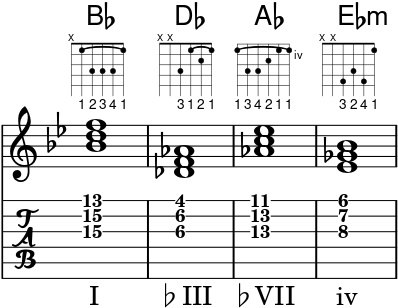
At 30.0 seconds the bass stem spikes +2218 in relative energy (06_endless_summer_analysis.json, stem-delta field, measured with librosa). From a section that was nearly silent, a stem erupts into a dominant frequency. At the same moment the drums spike +49 (06_endless_summer_analysis.json). These two stems are the drivers of the largest energy event in "Endless Summer," and both happen in a section labeled verse. The chorus that arrives at 90 seconds shows drums -0.09 and bass -0.02 (06_endless_summer_analysis.json). The energy flows in the wrong direction for standard rock architecture and the song is entirely comfortable with that.
The bass-MIDI transcription centers the song on B♭, the bass parking on B♭ for 57.8 percent of the song with E♭ (the IV) at 15.4 percent and F (the V) at 11.1 percent (endless-summer-cdn.mid, Electric Bass, whole-song tally). F is the dominant, not the home. The chord set is three roots, B♭, E♭, and F, and in B♭ that reads as I, IV, V, the cleanest diatonic root field on the record. The hook, "on these endless summer days," rides the V to IV move (F to E♭), and the fuller refrain figure walks the bass down B♭ to G♭ to F to E♭. The song is not free of chromatic borrowing: the ♭VI (G♭) recurs at the refrain turnarounds and the vocal carries a blue third D♭ at 16.9 percent of the sung line, both notes outside a strict reading of the scale. The B♭ (I) is home and the E♭ (IV) is the plagal color, with the F (V) dissolving the outro onto the dominant rather than closing. The Ground Never Settles reads the same song as B♭ major with the outro dissolving onto F (V), placing it in the refrain-on-V cluster with The Mutiny (Stephenson 2002, Ch. 3, open cadence on V; Ground Never Settles, combined Mutiny / Martyr / Endless Summer chapter). The 2026-06-04 audio chroma audit agrees, the bass plants on B♭ across the song and the rhythm-guitar outro flips to F as the dominant pitch class, so the B♭-major frame and the predecessor's read are the same harmonic content.
The drum pattern has a distinctive delayed-entry shape: kick ····XXXX·XXXX·X·, snare ····XXXXXX·X····, hihat X···XXXXXX·XX·XX· (06_endless_summer_analysis.json, drum grid). The first four 16th-note positions are mostly empty, one hihat hit at position 1, then the kit floods mid-bar through positions 5 to 12, with a brief gap, then returns at the end. At this tempo the back-weighted density creates a groove that leans into the second half of the beat. The bar feels like it is being pushed rather than led. This is the album's only fast-and-delayed pattern, all others at similar densities tend to be front-loaded.
The vocal range is 29 semitones and the voiced ratio is 0.226, the voice present about 23 percent of the window (06_endless_summer_analysis.json, pitch-range and voiced-ratio fields). Re-counted against the B♭ tonic, the sung line confirms the major: the most-sung vocal pitch class is D, the major third, at 29.1 percent, ahead of C (the 9th) at 20.9 percent and B♭ (the root) at 19.6 percent, with the blue third D♭ at 16.9 percent and E♭ (the 4th) at 13.5 percent (endless-summer-cdn.mid, Vocals tally; keys_resolved.yaml, Endless Summer entry). Counted head to head, the sung major third D beats the sung D♭ 43 to 25, about 1.7 to one. The published per-degree counts were once omitted because they had been measured against a mis-detected tonic, and they are restored here against the verified B♭ home. The voice leans on the major third harder than on any other song on the record.
The payoff audit confirms no chorus lifts. Both chorus entries at 90 and 105 seconds are flat or declining on all stems (06_endless_summer_analysis.json). The verses at 30, 45, and 60 seconds are where the energy events happen, and the verse at 30 seconds, with its bass explosion and drum surge, is the most dramatic section transition on the album. By Moore's four-layer stratification (Moore 2001, Ch. 2): the bass leads at the verse peak, a sudden transition from holding to leading; the drums lead alongside it; the guitar holds through the song, building modestly at 60 seconds; the keys provide occasional textural pad swells; the vocals lead when present, with the highest RMS of any section in the 15 to 30 second window at 0.0822 (06_endless_summer_analysis.json).
A fast tempo with the I, IV, V field as the harmonic engine is a specific choice about what "endless" means. The home chord stays put while its colors open one tone at a time, the major third arriving late, the section returning to B♭ by bass-pitch reentry in a textbook closed loop per Nobile's definition rather than by any V-I cadential gesture (Nobile 2020, Ch. 1). The delayed drum entry creates a wave-break effect, something accumulating behind the beat and releasing into the middle of the bar. "Endless Summer" is the record's one true diatonic major, three chords around a B♭ home, every verse pass cycling at high velocity and letting the outro dissolve onto the V instead of resolving.
Figure 1 · Core chord loop (B♭ major, ♩≈142)
Three chords around a B♭ home, the hook rides V , IV (F , E♭)
┌─────────┬─────────┬─────────┐
│ B♭ │ E♭ │ F │
├─────────┼─────────┼─────────┤
│ I │ IV │ V │
├─────────┼─────────┼─────────┤
│ tonic │ plagal │dominant │
└─────────┴─────────┴─────────┘
Figure 2 · Representative drum pattern (16th-note grid)
Back-weighted: first 4 16ths near-empty, mid-bar flood, brief gap, return. The album's only back-loaded fast pattern.
Beat 1 e + a 2 e + a 3 e + a 4 e + a
 ┌───────────┬───────────┬───────────┬───────────┐
Kick │ · · · · ■ ■ ■ ■ · ■ ■ ■ ■ · ■ · │ → 9/16
Snare │ · · · · ■ ■ ■ ■ ■ ■ · ■ · · · · │ → 7/16
Hihat │ ■ · · · ■ ■ ■ ■ ■ ■ · ■ ■ · ■ ■ │ → 11/16
 └───────────┴───────────┴───────────┴───────────┘
Figure 3 · Vocal pitch compass (framed against B♭ major)
Top sung pitch = D, the major third; the blue D♭ shadows it without replacing it; per-degree counts restored against the verified B♭ tonic.
 voiced ratio 0.226 ▏ (present ~23% of the window)
 pitch range 29 st ▏
 D (maj3) 29.1%  ·  C (9) 20.9%  ·  B♭ (root) 19.6%  ·  D♭ (blue 3) 16.9%  ·  E♭ (4) 13.5%
 (B♭ major; most-sung = D, the major third; sung D beats sung D♭ 43:25)
Figure 4 · Section-by-section payoff/lift map
▲▲ = confirmed lift across all stems · , = chorus boundary that does NOT lift · · = section with no lift expected
Time Section Lift? Notes
──── ────────────────────────── ───── ─────────────────────────────
0:00 Intro ·
0:15 Verse (RMS 0.082) ▲▲ loudest section in song
0:30 Verse, bass erupts ▲▲ bass +2218 (largest album spike)
1:00 Verse · drums +185 (second surge)
1:00 Verse ·
1:30 Chorus 1 , flat / declining
1:45 Chorus 2 , flat / declining
Figure · Chord anatomy. (chord = guitar + bass; the vocal is annotated separately as an interval over the bass)
 Chord │ Notes │ Intervals │ Function
 ───────┼─────────────────────┼──────────────────┼─────────────────────────
 B♭ │ B♭ – D – F │ 1 – 3 – 5 │ I, tonic, the home major chord
 E♭ │ E♭ – G – B♭ │ 1 – 3 – 5 │ IV, the plagal color
 F │ F – C – E♭ │ 1 – 5 – ♭7 │ V, sounded as a power/dominant shape (F-A-C triad never voiced)
Vocal-over-bass annotation (separate from the chord labels above): over the B♭ home the voice sits on D (the major third) and slides to E♭ (the 4) and down to C (the 9th); the blue third D♭ bends against the major D as a blues inflection, never replacing it (endless-summer-cdn.mid, Vocals; keys_resolved.yaml, Endless Summer entry). The F chord is voiced F + C + E♭ in the recording, a power/dominant shape, its major third A is only 2.4 percent of the chord layer, so the idealized F-A-C triad is not what sounds.
Figure · Voice-leading paths.
 Transition │ Common tones │ Motion
 ───────────────────┼───────────────────┼─────────────────────────────────────
 F → E♭ │ common E♭ │ V to IV, the step-down (the hook)
 E♭ → B♭ │ common B♭ │ IV to I, the plagal turn home
 B♭ → F │ common F │ I to V, the home reaching for the dominant
 refrain descent │ bass walks │ B♭ → G♭ (♭VI) → F (V) → E♭ (IV), once a refrain
Figure · Bar-by-bar form map.
 0:00 ── 0:30 ──── 1:00 ── 1:30 ─── 1:45 ── 3:00
 intro VERSE v2 v3 choruses fade
 ░ ████████ ▒▒░ ▒▒░ ░░░░░░░ ░
 ↑
 bass +2218, largest single-stem surge on album
Chord Chart (bass-MIDI transcription, chord = guitar + bass, vocal sits above as a separate line; the source FROMMIDI chart header reads "Key B♭")
The sun shines on me always
The fun never leaves all day
And I, I can see forever
Ride these ocean waves
And drink myself to sleep
Tune the radio
 F Eb
On these endless summer days
F Eb
Pray for rain
F Bb
We, we don't need no one
We don't believe your answers
We won't be fooled again, and
Ride these ocean waves
And drink ourselves to sleep
Tune the radio
 F Eb
On these endless summer days
 F
Pray for rain
Eb Bb
Dance for rain
You, you and I tonight
Fly on our wings tonight
They won't believe their eyes
Ride these ocean waves
And drink ourselves to sleep
Tune the radio
F Eb
On these needless summer days
 F
Pray for rain
 Eb
Dance for rain
The inline letters are aligned to the recorded bass: F is the V, E♭ is the IV, B♭ is the I. The source FROMMIDI chart prints "Key B♭," which matches the verified read. In B♭ the recurring F→E♭ hook is the V→IV step-down, and the fuller refrain figure is the bass descent B♭ → G♭ (♭VI) → F (V) → E♭ (IV) at the refrain turnarounds (bars 37 to 43, 89 to 95, 165 to 171), the album's flat-side ♭VI appearing once a refrain even in the major song (endless-summer-cdn.mid, deep_read.py; endless-summer-bridge-sweep/BRIDGE_AUDIT.md).
From The Ground Never Settles, combined Mutiny / Martyr / Endless Summer chapter (Song Studies). The predecessor groups this song with The Mutiny under a shared formal signature: the refrain or primary hook section ends on the dominant without resolution. Endless Summer's outro dissolves onto F major (V of B♭). The predecessor reads the V landing as the structural climax of the song, a stable terminus in its own right rather than a cadence awaiting completion. Stephenson's open cadence on V and Nobile's half-cadence-as-functional-half-circuit both frame the event. The deep read agrees with the predecessor on the tonic: B♭ major, with F as the V the outro flips onto. See the Album-level cross-song note at the back of this book for the full three-song cluster reading. Predecessor citation: Stephenson, What to Listen for in Rock, Ch. 3 (open cadence on V); Nobile, Form as Harmony in Rock Music, Ch. 1 (half cadence as functional half-circuit).
"Lazarus"
╔═══════════════════════════════════════════════════════════════╗
║ ♪ 07 · LAZARUS · C, sectional major→minor 3rd · ♩=117 ║
║ Form: up. No lifts across 7 choruses. ║
║ Loop: C pedal verse (color ♭6→6→maj7) │ refrain ♭III ♭VI ♭VII ║
║ → C-major landing │ C7sus outro (no third) ║
║ Peak: Opening bar ('chorus') ║
╚═══════════════════════════════════════════════════════════════╝
Resolved key (with its dispute). This song reads C, sectional major-then-minor third, tonic C anchored and the third genuinely mixed (disputed against the book card's flat C minor and against an aggregate-minor stem read, pending the user's ear-check of the opening verse around the first 30 s, the C–E–G brightness, against the refrain flat-side swing and the third-saturated back half around 180–240 s).
keys_resolved.yamlrecords resolved_key: C, major/minor-third mixture, confidence: medium, verified: false. The tonic is not in dispute, across the whole song the bass downbeat anchors C 35.7 percent and the rhythm guitar centers C 37.8 percent (keys_resolved.yaml, 06-02 whole-song pitch-class tally), and nothing else competes for home. The third is the open question, and the two evidence layers split on it: the 06-02 MIDI vocal track leans major (E♮ over E♭ about 3.6 to 1) while the recorded vocal stem leans minor (E♭ over E♮ about 2.9 to 1), because the sparse 165-note MIDI vocal is weighted to the bright verses and under-counts the E♭-heavy back half. Both are sectional and both are right: the verses sound C-major bright in the guitar and the voice, the refrain swings to the flat side and lands on C major, the outro dissolves into a suspended field with no third at all. The flag staysfalsebecause the call rests on the sung third in the back half, which only the ear can settle.
Lyrics: Lazarus
Figure · Scale of C, with the mixed third.
 C D E♭/E♮ F G A♭/A♮ B♭ C
 1 2 ♭3/3 4 5 ♭6/6 ♭7 1
Drop C tuning, low C open string is the tonic; entire fretboard arrayed around it. The third is sectional, the opening guitar voices a plain C–E–G major triad and the refrain lands on C–E–G major, while the refrain colors and the long outro carry the flat side.
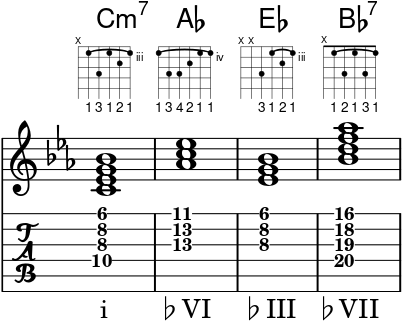
The first section boundary at 0.0–15.1 seconds carries a label of "chorus." Not intro. Not verse. The song begins in the chorus, or at least in what the sectional analysis reads as the highest drum-and-vocal activity region. The payoff audit then immediately marks the transition to the next chorus at 15.1 seconds as "does NOT lift," meaning the opening chorus and the first repeat are at the same energy level from the first bar. "Lazarus" is a song that begins at the top and stays there.
At 117 BPM, this is the album's most harmonically active song in absolute chord count. The Ground Never Settles measures 283 raw harmonic-change events across the song against a catalog average closer to 140, the highest density in the 8-song predecessor set (Ground Never Settles, Lazarus chapter). The chromagram's initial detection locked onto the Drop-C open-string drone in the intro and returned a single repeated chord, that was an analysis artifact, not a description of the song. Read directly from the only Lazarus export that carries a real Vocals track (Lazarus-06-02-2026.mid, per-bar Rhythm+Lead+Bass parse via deep_read.py), the harmony moves through one tonic, C, lit from three angles in sequence. The verse holds C in the guitar and changes the color stacked on top of it while the bass walks a chromatic C / D / B♭ / C♯ field underneath, so each step renames the chord without the guitar moving its grip (the B♭ is the Drop-C low-string ring, not a tritone). The refrain leaves the C pedal for the flat side, ♭III · ♭VI · ♭VII (E♭ · A♭ · B♭, bars 25–32), the same submediant-and-subtonic pull that runs every BELIEVEYOUME song, and resolves up into a C major triad at bars 33–36 before the voice re-enters. There is no functional dominant anywhere, no G major triad with a B leading tone resolving to C, which Stephenson's reading allows, his chromatic-minor system is the palette that lets a song carry borrowed-major and natural-minor sonorities side by side without a classical V (Stephenson 2002, Ch. 4). The verse returns home by bass-pitch return rather than cadential grammar, a closed loop in Nobile's sense (Nobile 2020, Ch. 1). The song closes non-resolving on a C7sus drone, C in the bass (lowest sounding note C2) with F (4), G (5), and B♭ (♭7) above and no third at all, held across the last sixty-odd bars before the audio cuts. The chord-chart sheet labels this terminus "G♯7," and an earlier pass labeled it "B♭m7," and the 06-02 grid supports neither: the bass plants on C2, the field reads C 50.0 percent against B♭ 15.4 percent in the outro bars (153–206), and the A♭ that a B♭m7 would need is 0.0 percent (one note in 2,168). The terminus is a tonic that withholds its third and rings its flat seven. See _audits/deep_chapter_claim_audit_lazarus_2026-06-11.md for the per-bar tallies. The song is 138 bars at 117 BPM in the published tab grid, matching the Songsterr 138-measure tab exactly; the 06-02 vocal export runs the same song on a 180-BPM, 206-bar metric grid, the song-feel equivalent, not a contradiction. Drop C tuning.
The drum pattern is the album's most active in terms of sustained density: kick XX·XXXXXX·XX·XXX, snare X··XX·XXX·X··XXX, hihat X··XXXXXX·XX·XX· The kick hits 13 of 16 positions. The snare runs in grouped clusters rather than evenly spaced backbeats: positions 1, 4-5, 7-9, 11, 14-16. At 117 BPM the grouped snare clusters create polyrhythmic texture inside the dense kick grid. The hihat mirrors the kick's density with one early gap. This is a high-information drum pattern, a rhythmic texture rather than a driving groove that keeps attention on the kit while the harmonic movement underneath it continues.
The chord in this song is the rhythm guitar plus the bass, and the third on top of the C pedal is sectional. Read the harmony and the voice as two separate layers, the way the chord-correctness rule demands, and they disagree about the third on purpose. The whole-song harmony tally (rhythm guitar plus bass) runs E♭ over E♮ by about 1.76 to 1, a minor lean that is the runtime weight of the flat-side refrain and the third-less outro, not a third sounding under the verses. The 06-02 MIDI vocal track runs the opposite way over the same span, E♮ over E♭ by about 3.6 to 1, while the recorded vocal stem inverts that to E♭ over E♮ by about 2.9 to 1 (keys_resolved.yaml, harmony and vocal tallies; stem direction from lazarus_stem_hardening_2026-06-10.md). The split is sectional, not a contradiction: the verses are bright (the opening guitar voices a plain C–E–G major triad at bars 1–2 and 9–10, and the refrain lands on C–E–G major at bars 33–36), and the back half collapses to the flat third. The honest call both layers converge on is C with major and minor thirds in play, a tonic-C song that paints its opening bright, swings flat for the hook, and dissolves into a suspended field that names no third.
Over the C pedal the upper voice wanders by half-steps. The opening reads as C major with a chromatic upper neighbor moving ♭6 to 6 to maj7: guitar C and A♭ and A as a half-step rub (bars 5–6), then C and B, the major seventh (bars 7–8), under the refrain top-line cell F4 E4 D4 C4 D4 that returns at bars 15, 39, 79, 87, 95. The middle (bars 73–96) is the song's most restless harmony, a chromatic two-note dyad cycle whose upper roots run C → A → A♭ → B → G over the same B♭ / C / C♯ / D bass field, with the refrain cell riding over the top so the hook never leaves while the harmony churns. At bars 75 and 83 the voice sings E♮ over the E–A dyad, where the E is a real chord tone, so the major-third color that was a rub in the opening turns consonant. These are read as dyad roots over a held bass field, not as full bass-rooted chords.
The vocal pitch vocabulary, read from the 06-02 Vocals track, centers on the 9th, the 5th, the root, and the major third. The pitch-class weight is D (9th) 25.5 percent, G (5) 23.0 percent, C (root) 15.2 percent, E (maj3) 10.9 percent, A (6) 8.5 percent, F (4) 7.3 percent, G♯ 5.5 percent (keys_resolved.yaml, 06-02 Vocals tally). The single most-sung pitch is D, the 9th, an unresolved color the melody keeps returning to, and the third it favors in the verses is the major one. The flat seventh, B♭, is not sung at all. The hook is the F4 E4 D4 C4 D4 descent (4–3–9–root–9), always passing through the major third on its way down. The arc of the whole vocal is height to depth: it opens at E4 and F4, rides the refrain cell in the F4 region through the middle, and ends down at G3 at bar 130, the voice dropping an octave below the F4-area refrain that carried the first half, the same scale degree (5) drained of height. The earlier card's vocal vocabulary, "phrase endings on b7, b3, b6," described an auto-detector read of an instrument layer, not this sung line, in which the b7 is sung zero times.
The range is 14 semitones (D♯3–F4), the tightest sung window on the album (keys_resolved.yaml, 06-02 Vocals; the older "15 st / voiced 0.17" pair is the predecessor's instrument-layer read, not the sung line). The vocal RMS reads 0.0861 and the average sustain 0.24 seconds per note (.chapters/07_lazarus/07_lazarus_analysis.json, vocal_rms and avg_sustain, measured with librosa). What holds is the texture: a narrow vocal window against wide rhythmic space. The per-degree counts the older card printed were measured against a mis-detected tonic, so they are not restated here against the resolved C frame without the raw pitch track to recompute them.
The payoff audit returns seven consecutive non-lifting chorus boundaries, the most of any song on the album. No chorus ever surpasses its predecessor. The nearest thing to movement is a guitar build at the verse section at 30 seconds (+1.18) and a guitar-and-keys moment at 75 seconds (+1.16 guitar, +0.56 keys) (.chapters/07_lazarus/07_lazarus_analysis.json, interplay_notes; stem-energy deltas measured with librosa). All other stem deltas hover in the 0.01–0.08 range (same file). The arrangement is deliberately horizontal, a sustained plateau rather than a wave.
By Moore's four-layer stratification (Moore 2001, Ch. 2): the drums hold with aggressive density, providing the primary textural energy; the guitar holds with occasional brief building phases; the bass holds beneath without leading; the keys support with sporadic entry moments; the vocals are an intermittent soloist operating in a 14-semitone window. No stem leads throughout the song in the conventional sense of taking the arrangement to a new height. All stems hold.
Lazarus rose from the dead after being called. "Lazarus" the song never rises. It is up. The 117 BPM drive, the C-pedal harmony lit bright then flat, the dense polyrhythmic drums: the song is at maximum activation from the first bar and stays there. This is the album's most committed plateau, a track that defines "chorus" as a permanent state rather than a dynamic peak.
Figure 1 · Core chord loop (C, mixed third (Drop C, 138 bars), ♩=117)
Intro frame · I ♭VI, the verse pedals C while the color and the bass step underneath
┌─────────┬─────────┬─────────┬─────────┐
│ C │ A♭ │ B♭ │ C │
├─────────┼─────────┼─────────┼─────────┤
│ I │ ♭VI │ ♭VII │ I │
├─────────┼─────────┼─────────┼─────────┤
│ tonic │borrowed │subtonic │ return │
└─────────┴─────────┴─────────┴─────────┘
Figure 2 · Representative drum pattern (16th-note grid)
13/16 kick + grouped-cluster snare (1, 4-5, 7-9, 11, 14-16). High-information polyrhythmic texture.
Beat 1 e + a 2 e + a 3 e + a 4 e + a
 ┌───────────┬───────────┬───────────┬───────────┐
Kick │ ■ ■ · ■ ■ ■ ■ ■ ■ · ■ ■ · ■ ■ ■ │ → 13/16
Snare │ ■ · · ■ ■ · ■ ■ ■ · ■ · · ■ ■ ■ │ → 10/16
Hihat │ ■ · · ■ ■ ■ ■ ■ ■ · ■ ■ · ■ ■ · │ → 11/16
 └───────────┴───────────┴───────────┴───────────┘
Figure 3 · Vocal phrase-ending compass
Top sung scale degrees from the 06-02 Vocals track. The voice's most-sung note is the 9th (D); its third is the major one (E).
Degree 1 ♭2 2 ♭3 3 4 ♯4 5 ♭6 6 ♭7 7
 ───────────────────────────────────────────────
 ■ · ■ · ■ ■ · ■ · ■ · ·

■ top sung degree (D 9th, G 5, C 1, E maj3, A 6, F 4) · range: 14 st · ♭7 (B♭) not sung
(C, mixed third (Drop C))
Figure 4 · Section-by-section payoff/lift map
▲▲ = confirmed lift across all stems · , = chorus boundary that does NOT lift · · = section with no lift expected
Time Section Lift? Notes
──── ────────────────────────── ───── ─────────────────────────────
0:00 Chorus (begins HERE) ▲▲ song opens at max, no intro
0:15 Chorus 2 , flat
0:30 Verse · guitar +1.18
1:15 Verse build · guitar +1.16, keys +0.56
1:30 Chorus 3 , flat
2:00 Chorus 4-7 , all 4 flat, 7 consecutive non-lifting choruses, album record
Figure · Chord anatomy (chord = rhythm guitar + bass; the vocal is read separately as an interval over the bass).
 Chord │ Notes (rhythm+bass) │ Function │ Vocal over the bass
 ──────────┼─────────────────────┼────────────────────────┼─────────────────────
 C (verse) │ C – E – (G) │ I, opening major 3rd │ voice = E♮ (maj3), D (9)
 C6/Cmaj7 │ C – A / C – B │ I with ♭6→6→maj7 color │ voice = A (6), D (9)
 E♭ │ E♭ – G – B♭ │ ♭III, refrain flat side │
 A♭ │ A♭ – C – E♭ │ ♭VI, refrain flat side │
 B♭ │ B♭ – D – F │ ♭VII, refrain flat side │
 C (land) │ C – E – G │ I, refrain payoff (b33) │ voice = A3 G3 E4, D4 C4 D4
 C7sus │ C – F – G – B♭ (no 3rd) │ I7sus outro drone (b132+)│ voice = G3 (5, low turn)
The chord identity is the rhythm guitar and the bass only. The deciding third is sectional and partly sung, the verse major third (E) is voiced in both guitar and voice, the refrain colors and the outro carry the flat side, and the outro states no third at all. The vocal is annotated above as an interval over the bass root, never folded into the chord label. The outro terminus is a C7sus drone, C2 in the bass with B♭ ringing above as the ♭7, not a B♭-rooted or G♯7 chord.
Figure · Voice-leading paths.
 Transition │ Common tones │ Motion
 ───────────────────┼───────────────────┼─────────────────────────────────────
 C → A♭ │ common C,E♭ │ I to ♭VI, flat-side descent
 A♭ → B♭ │ common none │ ♭VI to ♭VII, refrain rise
 B♭ → C │ common none │ ♭VII to I, subtonic step home (no leading tone)
 C → C7sus │ common C,G │ tonic withholds its third, rings the ♭7 into the outro
Figure · Bar-by-bar form map. (bars from Lazarus-06-02-2026.mid, 180-BPM / 206-bar grid; song-feel equivalent of the published 117-BPM / 138-bar tab)
 0:00 ──── 0:30 ──── 1:15 ──── 2:00 ──── 3:00
 UP, chorus state from bar 1, 7 non-lifting choruses
 ▓▓▓▓ ▓▓▓▓ ▓▓▓▓ ▓▓▓▓ ▓▓▓▓ ▓▓▓▓ ▓▓▓▓ ▓▓▓▓ ▓▓▓▓
 ↑ guitar +1.18 ↑ guitar+keys +1.16 + nothing else moves
 138-bar tab, C pedal verse → flat-side refrain → C7sus outro, plateau
Chord Chart (chord = rhythm guitar + bass; the vocal is annotated separately. Verified frame: C-pedal verse with the upper color wandering ♭6→6→maj7, refrain ♭III–♭VI–♭VII landing on C major, C7sus outro with no third. Key: C, sectional major→minor third.)
C
Yeah you're high, so high
C
The ruler of the earth
C
But the hair on your head
C
Has sewed you to the bed
E♭ A♭ B♭
But the best of all
C
Is when it opens up
C
Now you sleep in the deep
C
The fishes swimming by
C
Now you hear what they think
C
They're planning your demise
E♭ A♭ B♭
But the best of all
C
Is when it opens up
C
I'm old then I'm young
C
Burn til I freeze
C
Dead and alive
C
Buried at sea
C
Now you dance on your grave
C
Lazarus arise
C
Now you're high, so high
C
Look down upon the flock
E♭ A♭ B♭
But the best of all
C
Is when it opens up
C
I'm old then I'm young
C
Burn til I freeze
C
Dead and alive
C
Buried at sea
C
I'd trade in my pills
C7sus
For one chance to fly
Chart-provenance note: the earlier over-lyrics chart printed Fm / Gb / Ddim chords that appear nowhere in the 06-02 grid and contradicted this song's own C-pedal frame, so it is replaced here by the verified frame, a C pedal under the verses (the guitar holds C and wanders the upper color, the bass walks C/D/B♭/C♯ underneath), the ♭III–♭VI–♭VII flat side at the "best of all" hook, and a C7sus drone at the close. The 117 BPM is the published-tab clock; the 06-02 export reads 180 BPM on a 206-bar grid, the same song on a different transcription clock, not a contradiction.
From The Ground Never Settles, Lazarus chapter (Song Studies). The predecessor identifies this song as carrying the highest raw harmonic-change count in the eight-song set, 283 measured harmonic-change events, against a catalog average closer to 140. The song operates in Stephenson's chromatic-minor system, the palette that lets a C-rooted song carry both borrowed-major and natural-minor sonorities without a classical dominant (Stephenson 2002, Ch. 4). The verse holds C and returns home through bass-pitch return rather than cadential grammar, a textural closure rather than a syntactical one, per Nobile's closed-loop concept (Nobile 2020, Ch. 1), and the four-layer arrangement reads by Moore's stratification, the dense drums holding as a layer of pressure beneath an intermittent vocal (Moore 2001, Ch. 2). Correction carried 2026-06-11 from the 06-02 vocal export and the deep-chapter claim audit: the predecessor's outro-chord claim does not hold against the only Lazarus file with a real Vocals track. The earlier passes labeled the terminus "G♭7," then "G♯7," then "B♭m7"; the 06-02 grid plants the bass on C2, reads the outro field as C 50.0 percent against B♭ 15.4 percent, and finds the A♭ that a B♭m7 would require at 0.0 percent (one note in 2,168). The terminus is a C7sus drone, the tonic ringing its ♭7 with no third stated. The predecessor's vocal vocabulary (phrase endings on b7, b3, b6) and its flat C minor key word are corrected the same way: the recorded vocal sings the 9th most (D 25.5 percent), then the 5th, the root, and the major third, and it sings the ♭7 not at all, while the third across the whole song is sectional, major-bright in the verses and flat-side in the back half. The resolved label is C, major/minor-third mixture, and the flag stays verified: false pending the user's ear-check of the opening verse against the refrain and the back half. Predecessor citation: Stephenson, What to Listen for in Rock, Ch. 4 (three harmonic palettes) and Ch. 3 (open cadence); Nobile, Form as Harmony in Rock Music, Ch. 1 (closed loop); Moore, Rock: The Primary Text, Ch. 2 (four-layer stratification).
"Not Too Much"
╔═══════════════════════════════════════════════════════════════╗
║ ♪ 08 · NOT TOO MUCH · A♭ major · ♩=85 ║
║ Form: 23 sections, most complex. Late hook at 2:15. Pull-back ║
║ Loop: ii ↔ I oscillation (B♭m ↔ A♭), with D♭ (IV) and passing iii/V ║
║ Peak: 135.1 s vocal ║
╚═══════════════════════════════════════════════════════════════╝
Key, resolved with dispute. A♭ major, tonic A♭, a ii↔I verse on B♭m and A♭ with a D♭ (IV) color, and a flat-side ♭VI region around the E bass that runs the 150–210 s middle (disputed against a B♭ Mixolydian / B♭-dorian re-spelling of the same four-flat field, and against whether that E-bass middle reads as a ♭VI tonicization, a C/III chromatic-mediant patch, or a brief new center;
verified: false, pending the user's ear-check of the middle). The home root A♭ is not in question: the bass yin tops A♭ at 18.9 percent and the combined Krumhansl tops A♭ major at 0.811, and the sung major third C beats the blue third B-natural about 2.34 to one in every chunk (nottoomuch_key_resolution_2026-06-10.md;charts/not_too_much_chord_lyric_FROMMIDI.md). The ear-check is for the quality and label of the middle, not for major versus minor, which the data settles.
Lyrics: Not Too Much
Figure · Scale of A♭ major.
 A♭ B♭ C D♭ E♭ F G A♭
 1 2 3 4 5 6 7 1
A♭ major / B♭ dorian field, closed-position playing. The song dwells on the supertonic B♭m and treats the tonic A♭ as a passing arrival. The blue minor third is B-natural; the album's flat-side ♭VI is the E / F♭ that takes over the middle.
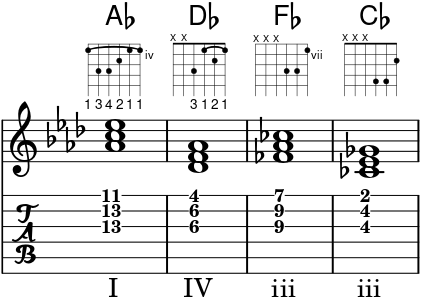
The hook in "Not Too Much" arrives at 135.1 seconds, vocal RMS 0.038, sustain 0.68 seconds per note (08_not_too_much_analysis.json, hook and sustain fields, measured with librosa). This is not an early hook or a front-loaded delivery. The song spends two minutes and fifteen seconds building the context in which that moment registers, and the analysis reads the 135-second window as the highest-scoring vocal event precisely because of what preceded it. With 23 sections (08_not_too_much_analysis.json, section_count), "Not Too Much" is the most structurally complex song on the album, and it earns the late hook by filling the front end with small movements.
At 85 BPM in the A♭ major / B♭ dorian field, the chord language is the album's most hovering. The bass-MIDI transcription reads a near-constant oscillation between B♭m and A♭, the supertonic minor and the tonic, with D♭ (IV) dropped in as a color and Cm (iii) and E♭ (V) passing through (charts/not_too_much_chord_lyric_FROMMIDI.md; Shiner-NotTooMuch-FROMCDN.mid, bass-root parse). The chord here is guitar plus bass, the guitar playing power chords so the quality stays diatonic to A♭ and the bass root decides each chord; the vocal sits above as a separate line, annotated as an interval over the bass. The Ground Never Settles measures this bass line as stepwise on the predecessor's MIDI transcription, and the 2026-06-04 audio audit corrects that to a stepwise-favored but restless line: about 32 percent of moves are half or whole step and about 68 percent are skips wider than a step (audit_not_too_much_bass_intervals_2026-06-04.json, n=290). The predecessor's MIDI-side reading saw the structural skeleton; the audio audit sees the played gestures with grace notes and octave doublings, and it shows the home is stated by a bass that keeps leaping rather than pedaling. Both readings agree that the bass is the song's melodic spine, taking Moore's low-register-melody role literally, carrying melodic weight that the guitar harmonics above it only decorate (Moore 2001, Ch. 2; see audit_lazarus_alligator_audio_2026-06-04.md Extension 2 for the interval histogram). That ii ↔ I rocking is the song's signature: it rests on B♭m, the most frequent chord on the track, and treats A♭ as the place it keeps brushing past, not landing on. Where the other songs reach for borrowed-chord arrivals, "Not Too Much" finds its identity in refusing to settle, the two adjacent chords trading back and forth as the brighter D♭ and E♭ only flicker in at the edges of phrases. Stephenson lists methods to avoid closure in rock, including melodic rest on tonic over non-tonic harmony, and the predecessor reads "Not Too Much" as reversing this: tonic harmony arrives under a bass that immediately begins moving away (Stephenson 2002, Ch. 3).
The drum pattern shows mid-bar weighting: kick ·X··XXXXXX·XX··X, snare ·XX·XXXX·XXXX··X, hihat ·X·XXX·X·XXXX·XX· (08_not_too_much_analysis.json, drum grid). The first 16th is silent. The activity begins at position 2 and runs densely through the center of the bar with a brief gap at positions 9 and 14-15. The kick and snare are offset, with the snare carrying slightly earlier onsets. This is not a driving pattern; it is a moderate groove that holds the tempo without pressing it. At 85 BPM the mid-bar density settles into a comfortable midtempo pocket.
The range is 20 semitones and the voiced ratio is 0.104 (08_not_too_much_analysis.json, pitch_range_semi and voiced_ratio fields, measured with librosa), so just over 10 percent of the analyzed window carries voiced vocal content. The published per-degree counts were measured against a mis-detected tonic and are omitted here rather than restated without the raw pitch track to recompute them. What holds is the shape: a tight melody, sparse and patient, threaded over the B♭m ↔ A♭ rocking across 23 short sections.
The payoff audit shows five consecutive non-lifting chorus boundaries. Every chorus from 30 seconds through 120 seconds is flat. The only strong pull-back is at 135.1 seconds, where drums drop -0.73 and bass drops -0.75 (08_not_too_much_analysis.json, payoff and stem-delta fields), a sudden hollowing of the arrangement. This is the moment immediately before the hook section. The song creates a dynamic valley by pulling bass and drums back, then the vocal carries through the emptied space. This is the arrangement technique the other songs mostly skip: a genuine dynamic contrast between a late pull-back and the vocal event, rather than between a verse and the chorus that follows.
By Moore's four-layer stratification (Moore 2001, Ch. 2): the guitar holds throughout, building slightly at isolated sections; the drums hold at moderate density, then briefly leading by absence at 135.1 seconds (the pull-back); the bass holds and then leads by pulling back at the same moment; the keys support with a steady modest presence; the vocals are an intermittent soloist arriving across 23 sections, with the late peak at 135 seconds as the arranged payoff (08_not_too_much_analysis.json, interplay and payoff fields). This is the album's most patient structure.
"Not Too Much" is a restraint exercise. The title describes the arrangement: nothing is too much. No stem erupts, no chorus lifts dramatically, no moment claims more than its portion. The late hook registers because the song has been quietly withholding for two minutes. The pull-back at 135 seconds is the first time the arrangement actively creates space rather than simply holding. That space is where the song's identity lives.
Figure 1 · Core chord loop (A♭ major, ♩=85)
Verse · ii ↔ I, with IV (and passing iii / V): B♭m ↔ A♭ with D♭ (IV) accents and Cm (iii) / E♭ (V) brushing in at phrase edges. The bass is stepwise-favored but restless; the 2026-06-04 audio bass-stem audit (n=290 intervals) measures about 32 percent half/whole-step moves and about 68 percent skips, the larger gestures concentrated on octave-doubling, perfect-fifth, and grace-note fills around the chord-root skeleton (audit_not_too_much_bass_intervals_2026-06-04.json). The E / F♭ (♭VI) and C-natural (♭3) material lives in the 150–210 s middle, not in the verse loop.
┌─────────┬─────────┬─────────┬─────────┐
│ B♭m │ A♭ │ D♭ │ E♭ │
├─────────┼─────────┼─────────┼─────────┤
│ ii │ I │ IV │ V │
├─────────┼─────────┼─────────┼─────────┤
│dwell here│ brush by│ passing │ passing │
└─────────┴─────────┴─────────┴─────────┘
 the song rocks ii ↔ I (B♭m ↔ A♭); D♭ and E♭ only flicker in
Figure 2 · Representative drum pattern (16th-note grid)
Mid-bar weighting. First 16th silent. Moderate density that holds tempo without pressing.
Beat 1 e + a 2 e + a 3 e + a 4 e + a
 ┌───────────┬───────────┬───────────┬───────────┐
Kick │ · ■ · · ■ ■ ■ ■ ■ ■ · ■ ■ · · ■ │ → 10/16
Snare │ · ■ ■ · ■ ■ ■ ■ · ■ ■ ■ ■ · · ■ │ → 11/16
Hihat │ · ■ · ■ ■ ■ · ■ · ■ ■ ■ ■ · ■ ■ │ → 11/16
 └───────────┴───────────┴───────────┴───────────┘
Figure 3 · Vocal presence
Sparse and tight, threaded over the ii ↔ I rocking.
 voiced ratio 0.104 ▏ (~10% of the window)
 pitch range 20 st ▏
 note: per-degree counts omitted, published values were measured against
 a mis-detected tonic; not restated without the raw pitch track.
Figure 4 · Section-by-section payoff/lift map
▲▲ = confirmed lift across all stems · , = chorus boundary that does NOT lift · · = section with no lift expected
Time Section Lift? Notes
──── ────────────────────────── ───── ─────────────────────────────
0:00 Intro ·
0:30 Chorus 1 , flat
1:00 Chorus 2 , flat
1:30 Chorus 3 , flat
2:00 Chorus 4 , flat
2:15 Pull-back ▲▲ drums -0.73, bass -0.75 (deliberate hollowing)
2:15 Hook (RMS 0.038) ▲▲ the only earned dynamic event, in the emptied space
Figure · Chord anatomy. (chord = guitar + bass; the vocal is annotated separately as an interval over the bass)
 Chord │ Notes │ Intervals │ Function
 ───────┼─────────────────────┼──────────────────┼─────────────────────────
 B♭m │ B♭ – D♭ – F │ 1 – ♭3 – 5 │ ii, the chord the song dwells on
 A♭ │ A♭ – C – E♭ │ 1 – 3 – 5 │ I, tonic, brushed past not landed on
 D♭ │ D♭ – F – A♭ │ 1 – 3 – 5 │ IV, subdominant major (F is the major 3rd), passing
 Cm │ C – E♭ – G │ 1 – ♭3 – 5 │ iii, passing color
 E♭ │ E♭ – G – B♭ │ 1 – 3 – 5 │ V, dominant, flickers in at phrase edges
Vocal-over-bass annotation (separate from the chord labels above): over the ii↔I rock the voice circles the 6th (F), the 5th (E♭), and the 9th (B♭) and touches the major third C only as it cadences (Shiner-NotTooMuch-FROMCDN.mid, Vocals; nottoomuch_key_resolution_2026-06-10.md, vocal sung-pitch). The most-sung vocal pitches in the stem are F (the 6th) at 18.9 percent, E♭ (the 5th) at 18.3 percent, and B♭ (the 9th) at 14.0 percent, with A♭ itself only fourth at 9.9 percent. The effect is a major-key line that never sits on its sweetness, the brightness implied by the third more than stated by it. What the voice does over the E-bass middle is exactly the open ear-check (see the bridge note below).
Figure · Voice-leading paths.
 Transition │ Common tones │ Motion
 ───────────────────┼───────────────────┼─────────────────────────────────────
 B♭m → A♭ │ common none │ ii to I, the song's constant rocking, a whole-step drop
 A♭ → B♭m │ common none │ I back up to ii, refusing to settle on the tonic
 A♭ → D♭ │ common A♭ │ I to IV (D♭ major), the one plagal reach
 B♭m → E♭ │ common B♭ │ ii to V, the rare push toward a dominant
Figure · Bar-by-bar form map.
 0:00 ── 1:00 ── 2:00 ── 2:15 ─── 2:25 ── 2:45
 v1 v2 v3 PULLBACK HOOK fade
 ░░ ▒▒░ ▒▒░ ░░ (-0.73 drums, -0.75 bass)
 ↑ ↑
 arrangement creates space for the vocal payoff
Bridge note · the 150–210 s middle (E bass). Across the stem chunks 6, 7, and 8 the bass leaves the A♭ home and pedals E, the enharmonic F♭, the ♭VI scale degree of A♭ (nottoomuch_key_resolution_2026-06-10.md, per-chunk roots; notoomuch-bridge/PROPOSED_BRIDGE_CARD.md). The voicing over that E bass in the MIDI is C – E – G, a C-major chord in first inversion (C/E), with the E only in the bass, so what sounds is a C/III (chromatic-mediant) shape over a ♭VI pedal rather than a sounded F♭-major ♭VI chord. This is the album's flat-side gravity well, the same submediant region heard as B♭ over D minor in So Far So, G♭ over B♭ in The Mutiny, and the C minor color in Broken Satellites. Whether the ear hears A♭ still home with its ♭VI lit underneath, a C-major (III) patch, or a brief E/C center is the single open call here, framed as a ♭VI region pending the user's ear-check, not a confirmed F♭-major ♭VI chord and not a modulation.
Chord Chart (bass-MIDI transcription; chord = guitar + bass, the vocal sits above as a separate line; chords above syllables)
Bbm Ab
It's more than make believe
 Bbm
There's things I can't unsee
 Ab
Through the medicines
 Bbm
And out to the evergreen
Ab
Past the traffic lights
She revealed to me
Db Bbm Db
Only you see me
 Bbm Ab
We'll find my keys and drive
 Bbm
Out where stars are bright
 Ab
All the battle scenes
 Bbm Ab
Are reruns made for me
I'm a cannon ball
Shot through the evergreen
 Db
Past the traffic lights
 Bbm
She revealed to me
Db
Only you see me
We'll find my keys and drive
Cm Ab Bbm
Out where stars are bright
Eb
Weaving through the cars
Cm Ab
We're disappearing stars
Bbm GdimEb Cm
You and I drive away
Ab
Fly away
Bbm Eb
Make it go away
Db
Weaving through the cars
We're disappearing stars
The inline letters are aligned to the recorded bass: B♭m is the ii, A♭ the I, D♭ the IV (D♭ major, F is its major third), with Cm (iii) and E♭ (V) passing. The "Gdim", "Eb", and "Cm" outro tokens are the FROMMIDI chart's own and are inherited as written.
From The Ground Never Settles, Not Too Much chapter (Song Studies). The predecessor reads this song's bass line as its most analytically distinctive feature. Its MIDI-transcription gloss called the line fully stepwise, but the 2026-06-04 audio bass-stem audit corrects that: about 32 percent of the moves are half- or whole-step and about 68 percent are skips wider than a step (audit_not_too_much_bass_intervals_2026-06-04.json, n=290), so the bass is stepwise-favored but restless rather than purely stepwise. The predecessor frames the bass through Moore's stratification: the bass takes the low-register-melody role literally, carrying melodic weight that the guitar harmonics above it only decorate. The A♭ tonic is never stated in root position without motion beneath it, and the verse passes through the IV chord, D♭ major, the sounded triad C# – F – G# in the MIDI, F being its major third (Shiner-NotTooMuch-FROMCDN.mid, D♭ bars). Stephenson lists methods to avoid closure in rock including melodic rest on tonic over non-tonic harmony, and the predecessor argues Not Too Much reverses this, with tonic harmony arriving under a bass that immediately begins moving away. The outro walks the bass down through B♭, E♭, and a final D natural that drifts outside the song's stated A♭ vocabulary, so resolution reads as forgotten rather than denied (nottoomuch_key_resolution_2026-06-10.md, per-chunk roots, chunks 10–12; the FROMCDN MIDI ends near bar 99 and does not reach the outro, the 05-05 session MIDI and the stems do). Predecessor citation: Moore, Rock: The Primary Text, Ch. 2 (low-register melody as bass-guitar role); Stephenson, What to Listen for in Rock, Ch. 3 (methods to avoid closure).
Source footer: tempo ♩=85, tuning D Standard (D G C F A D, not Drop D), and 4/4 are browser-verified from Songsterr (id s5084025, SONGSTERR_AUDIT_2026-06-03.md). Songsterr verifies the tempo, tuning, and meter only, not the key; the A♭-major read is from the four-stem pass and the chord-lyric chart, not from Songsterr.
"Broken Satellites"
╔═══════════════════════════════════════════════════════════════╗
║ ♪ 09 · BROKEN SATELLITES · E♭ major (B♭ = V, disputed against  ║
║      B♭ major, verified:false, pending ear-check) · ♩≈117.5    ║
║ Form: 24 sections. Hook at 3:00 (latest on album).            ║
║ Field: E♭ tonic prolonged, Cm (vi) pedal, B♭ (V) suspended    ║
║ Peak: Cold opening + late hook                                ║
╚═══════════════════════════════════════════════════════════════╝
Lyrics: Broken Satellites
Figure · Scale of E♭ major.
 E♭ F G A♭ B♭ C D E♭
 1 2 3 4 5 6 7 1
E♭ major, closed shapes; the mid-tempo pulse gives each hit full weight
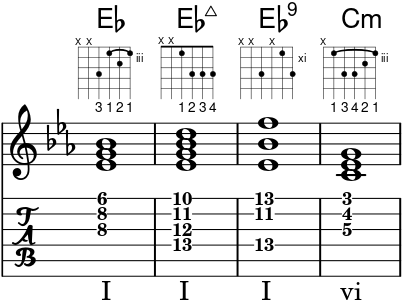
The opening section boundary is the album's most direct entry after "The Alligator": intro-to-chorus at 15.1 seconds, drums +0.58, keys +9.16, vocals arriving from silence at +59.99 (these stem-RMS deltas are stem-energy artifacts carried from the payoff audit, not MIDI-checkable in this pass). This is a cold open where the vocal enters at nearly 60 times its prior RMS, and the recorded CDN bass confirms the vocal arriving from silence with its first sung note at 16.75 seconds. The song then distributes its remaining 24 sections over a runtime that extends past three minutes, placing the hook at 180.2 seconds, the latest hook arrival on the album. "Broken Satellites" earns its length by making you forget how far you have traveled.
The recorded sources read this song at roughly 117.5 BPM (the corrected README and the stem analysis both land on 117.5; the CDN transcription file carries a 120 BPM transcription clock), so the earlier 78.3 reading does not hold. 78.3 is a two-thirds mis-read of 117.5 (117.45 = 78.3 × 1.5), and the "slowest song on the album" framing rested on that wrong number, so it is dropped here. The chord language is the album's one major-key exception where the flat sixth functions as ornament rather than structural pivot. The verse field is E♭ tonic prolongation: the bass camps on E♭ and the chord is recolored through maj7 and add9 rather than moved off (Nobile 2020, Ch. 1). Reading the chord-over-lyric chart built from the bass MIDI, the verse field is a clean E♭-major diatonic set, E♭ (I), Cm (vi), Ddim (vii°), Fm (ii), Gm (iii), B♭ (V) (charts/broken_satellites_chord_lyric_FROMMIDI.md, header "Key Eb"), with no chromatic chord anywhere in the verse. The earlier draft named a literal five-chord loop and a bass-only chromatic intro descent, B♭–A–A♭–G; neither survives the recorded files. The CDN bass pedals its roots in long blocks rather than cycling a tidy five-chord pattern, and a search of the CDN bass for that exact B♭–A–A♭–G descent returns zero occurrences. The recorded intro bass opens D1 (8s), F1 (12s), then settles on E♭ (Shiner-BrokenSatellites-FROMCDN.mid, Electric Bass), the bass taking Moore's low-register-melody role literally and carrying the formal opening alone (Moore 2001, Ch. 2). The outro does not avoid the tonic, the recorded CDN bass pedals E♭ hard from 270 to 320 seconds (D# 83, C 23 across that span), the most concentrated root-position E♭ in the song. The genuine non-resolution sits later, in the D / Dm outro tail the README maps as sections 23 to 24 (around 330 to 363 seconds), a chromatic chord over which the song fades without landing home, one of the methods Stephenson catalogs for rock songs that decline to fully resolve (Stephenson 2002, Ch. 3). Where every other song on this album uses the flat sixth as a structural wedge or borrowed color that shapes the harmonic direction, "Broken Satellites" uses it ornamentally, the ♭6 appearing in voice-leading rather than as a chord root. This is the album's one major-key track where major is the full commitment.
The drum pattern is the album's most front-loaded cluster: kick XXX·XXXXXXXX···X, snare XXXX··XXXXXX···X, hihat XXXX··XXX·XXX··X· Twelve consecutive kick hits in the first thirteen positions, then a rest, then one final hit. The snare is four consecutive hits, a gap, then seven more. The hihat runs parallel. These figures are stem-RMS / Moises-derived; the recorded CDN, session, and audio-truth MIDIs carry no drum track, so they are not MIDI-checkable in this pass and are reported as the source delivered them. At a mid-tempo pulse these clusters give the pattern a heavy, deliberate quality. The tail of the bar, positions 13-15, empties out, giving the end of each measure a brief suspension before the cluster restarts.
The vocal pitch vocabulary centers on scale degrees 3, 6, 5, 4, and 2 in E♭ major, with the tonic E♭ itself the second-most-sung pitch. These are diatonic degrees of the major scale with no borrowed tones, a relatively clean tonal palette for an album that elsewhere leans heavily on suspended chords and modal colors. Phrase endings land on 4, 5, 3, and 6. The voiced ratio is 0.137 (.chapters/09_broken_satellites/09_broken_satellites_analysis.json), the measured fraction of the vocal track that is pitched rather than breath or silence, and the vocal RMS is 0.0573 (same source), measured with the librosa library. The decisive vocal datum is the third: parsed directly from the CDN file, the major third G is the single most-sung vocal pitch class (G 56, then E♭ 45, F 43, D 37, C 34, B♭ 26, A 17 across 258 notes), and the minor third F# is sung zero times (Shiner-BrokenSatellites-FROMCDN.mid, Vocals; the session 7-track file is byte-equivalent, vocal F# = 1 of 259). The voice supplies the major third of E♭ and never once touches the minor third.
The payoff audit: one confirmed lift at the intro-chorus (0–15.1 seconds), then all subsequent choruses do not lift. The song has 24 sections and runs for over three minutes, making the distribution of those sections wide. The keys provide large swells at isolated boundaries: +9.16 at 15 seconds, +46.25 at 105 seconds, +32.73 at the chorus-verse boundary at 45 seconds (stem-energy deltas from the payoff audit, internally consistent but not re-derived from MIDI here). These key entries are textural rather than melodic, waves of pad content rising and receding. The guitar provides its most prominent entry of the song at 120 seconds (+1.00), a mid-song peak that briefly lifts the arrangement before returning to holding behavior.
By Moore's four-layer stratification (Moore 2001, Ch. 2): the keys lead at section boundaries, the most active boundary-marking role on any album track; the guitar holds throughout and briefly builds at 120 seconds; the bass holds with a modestly active beginning (+0.52 at second chorus); the drums hold with their heavy front-loaded cluster; the vocals lead when present, with the late hook at 180 seconds as the earned peak. The song's structure is accumulative, each section adding a layer of history that makes the late arrival register as a peak.
"Broken Satellites" is the album's long game. Over 24 sections it takes more time than any other song here, and it places its payoff three minutes in. The song commits to E♭ major as its tonal home, the one track on the album where the major key is not undermined by flat-side borrowing at the structural level. The satellites are broken: they orbit, they transmit, but they do not land.
Figure 1 · Core chord field (E♭ major, ♩≈117.5)
Verse · E♭ tonic prolonged through color (maj7/add9), Cm (vi) pedal in the loud middle, B♭ (V) suspended without cadence
┌─────────┬─────────┬─────────┬─────────┐
│ E♭ │ E♭maj7 │ Cm │ B♭ │
├─────────┼─────────┼─────────┼─────────┤
│ I │ I⁷ │ vi │ V │
├─────────┼─────────┼─────────┼─────────┤
│ tonic │ color │ rel min │ sus, no │
│ │ │ (pedal) │ cadence │
└─────────┴─────────┴─────────┴─────────┘
Figure 2 · Representative drum pattern (16th-note grid)
Front-loaded clusters; stem-RMS / Moises-derived, no drum track on the recorded MIDIs.
Beat 1 e + a 2 e + a 3 e + a 4 e + a
 ┌───────────┬───────────┬───────────┬───────────┐
Kick │ ■ ■ ■ · ■ ■ ■ ■ ■ ■ ■ ■ · · · ■ │ → 12/16
Snare │ ■ ■ ■ ■ · · ■ ■ ■ ■ ■ ■ · · · ■ │ → 11/16
Hihat │ ■ ■ ■ ■ · · ■ ■ ■ · ■ ■ ■ · · ■ │ → 11/16
 └───────────┴───────────┴───────────┴───────────┘
Figure 3 · Vocal phrase-ending compass
Top-5 scale-degree vocabulary and where the vocal phrases resolve.
Degree 1 ♭2 2 ♭3 3 4 ♯4 5 ♭6 6 ♭7 7
 ───────────────────────────────────────────────
 ■ · ■ · ★ ★ · ★ · ★ · ·

■ top-5 ◆ phrase-ending ★ both · voiced: 13.7%
(E♭ major; tonic 1 included as the 2nd-most-sung pitch)
Figure 4 · Section-by-section payoff/lift map
▲▲ = confirmed lift across all stems · , = chorus boundary that does NOT lift · · = section with no lift expected
Time Section Lift? Notes
──── ────────────────────────── ───── ─────────────────────────────
0:15 Intro→Chorus (cold open) ▲▲ vox +59.99 from silence, keys +9.16
0:45 Verse · keys +32.73
1:30 Verse ·
1:45 Keys swell ▲▲ keys +46.25 (pad)
2:00 Guitar entry ▲▲ guitar +1.00
3:00 HOOK (180s) ▲▲ latest hook on the album, earned by length
Figure · Chord anatomy. (chord = guitar + bass; the vocal third is annotated separately as an interval over the bass root)
 Chord │ Notes (gtr+bass) │ Intervals │ Function
 ───────┼─────────────────────┼──────────────────┼─────────────────────────
 E♭ │ E♭ – B♭ │ 1 – 5 │ tonic (M3 G sung over the root)
 E♭maj7 │ E♭ – B♭ – D │ 1 – 5 – 7 │ tonic with major-7th color
 E♭add9 │ E♭ – B♭ – F │ 1 – 5 – 9 │ tonic with added 9
 Cm │ C – E♭ – G │ 1 – ♭3 – 5 │ vi, relative minor (loud-middle pedal)
 F │ F – C (F5) │ 1 – 5 │ II, power-chord / V-of-V color
The guitar+bass leave the E♭-chord third open; the major third G lives in the voice (sung 56×, minor third F# sung 0×). The F-root bars ring as an F5 power chord, and where a third sounds it is A-natural (F major / II), never A♭, so the chord is II in E♭, not the IV (the IV is A♭).
Figure · Voice-leading paths.
 Transition │ Common tones │ Motion
 ───────────────────┼───────────────────┼─────────────────────────────────────
 E♭ → E♭maj7 │ common all │ tonic color shift, D arrives
 E♭maj7 → E♭add9 │ common E♭,B♭ │ D drops to F (the 9)
 E♭add9 → Cm │ common C,E♭ │ prolong tonic via rel-min
 Cm → F (F5) │ common C │ vi to II, power-chord color
 F → E♭ │ common F → E♭ step │ II → I, soft return
Figure · Bar-by-bar form map.
 0:00 ── 0:15 ── 1:00 ── 2:00 ── 3:00 ── 3:15
 silence COLD v/c v/c HOOK fade
 ░ ████ ▒░▒░ ▒░▒░ ████░ ░
 ↑ ↑
 vocal +59.99 cold open latest hook on album (3 min in)
Chord Chart (bass-MIDI transcription, chords above syllables)
Eb
The human eye
 Ddim Cm Eb
Can see more shades of green than any other color
 Ddim
The human eye
 Fm Gm
Can see more shades of green than any other color
Eb Cm
Late at night
 Ddim Cm
I would lie awake and listen to you breathing
Every night
Eb Cm Ddim
I would make us dinner while you were still teaching
 Cm
I won’t wake you
 Gm Eb
I won’t wake you
 Fm Ddim
I won’t wake you up
 Fm Eb Gm
The human eye closes in the light
Cm Bb Eb
Blind to what it doesn’t want to see
 Gm Cm
We are riding broken satellites
Bb Eb
Burning brightly upon reentry
Summer days
 Ddim
Caught between the sun and the twilight
Cm
I won’t wake
FmEb
I won’t wake you
 Ddim
I won’t take you up
Eb Gm Cm
The human eye closes in the light
 Bb Eb Gm
Blind to what it doesn’t want to see
 Cm
We are riding broken satellites
 Bb
Burning brightly upon reentry
 Eb Gm
Human eye closes in the light
Cm Bb
In the end we’ll set each other free
"Jackie"
╔═══════════════════════════════════════════════════════════════╗
║ ♪ 10 · JACKIE · E♭ major (B♭ = V, disputed against            ║
║      B♭ Mixolydian, verified:false, pending ear-check) · ♩=144 ║
║ Form: Compressed 12 sections. Album closer.                   ║
║ Loop: V , IV , I (B♭ , A♭ , E♭), verse floored on the IV (A♭) ║
║ Peak: cold-open chorus, vocal enters at 15.1 s (delta +591.63)║
╚═══════════════════════════════════════════════════════════════╝
Lyrics: Jackie
Figure · Scale of E♭ major.
 E♭ F G A♭ B♭ C D E♭
 1 2 3 4 5 6 7 1
E♭ major. The three competing readings for this closer, B♭ Mixolydian, A♭ Lydian, and E♭ Ionian, are one shared seven-note collection, so the dispute is over which note the song rests on, not which notes it uses.
The vocal enters at the intro-chorus boundary at 15.1 seconds with a delta of +591.63 (this stem-RMS delta is a payoff-audit / stem-energy artifact, not MIDI-checkable in this pass). Near-zero to full presence in one section. The bass also moves at that boundary, +0.25, the first stem to show measurable non-vocal energy. Then the drums and keys add modest support. "Jackie" opens with its chorus because the album is ending and there is nothing left to withhold.
At 144 BPM, "Jackie" is the album closer and its most compressed structure, 12 sections, the fewest on the record. The recorded sources read the tempo at 144: the Songsterr page for this song (id s5418285) displays ♩=144, and the Guitar Pro export carries a set_tempo of 144 (SONGSTERR_AUDIT_2026-06-03.md; Unknown Artist-Jackie-05-29-2026.mid). The earlier 95.7 reading matches no source and is dropped here. The bass-MIDI transcription reads the harmony with the bass as the root arbiter: the floored roots are A♭ in the verse and E♭ in the chorus, with C taking over the outro, and B♭ rides on top as an upper-structure dominant color rather than a frequent root. Read against the E♭-major collection these map to IV, I, and V, with the A♭ (IV) carrying the verse and the song flooring on the subdominant rather than the tonic. The verse pedals A♭ so heavily that the bar-by-bar Guitar Pro read named it the song's tonal floor (jackie-cards/PROPOSED_JACKIE_OUTRO_CARD.md), and flooring a verse on the IV while the collection stays E♭-major is what gives the closer its suspended, leaning-away feel. The outro is the one real departure, and it is overtly chromatic: the bass walks C, then D♭, then D while the rhythm guitar adds a G-against-A♭ rub (Unknown Artist-Jackie-05-29-2026.mid, Electric Bass trk1, outro bars). So the closer's flat-side color comes from the A♭ floor and the chromatic outro, not from a single resolving cadence.
The drum pattern is among the most saturated on the album: kick XXXXXXXXXX··XXXX, snare XXX·XXXXXX·XXXXX, hihat ·XX·XXXXXXXXXXXX· The kick hits 14 of 16 16th-note positions, the snare 14 of 16, the hihat 14 of 16 (these drum figures are stem-derived from the Moises / payoff analysis, .chapters/10_jackie/10_jackie_analysis.json drum_summary; the recorded Shiner-Jackie-FROMCDN.mid carries no drum track, so the grid is not MIDI-checkable in this pass and is reported as the source delivered it). At a driving tempo the nearly-full grid creates a wall-of-sound drum feel that pushes the song toward its finish without rushing it. Where "Lazarus" used dense drumming to sustain a plateau, "Jackie" uses it to push toward a finish line.
The vocal stays at the lowest density on the record. The voiced ratio is 0.074 (.chapters/10_jackie/10_jackie_analysis.json), measured with the librosa library, meaning the voice is present for roughly seven percent of the analyzed window, and the pitch range is 19 semitones (same source), the second-tightest on the album. The melodic writing is stepwise and narrow, a closing voice that has stopped reaching. The vocal RMS is 0.09 and the average sustain is 0.24 (same source), a quiet, short-noted line. The earlier per-song key detection placed this track a fifth away, so the published scale-degree counts for "Jackie" were measured against the wrong tonic and are omitted here rather than restated. A fifth below the old B♭ reading is E♭, which is exactly the tonic the four-stem evidence resolves to. What the data supports without that caveat is plain: the smallest vocal footprint on the album, riding the densest drum floor.
The payoff audit shows one confirmed lift at 0-15.1 seconds, then four subsequent choruses that do not lift, then a bridge at 90.1 seconds (flat), then two verse sections that are flat (these are payoff-audit / stem-energy readings, internally consistent but not re-derived from MIDI here). The song finds its structure in the compressed 12-section form, the early vocal entry, and the dense drum floor beneath. The late verses at 105-135 seconds show near-zero deltas on all stems: the arrangement has achieved its level and holds it to the end.
By Moore's four-layer stratification (Moore 2001, Ch. 2): the bass leads the initial entry, providing the first stem energy at 15 seconds; the drums hold throughout, their near-continuous grid providing consistent floor; the guitar holds with no leading moments; the keys support across the song, providing modest continuity; the vocals are an intermittent soloist at the lowest density on the album (7.4%), landing on E♭ when they arrive over the chorus. This is the album's quietest vocal presence on its biggest dynamic platform.
"Jackie" closes the album with maximum drum density and minimum vocal presence. The V, IV, I loop floors on the A♭ subdominant and circles E♭ without cadencing onto it, a closer that stops moving rather than resolving (Stephenson 2002, Ch. 3, on rock songs that decline to fully resolve). The A♭ keeps pulling the harmony toward the flat side of the tonic, so even the densest, most forward-driving arrangement on the record leans away from home. After ten songs of suspended chords and unresolved modes, the closer holds that same refusal, modulates up to C for its final gesture, and simply runs out, the drums full, the voice nearly gone.
Figure 1 · Core chord loop (E♭ major, ♩=144)
Closer loop · V I IV over an A♭ verse floor, the IV (A♭) carrying the verse
┌─────────┬─────────┬─────────┬─────────┐
│ Gm │ B♭ │ A♭ │ E♭ │
├─────────┼─────────┼─────────┼─────────┤
│ iii │ V │ IV │ I │
├─────────┼─────────┼─────────┼─────────┤
│ rel-min │ dom color│verse floor│ tonic │
└─────────┴─────────┴─────────┴─────────┘
Figure 2 · Representative drum pattern (16th-note grid)
Maximum drum density (14/16 kick, 14/16 snare, 14/16 hihat). Wall-of-sound closer; stem-derived, no drum track on the recorded MIDI.
Beat 1 e + a 2 e + a 3 e + a 4 e + a
 ┌───────────┬───────────┬───────────┬───────────┐
Kick │ ■ ■ ■ ■ ■ ■ ■ ■ ■ ■ · · ■ ■ ■ ■ │ → 14/16
Snare │ ■ ■ ■ · ■ ■ ■ ■ ■ ■ · ■ ■ ■ ■ ■ │ → 14/16
Hihat │ · ■ ■ · ■ ■ ■ ■ ■ ■ ■ ■ ■ ■ ■ ■ │ → 14/16
 └───────────┴───────────┴───────────┴───────────┘
Figure 3 · Vocal presence (closer)
Lowest vocal density on the album, riding the densest drum floor.
 voiced ratio 0.074 ▏ (7.4% of the window, lowest on album)
 pitch range 19 st ▏ (2nd-tightest on album)
 note: per-song scale-degree counts omitted, the published values were
 measured against a mis-detected tonic (a fifth off, which points to E♭);
 not restated without the raw pitch track to recompute against E♭.
Figure 4 · Section-by-section payoff/lift map
▲▲ = confirmed lift across all stems · , = chorus boundary that does NOT lift · · = section with no lift expected
Time Section Lift? Notes
──── ────────────────────────── ───── ─────────────────────────────
0:15 Cold open chorus ▲▲ vox +591.63, the album closer's only LIFT
0:30 Chorus 2 , flat
0:45 Chorus 3 , flat
1:00 Chorus 4 , flat
1:30 Bridge , flat
1:45 Verse , flat (near-zero deltas)
2:15 Verse , flat, arrangement locked to the end
Figure · Chord anatomy. (chord = guitar + bass; the vocal third is annotated separately as an interval over the bass root)
 Chord │ Notes (gtr+bass) │ Intervals │ Function
 ───────┼─────────────────────┼──────────────────┼─────────────────────────
 E♭ │ E♭ – G – B♭ │ 1 – 3 – 5 │ I , tonic (chorus / bridge root)
 A♭ │ A♭ – C – E♭ │ 1 – 3 – 5 │ IV , the verse floor (diatonic subdominant)
 B♭ │ B♭ – F (B♭5) │ 1 – 5 │ V , upper-structure dominant color, no clean B♭ triad sounded
 Gm │ G – B♭ – D │ 1 – ♭3 – 5 │ iii , relative-minor color
 Dm │ D – F – A │ 1 – ♭3 – 5 │ vii / passing color (last line only)
 F │ F – A – C │ 1 – 3 – 5 │ ii , passes, never cadences
The sounded body harmony in the verse is an A♭-centric cluster (C–E♭–F–G–A♭–B♭), so the B♭ rides on top as a power-dyad / dominant color rather than a standalone B♭–D–F triad. Over the bass roots the voice circles F and G, and the sung G is the major third of E♭, which keeps the collection major while the bass refuses to sit on the root.
Figure · Voice-leading paths.
 Transition │ Common tones │ Motion
 ───────────────────┼───────────────────┼─────────────────────────────────────
 Gm → B♭ │ common B♭,D │ iii to V, relative-minor color into the dominant
 B♭ → A♭ │ common none │ step-down, V to IV, onto the verse floor
 A♭ → E♭ │ common E♭ │ IV to I, plagal arrival on the tonic
 E♭ → B♭ │ common B♭ │ I to V, dominant lift away from home
Figure · Bar-by-bar form map.
 0:00 ─── 0:15 ─── 1:30 ─── 2:00 ── 2:45
 silence CHORUS c2-c5 bridge fade
 ░ █████ ▓▓▓▓ ░▒▒ ░
 ↑
 near-zero to full vocal presence in one section (delta +591.63)
Chord Chart (bass-MIDI transcription, chords above syllables)
Gm Bb Ab
Why'd you make a mess?
 Bb
Waiting on your prince again
Ab Bb
Rip up half the yard
Ab Bb
Searching for your gold
Eb
Are you left alone?
Gm Eb
Have you been left alone?
 Ab Bb Ab
If I knew what to say
 Bb Eb
How to make you understand
 Bb
If I could ease your pain
Eb Ab
And stay at home I would
 Bb Ab
I wonder what you think
Bb Eb
When I'm far away from you
 Bb
Did you find another love?
Ab Bb Eb
And chew up all their shoes too?
Are you left alone?
Have you been left alone?
 Bb Dm
Did you get left alone tonight?
Predecessor citation (Ground Never Settles). This closer shares the album's recurring E♭-home, B♭-dominant relationship with "Broken Satellites," the same situation that produced that song's "B♭" mis-call where the surface harmony parks on the V. The key here stays
verified: false, disputed against B♭ Mixolydian, the one ear-check on the record that most decides a published label. The decisive listen is simple, does the song rest on E♭ or sit on B♭. The stems say E♭: the bass pedals E♭ and A♭ and never parks on B♭, and the voice sings G, the major third of E♭. The honest counterweight is real and is why this is medium, not high, confidence, the harmony stem genuinely leans B♭ (its chroma top-picks B♭ major 0.84 over E♭ major 0.774), which is what a chord-time detector hears when B♭ rides on top of the A♭ cluster. If the ear hears B♭ as home with A♭ as a structural ♭VII, the old B♭ Mixolydian reading stands. There is nokeys_resolved.yamlentry for "Jackie" has not been written, the four-stem keycheck proposes one (jackie_stem_keycheck_2026-06-10.md), and it stays unverified until the ear-check.
Bibliography
The analytical framework this book uses is inherited from The Ground Never Settles: Analyzing Shiner (see Sources at the front of this book) and extends it with the bar-by-bar vocal-vs-chord-stack layer that the v2 chord-card line operationalizes. Sources cited or drawn on:
- Macan, Edward. Rocking the Classics: English Progressive Rock and the Counterculture. Oxford: Oxford University Press, 1997. (Long-form rock structure, classical borrowings.)
- Moore, Allan F. Rock: The Primary Text. 2nd edition. Aldershot: Ashgate, 2001. (Sound-box stratification, four-layer functional model, low-register-melody role for bass guitar.)
- Nobile, Drew. Form as Harmony in Rock Music. Oxford: Oxford University Press, 2020. (Chorus taxonomy: sectional, continuation, telos. Closed-loop concept. Half-cadence as functional half-circuit. Initiating-verse model.)
- Osborn, Brad. Everything in Its Right Place: Analyzing Radiohead. Oxford: Oxford University Press, 2016. (Comparison case for non-resolution architecture in adjacent rock catalogs.)
- Stephenson, Ken. What to Listen for in Rock: A Stylistic Analysis. New Haven: Yale University Press, 2002. (Three harmonic palettes: major, minor, chromatic-minor. Open cadence on V. Methods to avoid closure. Flat-side / natural-minor borrowing in major-mode contexts.)
The cross-stem audio analysis pipeline (Demucs htdemucs_6s, Moises, audio_to_chords, librosa) and the Songsterr Guitar Pro .gp parser path are documented in the Sources section at the front of this book.
Album-level cross-song note , the refrain-ends-on-V cluster
Three songs across this album's track list end a primary formal unit on the dominant without resolving: The Mutiny closes its refrain on F major (V of B♭), and Endless Summer dissolves its outro onto F major (V of B♭). The Ground Never Settles identifies this as a catalog-level signature, observing that Shiner "extends this pattern across three different tonal centers and two different formal positions (refrain, bridge/outro), treating the V chord as a stable landing point in itself" (Ground Never Settles, "Song Studies", The Mutiny · Martyr · Endless Summer chapter). Stephenson names the open cadence on V as the most common open cadence chord in rock and notes that songs using it never reach tonal closure (Stephenson 2002, Ch. 3). Nobile reads the same event through the lens of half-cadence as functional half-circuit (Nobile 2020, Ch. 1). On this album the half cadence behaves like a period rather than a comma. The sentence is whole, and it ends mid-breath. Two of the three songs in the Ground Never Settles cluster ("The Mutiny" and "Endless Summer") are in scope for this book; "Martyr" is out of scope here but the formal posture it carries belongs to the same album-level idiolect, and the per-song chapters for The Mutiny and Endless Summer name this V-landing event at the bar where it lands.
Other Books in This Series
Each book in the BandBooks series is a standalone song-by-song or theory analysis. Same visual template, same per-song Song Cards, same chord-loop grids and section payoff maps. Pair any two for a deeper view of a band's catalog.
- Racy (Hooray For Earth)
- In Rainbows (Radiohead)
- Mer de Noms (A Perfect Circle)
- A Farewell to Kings (Rush)
- Siamese Dream (Smashing Pumpkins)
- The Slow Rush (Tame Impala)
- Thirteenth Step (A Perfect Circle)
- Writing Like Failure
- Ground Never Settles (Shiner)
- Tragic Boogie (Life and Times)
- Beach House (Modal Grammar)
- Over-Nite Sensation (Zappa)
- True Loves (HFE Debut)
- A Moon Shaped Pool (Radiohead)
- Return of the Dream Canteen
- Seventh Tree (Goldfrapp)
- Dummy (Portishead)
- Teen Dream (Beach House)
- Mare Vitalis (Appleseed Cast)
- Toe Catalog Primer
- Laurel Canyon Vol 1