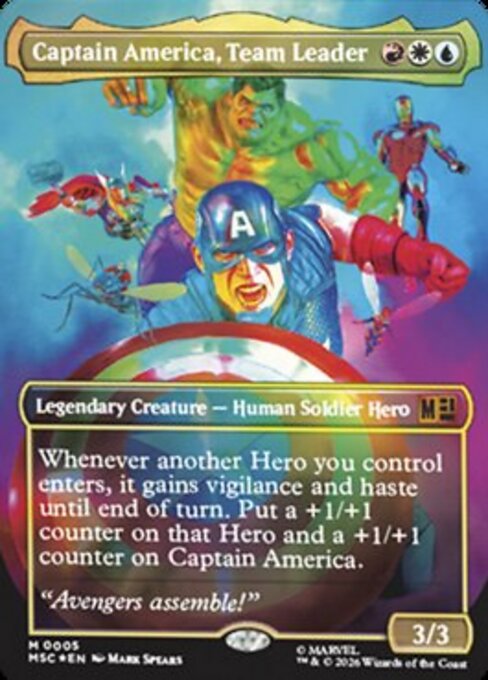
Captain America, Team Leader is a three-color Jeskai (white, blue, red) commander whose one line of text reads: whenever another Hero you control enters, it gains vigilance and haste until end of turn, and you put a +1/+1 counter on it and one on Captain America. Every Hero that enters is two counters and an attacker that can swing the same turn. The deck plays many Heroes, lets the counters stack, and turns that board into damage through payoffs that reward a modified creature. Below is a complete 100-card build, the curve behind it, and the plan for playing it out.
Captain America gives every hero a +1/+1 counter the moment it enters, plus one to himself, and lets it attack right away. So the plan is to play lots of heroes, watch them grow, then attack with the whole team. Below is the full 100-card deck and how to play it.
At a glance
- Colors: Jeskai, white, blue, and red.
- Hero target: 27 Heroes in the 99, 28 counting Captain America, most at two to four mana.
- Power level: mid-power casual, a precon pointed toward focus rather than a cEDH list.
- Primary win condition: a wide modified board given flying by Iron Man or double strike by War Machine.
- Ideal Captain America turn: commander down by turn three, then aim to cast two Heroes during developed turns, each worth two counters.
At a glance
- Colors: white, blue, and red.
- Heroes: about 28, most of them cheap.
- How you win: a big team of grown-up heroes that flies over or hits twice.
- Best turn: play Captain America, then two heroes a turn, and watch the counters pile up.
One turn, start to finish

Say it is turn four and Captain America is down. You cast a two-mana Hero. It enters, gains vigilance and haste, takes a +1/+1 counter, and Captain America takes one too. Director Nick Fury has your Hero spells costing one less, so you cast a second Hero the same turn for two more counters. If Kindred Discovery is out set to Hero, each of those entries drew you a card. You attack with both new Heroes and Captain America, and Iron Man, if it is attacking, gives your modified creatures flying for the swing. Two cards spent, four counters made. That loop is the core of the deck, and the rest of the list exists to keep it running.
Your turn, step by step:
- Play a hero. It gets a +1/+1 counter, and Captain America gets one too.
- The hero can attack right away, because it comes in with haste.
- If you have the mana, play a second hero. That is two more counters.
- Attack with your whole team. Some cards let them fly or hit twice.
- Next turn, do it again. The board keeps growing.
The full 100, by package
Here is one complete build, drawn from Captain America's EDHREC card pool captured 2026-07-14. It is a coherent list rather than the only correct one, and any slot can flex. It starts from the Avengers Assemble precon, and it rebuilds the mana base and several other slots beyond the headline swaps below, so read it as a finished, optimized list rather than the precon plus exactly ten cards. The packages below show what each group of cards is doing and how many the deck runs, and together they total one hundred. As listed it is a mid-budget build, and the fetchlands and Cavern of Souls are the higher-cost slots, and each drops to a tapland or a basic with little loss to the plan. Each card is counted once, under its main role, even though several pull double duty: Nick Fury is a Hero and a cost reducer, and Iron Man is a Hero and a payoff.
Commander 1
- Captain America, Team Leader 3
The enters engine 28
- Director Nick Fury 3
- Black Widow, Agile Avenger 3
- Ant-Man, Elusive Avenger 3
- Jarvis, Earth's Mightiest Butler 3
- Quicksilver, Speedster 5
- Silver Sable, Mercenary Leader 3
- Hawkeye, Trick Shot 4
- Spider-Woman, Stunning Savior 2
- The Wasp, Winsome Avenger 2
- Falcon and Redwing 3
- Agent Phil Coulson 2
- Shang-Chi and the Ten Rings 3
- Scarlet Witch, Chaotic Avenger 4
- Iron Man, Armored Avenger 4
- Photon, Mighty Marvel 4
- Firebird, Blazing Ranger 3
- Captain America, Living Legend 3
- Captain America, Super-Soldier 3
- Vision, Synthezoid Avenger 4
- Metallic Mimic 2
- Bastion Protector 3
- Roaming Throne 4
- Winter Soldier, Reborn Avenger 5
- War Machine, Avenging Arsenal 5
- Captain Marvel, Apex Avenger 7
- Thor, Asgard's Avenger 4
- She-Hulk, Wallbreaker 6
- Professor Hulk 6
Counter & go-wide payoffs 3
- Champions from Beyond 2
- Door of Destinies 4
- The Ozolith 1
Ramp & cost reduction 9
- Sol Ring 1
- Arcane Signet 2
- Talisman of Progress 2
- Talisman of Conviction 2
- Talisman of Creativity 2
- Fellwar Stone 2
- Mind Stone 2
- Herald's Horn 3
- Urza's Incubator 3
Card advantage 7
- Kindred Discovery 5
- Reconnaissance Mission 4
- Avengers Assemble! 5
- Origin of the Avengers 2
- Tome of Legends 2
- Chronicle of Victory 6
- Folk Hero 2
Spot removal 6
- Swords to Plowshares 1
- Path to Exile 1
- Generous Gift 3
- Rip Apart 2
- Destroy Evil 2
- Make Your Move 3
Board resets & mass removal 5
- Raise the Palisade 5
- Damning Verdict 5
- Wave Goodbye 4
- Austere Command 6
- Dismantling Wave 3
Protection & countermagic 5
- Flawless Maneuver 3
- Akroma's Will 4
- Arcane Denial 2
- An Offer You Can't Refuse 1
- Heroic Sacrifice 2
Manabase 36
- Avengers Tower
- Command Tower
- Plaza of Heroes
- Path of Ancestry
- Cavern of Souls
- Secluded Courtyard
- Unclaimed Territory
- Hallowed Fountain
- Sacred Foundry
- Steam Vents
- Prairie Stream
- Irrigated Farmland
- Mystic Monastery
- Glacial Fortress
- Clifftop Retreat
- Sulfur Falls
- Port Town
- Furycalm Snarl
- Frostboil Snarl
- Raugrin Triome
- Flooded Strand
- Arid Mesa
- Scalding Tarn
- Battlefield Forge
- Adarkar Wastes
- Shivan Reef
- Spectator Seating
- Reliquary Tower
- Rogue's Passage
- Plains
- Plains
- Plains
- Island
- Island
- Mountain
- Mountain
1 + 28 + 3 + 9 + 7 + 6 + 5 + 5 + 36 = 100
The small number after a card is its mana value; lands are not numbered.
The whole deck is 100 cards: Captain America plus 28 engine creatures (27 of them Heroes), a few counter payoffs, 9 ramp cards, 7 draw cards, 6 removal spells, 5 mass-removal spells, and 5 protection and counter spells, and 36 lands. Every card is real and comes from Captain America's EDHREC page.
Dead-draw audit
Snail's harder question comes after the jobs: a card is only as good as how often it can do its job. A payoff whose support pieces show up too rarely turns into a dead draw. Each questioned card below gets five fields and a verdict of core, supported, situational, or cut.
| Card | Primary job | Secondary synergy | Support count | Use without Cap | Verdict |
|---|---|---|---|---|---|
| Kindred Discovery | Draw on each Hero that enters or attacks | Pays off tokens and recursion | 27 Heroes plus every Hero token and reanimated Hero | Independent of Cap | Core |
| Iron Man, Armored Avenger | Modified attackers fly; each draw adds a counter | Turns card draw into counters | 27 Heroes, and every draw for the counter half | Draw-to-counter works; flying wants a modified board | Supported |
| War Machine, Avenging Arsenal | Modified attackers gain double strike | Closes a wide counter board | Needs modified attackers, fed by Cap and entries | Weak without another counter source | Supported |
| Champions from Beyond | Makes X Hero tokens, scry-and-draw at four attackers | Each token triggers Cap | A wide board, plus Cap for the per-token counter | Still makes tokens and draws; loses the per-token counter | Supported |
| Door of Destinies | Anthem that grows only when you cast a Hero | Snowballs a wide Hero board | Direct Hero casts; tokens and reanimation do not grow it but still get its bonus | Independent of Cap | Situational (casting-only payoff) |
| The Ozolith | Banks counters when a creature leaves the battlefield | Insurance against a wipe | Any counters on board, from Cap, entries, or payoffs | Works with any counter source | Supported |
| Shared Animosity (power branch) | On-attack pump for each attacking Hero | Go-wide finisher | About 27 attacking Hero bodies | Independent of Cap | Core in the aggressive branch |
| Cathars' Crusade (power branch) | A counter on all your creatures per creature entry | Counts tokens and reanimation | Every creature entry, tokens and recursion included | Independent of Cap | Core in the aggressive branch |
| Teferi's Protection (power branch) | Protects you and phases out your board | Saves a developed board from a wipe | Any board worth protecting | Independent of Cap | Situational, essential in the moment |
The audit earns its keep on the close calls. Door of Destinies looks like a counters payoff, so it reads as core at a glance. It gains a charge counter only on a Hero you cast, so the tokens and reanimated Heroes this build makes do not grow it, and they still get its +1/+1 bonus. Its real charge-counter support is smaller than the raw Hero count suggests, which is the difference between a card that backs the whole engine and one that backs only the casting half.
Reading the audit uses four more of Snail's tests. Strength over count: Kindred Discovery reaches its payoff through many dependable routes: every Hero, Hero token, and reanimation. Door of Destinies has one route, direct casting, which is why it drops to situational. By stage: Kindred Discovery and Champions from Beyond pull weight from development onward, War Machine and She-Hulk are late finishers, and The Ozolith is recovery insurance, so a card that is quiet early keeps its slot when the deck reliably reaches its stage. From the finished list: every support count above is read off this 100 after the swaps rather than off EDHREC averages, so the Door of Destinies verdict already accounts for the token and recursion sources that do not grow it. Flexibility floor: tuning toward Heroes did not strip the answers, since the build still runs six spot removals, five mass-removal spells (four creature resets plus Dismantling Wave for artifacts and enchantments), five protection and counter cards, and seven card-draw effects, so it can respond to a changing board rather than only chain one big turn.
Dead-draw check: a card is only good if the cards it needs show up often. Kindred Discovery works off every hero, so it stays live. Door of Destinies grows only when you cast a hero as a spell, so hero tokens and reanimated heroes do not grow it, which makes it weaker than it looks.
Three ways a card goes dead
- A Hero with no board behind it. She-Hulk gives your team trample and counters once a wide board is down. Drawn with nothing else out, she does little on her own.
- Protection you cannot rebuild behind. Flawless Maneuver saves the board in front of you. Held with one creature out and nothing to follow, it saves almost nothing, so keep a Hero or two in hand to make it worth casting.
- A strong card that ignores the plan. A five-mana bomb that neither adds a Hero, protects the board, nor turns counters into damage belongs in a different deck. It fails the five-job test even when its ceiling is high.
The mana curve
Counts cover the sixty-four nonland cards, the commander included. The deck wants its weight low so the counters start on turn two or three, with a smaller top end for the payoffs that end games.
Two and three carry the deck. That is where Nick Fury, Black Widow, Shang-Chi, and the cheap rocks live, and it is why a good keep can start playing Heroes by turn two.
Most cards cost two or three mana, so you can start playing heroes early. Only a few cost five or six, and those are the big finishers.
The signature engine: inclusion is not synergy
EDHREC snapshot, 2026-07-14
EDHREC prints two numbers per card, and they answer different questions. Inclusion is the share of Captain America decklists that include the card. Synergy is how much more this commander runs it than the average deck that legally could. A high inclusion with a high synergy is a signature card, something builders reach for far more here than elsewhere. A high inclusion with a low synergy is a staple, a card good in any deck of these colors. Synergy is a percentage-point gap, so +88.8% means the card shows up that many points more often here than in the average eligible deck. The table keeps the two apart.
| Card | Inclusion | Synergy | Job |
|---|---|---|---|
| Director Nick Fury | 95.1% | +88.8% | Hero spells cost 1 less; attack digs 4 cards for a Hero |
| Avengers Tower | 94.2% | +86.3% | Hero-fixing land; for four mana and a tap, looks at three and keeps a Hero |
| Iron Man, Armored Avenger | 92.1% | +85.1% | Draw puts a counter; modified attackers fly |
| War Machine, Avenging Arsenal | 91.1% | +83.6% | Modified attackers gain double strike |
| Black Widow, Agile Avenger | 90.3% | +82.0% | Cheap menace Hero; punishes an opponent's extra draw |
| She-Hulk, Wallbreaker | 88.4% | +81.3% | Team trample; blocked Heroes gain counters |
| Winter Soldier, Reborn Avenger | 88.4% | +81.2% | Attack returns a creature within his power; a Hero re-enters with an extra counter |
| Kindred Discovery | 86.0% | +80.8% | Choose Hero: draw on every Hero that enters or attacks |
| Raise the Palisade | 86.0% | +82.4% | Bounce non-Hero creatures; strongly favors your Hero-heavy board |
| Swords to Plowshares | 90.5% | +22.8% | Staple: high inclusion, low synergy, run in any white deck |
| Arcane Denial | 68.5% | +52.0% | Cheap counter that replaces itself; more commander-tied than a plain staple |
What EDHREC can and cannot tell you
These percentages are a snapshot of what other builders put in their lists. A high number means many decklists include the card, and it carries no claim about card quality, correct play, or copying a card during a game. Use inclusion to find cards worth trying and to spot the staples, then judge fit at your own table, because the number alone will not rank two cards or promise that one belongs in your build. Read the numbers as a starting map, then let the five-job test settle the close calls.
The percentages just say how many other people put a card in their deck. A big number does not mean the card is best, and it has nothing to do with copying a card during the game. Use the numbers as a hint about what to try, then decide for yourself.
More than casting: tokens, blink, and reanimation

The trigger is written on the word enters. Players read it as cast, and they skip that swap all the time. Any Hero that arrives under your control fires the counters, so casting is one route of several. A Hero token entering counts. A Hero returning from a blink counts. A Hero coming back from the graveyard counts. Winter Soldier, Reborn Avenger shows it clearly: when it attacks it returns a creature within its power from your yard, and when that creature is a Hero it enters, triggers Captain America, and Winter Soldier adds an extra counter on top. Kindred Discovery draws you a card on the same entry. A build that only counts cast Heroes tends to leave those repeated entries unused, and repeated entries can be more triggers from fewer cards.
So the construction target is Hero density plus a few ways to make Heroes enter more than once. Direct casting stays the backbone of the list. Token production and recursion are the secondary engines that let a smaller pool of Heroes fire the trigger again.
Read the card closely: it says "enters." A hero counts every time it shows up, even when you did not play it from your hand. A hero made as a token counts. A hero that comes back from the graveyard counts. Winter Soldier brings heroes back so they enter again and grow again. So the deck likes any card that makes heroes appear more than once.
Cashing the counters: the modified payoffs
A wide board of counters becomes damage through the payoffs. They share one keyword: modified. A creature with a counter on it is modified, so your countered Heroes meet these rewards at once.
Card draw feeds the same loop. Iron Man puts a counter down whenever you draw. Shang-Chi and the Ten Rings grows on every draw and, at ten counters, draws you five and gains five life. Professor Hulk draws you a card for each point of combat damage it deals. Kindred Discovery pairs with these, because its trigger draws a card and turns on Iron Man and Shang-Chi. One rules trap to know: Director Nick Fury, Avengers Tower, and Herald's Horn reveal a Hero and put it into your hand, which does not count as drawing, so those digs do not add a counter through Iron Man or Shang-Chi. Only the effects that use the word draw turn those counters on.
A creature with a counter is called "modified." When Iron Man attacks, your other modified creatures gain flying. War Machine gives them double strike. She-Hulk gives them trample and grows any hero that gets blocked. Drawing cards also adds counters, so the deck can get bigger every time you draw.
How the deck closes
A wide board is not the win on its own. One payoff turns it lethal. Attack with a countered team and War Machine gives them double strike, or Iron Man gives them flying, or She-Hulk gives them trample through the chump blocks. Any one of the three can turn a wide board into a game-ending swing when you have the power and a clear path, so keep a Hero or two back for the follow-up. Champions from Beyond adds a second gear: at eight or more attackers its Full Party mode pumps the team by four each. On the turn you go for it, know the job of each protection spell. Flawless Maneuver is the free save: it makes your team indestructible, which beats a wipe or targeted destruction, and it does nothing against exile, bounce, or a chump block. Akroma's Will is the finisher: with Captain America out you take both modes, so your team gains flying, vigilance, and double strike alongside indestructible and protection from every color, which pushes the damage through and shrugs off colored blockers and removal. A colorless flyer or reacher can still block. Both wear off at end of turn, so surviving a sweeper on the next turn takes countermagic or a card kept in hand. The optional power branch closes harder, with Shared Animosity paying per attacker and Cathars' Crusade snowballing the counters.
How you win: build a team of heroes with counters, then attack. War Machine lets them hit twice, Iron Man lets them fly, and She-Hulk lets them trample. Any one of those ends the game. Play a protection spell like Flawless Maneuver the same turn so nothing stops the swing.
Three winning turns
- Wide board plus a multiplier. Six or more countered Heroes down, then War Machine or Iron Man attacks to add double strike or flying, and the swing is lethal.
- Protected alpha after a rebuild. Rebuild off Nick Fury digs, hold Flawless Maneuver or Akroma's Will, then attack into an open board with the buff up.
- Grind them out. Kindred Discovery and Champions from Beyond draw on every Hero, so even a slow game buries the table in card advantage and counters.
Interaction, protection, and the board-wipe question
A go-wide deck has one real fear, the sweeper that clears a board full of counters. This list answers that in three layers. First, spot removal keeps the path clear: Swords to Plowshares is the clean one-card answer, run in nine of ten lists. Second, cheap countermagic like Arcane Denial protects the engine and replaces itself. Third, and this is the piece a primer skips, Raise the Palisade is a sweeper you run yourself. It returns every creature that is not your chosen type to its owner's hand, so you pick Hero and every non-Hero on the table goes back to hand. Two caveats keep it honest: an opponent's own Heroes stay put, and your handful of non-Hero creatures bounce along with theirs. In a Hero-heavy list it still works as a strongly asymmetric sweeper.
When an opponent resolves a wipe instead, be honest about what dies: Captain America, Nick Fury, Winter Soldier, and the whole countered board go with it. The recovery is not on the battlefield. It waits in your hand and the command zone. Because you rarely empty your hand, you recast Captain America and rebuild with the cheap Heroes you held back, and Nick Fury or Winter Soldier help again once you recast or redraw them. The counters are gone, and the plan becomes a fresh curve of Heroes from hand.
The scary card: a "board wipe" kills everyone's creatures, and your counters go with them. Three answers: Swords to Plowshares removes one big threat cleanly; Arcane Denial says no to a spell and draws you a card; and Raise the Palisade is your own wipe: you pick Hero, and every creature that is not a hero goes back to its owner's hand. That mostly hits the other players. Their own heroes stay, and your few non-hero cards come back to your hand too. If someone else wipes the board, remember it kills your heroes and Captain America with them. The way back is the heroes still in your hand: play Captain America again and rebuild with cheap heroes, a little at a time.
The real rule: five jobs
Before a nonland card makes the deck, ask which of five jobs it covers: add Heroes, speed them out, refill your hand, protect the board, or clear a path. The best cards cover two of the five.
The old shorthand, "if it is not a Hero and does not pump, protect, or find Heroes, it is fighting the plan," fails on contact with a real hundred-card deck: it reads removal and ramp as suspects. Swords clears a path, Sol Ring and Nick Fury speed Heroes out, Kindred Discovery refills. A card that does none of the five is the one fighting the plan, and a card that does two of them is the one you cut last.
How to pick a card: ask whether it does one of five jobs, meaning it makes heroes, makes them cheaper, draws you cards, protects your board, or removes something in your way. A card that does none of the five should be cut, and a card that does two of them is a keep.
Ten to cut, ten to add
The 100 above is an optimized build. It goes past the precon with more than ten changes, including a rebuilt mana base and a few other slots. Below are the headline swaps from the Avengers Assemble precon, a strong first upgrade package. The first three follow the Snail project: the deckbuilding principle is Salubrious Snail's, and the exact card exchanges come from the Gathering Games Avengers Assemble upgrade guide. The other seven are recommendations built for this list. Every cut is a real precon card, and every add is legal in Captain America's Jeskai identity.
Three goals sort these upgrades. Keep the theme: Champions from Beyond, Roaming Throne, and The Ozolith deepen the Hero-and-counters plan. Add consistency: Urza's Incubator, the mana rocks, and the fetch-and-shock mana base find and cast Heroes on time, and Path to Exile plus Generous Gift keep the interaction reliable. Add power: Damning Verdict and Wave Goodbye are one-sided resets, Flawless Maneuver and Akroma's Will add protection, and the power branch below raises the ceiling against stronger tables.
Three applied Snail changes
Snail principle applied through the Gathering Games upgrades. All three use the deck's counters: two are one-sided sweepers, and one turns a wide board into Hero tokens and card draw.
| Cut (in the precon) | Add | Why the swap |
|---|---|---|
| Love on the Battlefield | Champions from Beyond | Love pays off only when you attack with exactly two creatures; Champions makes X 1/1 Hero tokens, each of which triggers Captain America as it enters, and it pays you for attacking with four or more. |
| Avenge | Damning Verdict | Avenge destroys every creature, your own board included; Damning Verdict destroys only creatures with no counters, so any countered creature survives, which for this deck means your Heroes. |
| Gift of Immortality | Wave Goodbye | A slow one-creature aura becomes a bounce that returns every creature without a +1/+1 counter, sparing every countered creature, which for you means your Heroes. |
Seven more upgrades for this build
These seven are recommendations built for this list, outside the Snail guide. Each cut is a real precon card.
| Cut (in the precon) | Add | Why the swap |
|---|---|---|
| Hulkbuster Armor | Roaming Throne | Hulkbuster pours equip mana into one attacker (Equip Hero costs three), which a wide deck would rather spend on more Heroes; the Throne makes Captain America's trigger happen an additional time for every future Hero, and you can choose Hero for the Throne itself. |
| Hero's Blade | The Ozolith | Hero's Blade auto-attaches to a legendary Hero as it enters, but it still buffs one body; The Ozolith banks your counters and hands them back after a wipe. |
| Patriot, Shield Wielder | Flawless Maneuver | A tap-to-buff-one Hero trades for free protection across the whole team. |
| Speed, Young Avenger | Akroma's Will | Speed only makes one haste creature unblockable, a narrow payoff next to the board-wide ones; Akroma's Will is four-mana protection or a finisher, both modes with your commander out. |
| Captain Mar-Vell, Space-Born | Urza's Incubator | Captain Mar-Vell lets your spells cast at flash once an opponent has cast a spell, so Heroes can enter on other turns; Urza's Incubator trades that flexibility for cost reduction, though many cheap Heroes save less than two. |
| Avengers Quinjet | Path to Exile | The Quinjet cheats a Hero into play or returns one from the graveyard, real engine value, but at five mana and crew three it is slow; Path is one-mana exile removal, trading engine for interaction. |
| Rescue, Pepper Potts | Generous Gift | Rescue is a flash flyer whose bounce can re-use a Hero's enter trigger, but the deck can spare it for removal that answers any permanent. |
Optional power branch
For a more aggressive, less legible build, run three stronger cards in place of the Snail versions: Shared Animosity for Champions from Beyond, Cathars' Crusade for Damning Verdict, and Teferi's Protection for Wave Goodbye. That trades two one-sided sweepers and a token engine for a bigger snowball and a blowout protection spell, and it gives up the source-guide simplicity.
Ten cards to swap. Take these ten weaker cards out of the box deck: Love on the Battlefield, Avenge, Gift of Immortality, Hulkbuster Armor, Hero's Blade, Patriot, Speed, Captain Mar-Vell, the Quinjet, and Rescue. Put these ten stronger cards in: Champions from Beyond, Damning Verdict, Wave Goodbye, Roaming Throne, The Ozolith, Flawless Maneuver, Akroma's Will, Urza's Incubator, Path to Exile, and Generous Gift.
Opening hand and three mistakes
A keepable hand wants three or four mana sources with your colors covered and at least one Hero you can cast by turn two or three. A realistic seven-card keep is three sources, one accelerator or fixer, two early Heroes, and one draw or protection spell, and multi-role cards let a leaner hand work. A three-color deck wants all three colors reachable by turn three, so a two-source hand keeps only when its fixing and acceleration are strong. Ship hands with fewer than two sources, hands that cannot reach all three colors, or hands with no Hero castable by turn three.
Keep or mulligan
- Three mana sources with your colors reachable.
- An early Hero, castable by turn two or three.
- A card-draw piece to refill.
- A protection or recovery spell.
- Only expensive Heroes, nothing early.
- Several Equipment or Auras with no creatures.
- Strong finishers with no early development.
- Two sources with weak fixing.
Three common mistakes
- Playing it as cast-only. Forgetting that tokens, blink, and reanimation also enter, so you leave the cheapest repeat triggers out of the deck.
- Dumping into an open wipe. Emptying your hand when a sweeper is likely, instead of holding a Hero or two and leaning on Raise the Palisade and the rebuild.
- Chasing off-plan power. Running a strong non-Hero that does none of the five jobs, thinning the Hero density that makes Captain America snowball.
Keep a hand with three or four mana sources and at least one hero you can play by turn three. Mistakes to avoid: only playing heroes from your hand and forgetting tokens and graveyard tricks; playing every hero right before a board wipe; and adding strong cards that are not heroes and do not help heroes.
Cap or Nick Fury: the two faces
The Avengers Assemble box ships with two full-identity commanders for the unchanged deck, Captain America and Director Nick Fury, and Captain America is the default for good reason. Both are Jeskai, so the color identity and most of the 99 stay the same. Captain America, Team Leader turns every Hero entry into counters and haste, which pushes a go-wide board that closes through the modified payoffs. Director Nick Fury leads a grindier build: his cost reduction and attack-triggered Hero digs make a deck built around card advantage and a steady stream of Heroes rather than a single explosive counter turn. Run Captain America for the aggressive Hero-and-counters plan this page describes. Move Nick Fury to the command zone when you would rather grind through card advantage, and the deck shifts from a counters theme toward a Legends and value theme. Other legendary creatures in the set can command rebuilt decks in their own color identities; Captain America, First Avenger, also Jeskai, is one such option, but it is not the commander of this unchanged shell.
Two leaders: the box lets you pick Captain America or Nick Fury. Captain America is the fast, go-wide plan in this guide. Nick Fury is a slower plan that draws more cards. Identical colors, a different feel.
| Commander | Playstyle | Strength | Weakness |
|---|---|---|---|
| Captain America, Team Leader (default) | Go-wide Heroes and counters, aggressive | Explosive counter turns, a clear beatdown plan | Vulnerable to a well-timed board wipe |
| Director Nick Fury | Grindy Hero value, card advantage | Cheaper Heroes, steady card flow, resilient | Slower to close, fewer blowout turns |
What the numbers say
EDHREC data captured 2026-07-14
On the day this was written, EDHREC listed 2,526 Captain America decks at rank 925, and its top theme tags were +1/+1 counters (173), Heroes (138), Legends (78), and Aggro (43). That build count shows broad adoption. It does not say the deck is strong, that the crowd is right, or that the commander is easy to learn. The counts and percentages move as the sample grows, so the figures here are stamped with their capture date, and a later read may differ. The reason the deck reads as beginner-friendly is a short decision tree: play a Hero, take the counters, attack, repeat. Whether it is the simplest deck in the box to play against is a claim this page does not make.
On the day this was written, about 2,526 people had built Captain America, ranked number 925. That means lots of people build it, which does not make it the best. The number changes over time, so this page notes the day it was checked: 2026-07-14.