Every Commander deck draws cards it cannot use. Some of that is mana variance you will never fully fix, drawing a land when you wanted a spell or the reverse. The rest is a build problem, and the Doom Prevails precon is a clean place to watch it happen. The number of dead non-land draws a deck produces is set as you build it, long before you shuffle up, and this deck gives you two clear engines to measure every card against.
The zero-dead-draw extreme
Picture a deck of thirty-five Swamps and sixty-four copies of one villain that gets bigger with each copy. It would never draw a dead card, because every nonland does the same job and stacks with the others. It would also do exactly one thing and fold the moment a board wipe resolves. That extreme is the ruler you measure against, and nobody should actually build it. What removes dead draws is cards that share a job and support each other, and the two questions that fall out of it are the whole method: what does a card accomplish on its own, and what else does it work with.
What Doom and Loki actually reward
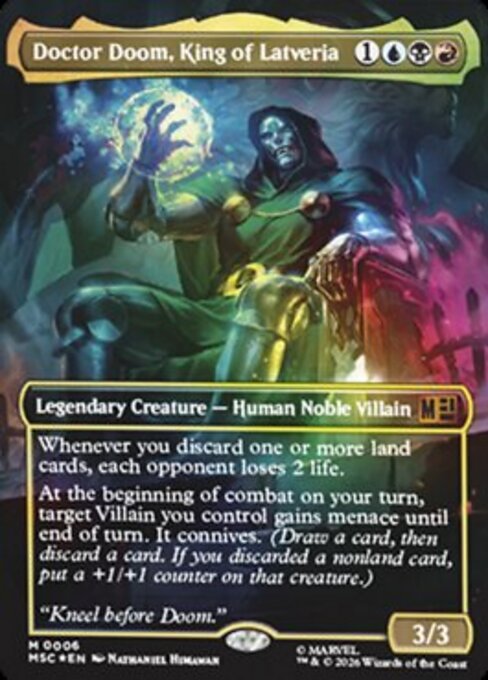
Doom Prevails runs two synergy axes, and almost every good card in it touches at least one. Doctor Doom, King of Latveria drains each opponent for two whenever you discard a land, so anything that lets you pitch, loot, or rummage away lands feeds him directly. Loki, the Deceiver makes a copy of another Villain when he attacks and draws you a card whenever your Villains deal combat damage, so Villains worth copying and payoffs for connecting feed him.
A card earns its slot in this deck to the degree it covers one of those two axes. A card that covers neither is a candidate for the cut, no matter how strong it looks in a vacuum. That is the lens for the whole ninety-nine.
Reading a card by floor and synergy
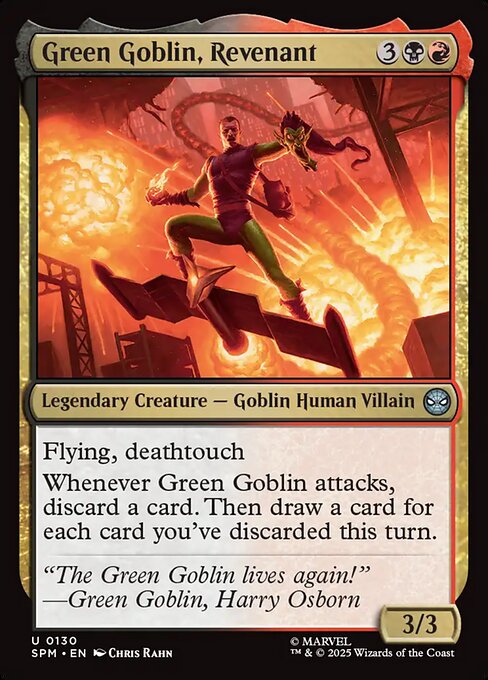
Take Green Goblin, Revenant, one of the guide's upgrade adds. A flying deathtouch body is a fine attacker on its own, so it has a high floor and rarely does nothing. On top of that floor it carries draw and discard, which hands Doom a land to pitch, and it is a Villain worth copying with Loki. It covers both axes and stands on its own, which is the exact profile you want from a synergy piece.
Now compare the card it replaces. Superior Foes of Spider-Man is a low-payoff piece that neither engine uses, so it is dead more often than not. The swap is a fit upgrade. You trade a card outside both engines for one that both engines want.
The card that only sometimes works

Not every synergy card earns a slot. The trap is a card that only pays off once the commander is going, and does little otherwise. If it lives and dies with Loki, a single removal spell turns it into a blank. Kingpin, Wilson Fisk avoids that trap. He turns the tokens you sacrifice off Loki into Treasure, so he rewards a line the deck runs every turn anyway and still gives you mana on a slow one. He asks a question the deck answers on its own.
The test is the one from the method. How often will this card be in a spot to help, and how much will it help when it is. A card that needs a specific board state to matter, and matters little without it, is a card you should be honest about before you sleeve it.
The upgrade swaps, read as one audit
Line up the guide's swaps and they are a single exercise: cut what neither engine uses, add what both engines want.
A vanilla five-drop leaves for a Treasure engine off your sacrificed copies.
An off-theme vehicle leaves for a piece that keeps a Loki copy past end of turn.
A card that only Doom wants leaves for card draw plus a Villain lord.
Pure draw leaves for a repeatable Villain-token maker that feeds Loki.
Nothing generically weak comes out. What comes out is whatever the discard and copy engines cannot use. That is the category audit doing its job.
Playing the specific cards responsibly
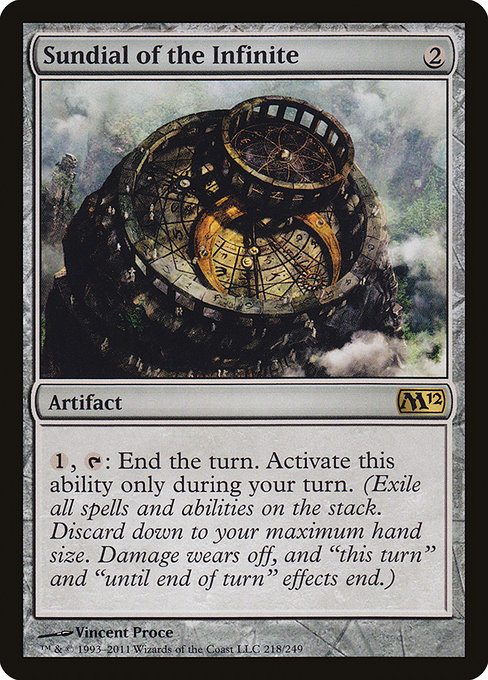
A few narrow cards are fine to run as long as you respect their windows. Sundial of the Infinite ends your turn to keep a Loki copy for good, which is a blowout on the turn the copy matters and a dead artifact on the turns it does not. You run one or two effects like that on purpose, and you play around their windows rather than pretending they are always live.
Put the whole thing together and Doom Prevails stops feeling clunky once you file every card under the job it does and cut the ones that did no job here. You did not chase power. You aimed the deck at its own engines. The engines were always the point. The upgrade just made more of the deck point at them.