Kang, Temporal Tyrant: The Second‑Draw Machine

The Doom box's control villain runs on one trigger, your second card each turn, and that trigger fires on every player's turn in the game, including all three of your opponents'. Every good card in the deck either helps you hit it or pays you off for hitting it.
Kang is a slow control villain. His whole deck is about drawing a second card every turn, and the clever part is that you can do it on other players' turns too. Each time you do, you drain the table.

This Kang, Temporal Tyrant deck tech is inspired by Salubrious Snail's published deckbuilding framework. Kang's inclusion figures come from his EDHREC commander page; card text is from Scryfall. Not authored or endorsed by Salubrious Snail or EDHREC.

On this page (7 destinations)

Kang, Temporal Tyrant reads like two small abilities, and together they define the whole deck. When Kang attacks he connives, which draws a card and then discards one. And whenever you draw your second card in a turn, each opponent loses a life and you gain one. Read the second ability closely. It says each turn, which counts every turn in the game, your opponents' turns included. That one detail is the whole deck. You get to drain the table on your own turn and on all three opponents' turns, as long as you can manufacture a second draw during each of them. This is a Dimir control deck that wins by turning a steady drip of extra draws into damage, tokens, and eventually the game.

Kang has two little powers. He draws and discards when he attacks, and every time you draw your second card in a turn, you drain every opponent for one. The word that matters is "each turn." That means you can drain people on their turns too, as well as on yours, if you find a way to draw a second card on their turn.

The one trigger that matters

Kang, Temporal Tyrant

Your first draw each turn is the free one from your draw step, or, on someone else's turn, the first card you happen to draw that turn. The second draw is the one you have to manufacture. Connive is the cleanest way to do it, because a connive draws a card as it resolves, then discards one. A connive is an effect that draws you a card, so any connive you get on a turn where you have already drawn once flips straight into your second draw and fires every payoff at once. So the build question is simple: how many ways can you reliably draw a second card, and on how many of the four turns in a rotation.

You draw one card on your turn for free. The trick is drawing a second one. Connive is the easy way, since conniving draws a card and then makes you discard one. One connive on top of a card you already drew becomes your second draw and fires all your rewards.

The turn-cycle math

Here is the ceiling most Kang primers skip. In a four-player game there are four turns in every rotation. If you build one second draw into each of them, Kang drains three opponents four separate times before your next main phase. Instant-speed draw is what reaches the opponents' turns, because a sorcery-speed cantrip can only ever fire on your own. The engine runs on one clean second draw repeated four times a lap. You never need seven trips around your own upkeep.

Your turn: draw step, then a connive or a cantripdrain 1
Opp A's turn: Frantic Search or Visions of Villainy at instant speeddrain 1
Opp B's turn: a second instant, or Ledger Shredder on the table's second spelldrain 1
Opp C's turn: a held-up instant drawdrain 1
One full rotation, before combat or tokens4 drains

Stack Gixian Puppeteer under that and every one of those drains is worth three instead of one, Kang's one life plus Puppeteer's two, so a full four-trigger rotation costs each opponent twelve life and gains you twelve. Stack Construct a Cosmic Cube under it and the same four triggers push four plan counters and four menace tokens a lap, so the seven-counter clock closes in under two rotations without you spending a single one of your own draw steps on it. The lesson for deckbuilding: instant-speed draw carries this deck, because it turns one payoff into four, so it belongs near the top of your priority list.

In a four-player game there are four turns before you get to go again. If you can draw a second card on each of them, you drain the table four times a lap instead of once. Cards that let you draw at instant speed, like Frantic Search, are the key, because they work on other people's turns. Add Gixian Puppeteer and every drain is worth three, Kang's one plus Puppeteer's two, so a four-trigger lap drains each opponent for twelve.

Reading the payoffs

EDHREC's high-synergy list for Kang is a stack of second-draw payoffs, and each one turns that trigger into a different kind of pressure.

Leader, Super-GeniusLeader, Super-Genius 72%. The engine piece. Its replacement effect adds one extra card before each connive, so a single connive becomes a draw plus the connive, and it hands you a free combat connive every turn on top.
Construct a Cosmic CubeConstruct a Cosmic Cube 67%. Every second draw makes a menacing Villain token and adds a plan counter. At the seventh counter you sacrifice it and control an opponent during their next turn, so the same steady value doubles as a hard clock.
Gixian PuppeteerGixian Puppeteer 48%. Adds two to the drain, since every second draw costs an opponent an extra two life and gains you two, which is three total once you count Kang's one, rather than double. Kang plus Puppeteer is three life per trigger before you do anything else, and across a full rotation that is twelve.
M.O.D.O.K., Evil IntellectM.O.D.O.K., Evil Intellect removal payoff. Whenever you draw your second card each turn, a target opponent sacrifices a nontoken creature of their choice. They pick the creature, so it is edict removal that clips their worst blocker rather than a targeted kill. Four second draws a lap is four forced sacrifices, which is how a durdle deck strips a board without spending removal spells.
Kid LokiKid Loki 45%. Every second draw puts a counter on him, and any creature you have put a counter on this turn has hexproof. Read that carefully: on his own he only protects himself, and only on turns he grows. To shield the rest of the board you need other counter sources feeding the same turn.

The most popular reward cards each cash the second draw differently: Leader adds an extra card before each connive, the Cosmic Cube makes tokens and eventually steals a turn, Gixian Puppeteer drains two, M.O.D.O.K., Evil Intellect makes an opponent sacrifice a creature, and Kid Loki grows and protects himself. Note Kid Loki only protects creatures you have grown that same turn.

Off-turn enablers, the cards that make the math work

If instant-speed draw is what turns one drain into four, these are the pieces that supply it, and they are the cards a Kang list should prioritize over a fifth sorcery-speed cantrip.

Frantic SearchFrantic Search 47%. An instant that draws two and untaps up to three lands. It costs three mana first and refunds it when three useful lands untap, so it is a mana-neutral second draw on an opponent's turn rather than a free one. The single best off-turn enabler in the shell.
Visions of VillainyVisions of Villainy 50%. An instant that draws two and costs one less with a Villain out. Cheap, repeatable-feeling, and legal to fire on anyone's turn.
Ledger ShredderLedger Shredder 42%. Connives whenever any player casts their second spell in a turn, which happens on their turns too. If you have already drawn once that turn, its connive is your second draw and a Kang drain.
Baron Strucker, HYDRA OverlordBaron Strucker, HYDRA Overlord 59%. The most-run card the old primer never mentioned. Villain spells cost one less, and once each turn a Villain entering may connive. That connive is a repeatable second-draw source, and the cost cut helps the whole Villain subtheme.
Madame MasqueMadame Masque 47%. Connives on enter and then makes a Villain token on every second draw you hit, so she is an enabler and a payoff in one body.

These cards let you draw that key second card, and the best ones work on other players' turns: Frantic Search, Visions of Villainy, Ledger Shredder, plus Baron Strucker, who makes your villains cheaper and lets one connive each turn, and Madame Masque, who both draws and rewards.

The other half of connive, the discard

Every connive draws a card and then discards one, so a deck full of connives is quietly a discard deck too, and that is a second engine most Kang primers walk right past. The pile of cards you bin each turn is a resource, and a few EDHREC staples turn it into value or removal.

Moonstone, Harsh MistressMoonstone, Harsh Mistress 42%. Whenever you discard a card you may exile it from your graveyard and play it until the end of your next turn, so the land or spell a connive threw away stays playable for a while. You still pay its cost and obey its timing, so this is extended card access rather than free recursion. She turns discarding into a filter rather than a loss.
Archfiend of IfnirArchfiend of Ifnir 32%. Whenever you discard a card, each creature your opponents control gets a minus-one-minus-one counter. Kang and his support connive over and over, so Archfiend turns the discard half of the engine into a slow board wipe that also cycles for value.
M.O.D.O.K.M.O.D.O.K. 40%. The other M.O.D.O.K., a flying lifelinker that pays three life to connive on your turn and gives every opposing creature minus-one-minus-one. He is a discard-and-connive engine on a body, feeding Moonstone and Archfiend as he chips the board down.

This is why the deckbuilding test below is wider than a pure draw count. A card like Moonstone can do more work than a fourth generic second-draw payoff, because she recovers what the engine throws away, and Archfiend converts the same discards into removal you were not paying for.

Connive draws a card and then makes you discard one, so Kang is secretly a discard deck as well. Moonstone lets you play cards you discarded for a little while, though you still pay their cost, so less is wasted. Archfiend of Ifnir shrinks every enemy creature each time you discard. M.O.D.O.K. connives over and over and weakens the board. The cards you throw away become a resource of their own.

Priority adds

Kang is a box alt with no upgrade list of his own, so the add list below reads EDHREC as a signal and runs it through the second-draw test, rather than copying the popular pile wholesale. Percentages are the share of recorded Kang decks running the card, read 2026-07-14, and the next section separates that inclusion from synergy so you can tell a signature card from a staple. One caution up front: this is an eighty-one-deck sample on a box that released in June 2026, so a few copied lists move the numbers a lot. Read the percentages as an early signal rather than proof.

Engine and payoffs

  • Leader, Super-Genius 72%
  • Construct a Cosmic Cube 67%
  • Baron Strucker, HYDRA Overlord 59%
  • Gixian Puppeteer 48%
  • Madame Masque 47%
  • Psychosis Crawler 47%
  • Teferi's Ageless Insight 47%
  • Alandra, Sky Dreamer shares Kang's trigger
  • M.O.D.O.K., Evil Intellect by function

Enablers and draw

  • Visions of Villainy 50% instant
  • Frantic Search 47% instant
  • Ledger Shredder 42% any turn
  • Black Market Connections Dimir staple

Two lanes, and do not confuse them

The adds serve two different goals, and the guide should keep them apart. One lane makes Kang feel like Kang, the Villain flavor, and the other simply raises your win percentage with efficient Dimir cards. Some pieces do both, but a reader tuning for power should know which is which.

Make Kang feel like Kang

  • Baron Strucker and Madame Masque, Villain enablers
  • M.O.D.O.K. and M.O.D.O.K., Evil Intellect
  • Villain-token makers that crew and chump
  • The connive and Villain subtheme generally

Raise win percentage

  • Frantic Search, Visions of Villainy, instant-speed draw
  • Psychosis Crawler and Teferi, the drain multipliers
  • Black Market Connections, efficient repeatable draw
  • Counterspell, Arcane Denial, spot removal, protection

Alandra, the Cube, and Gixian Puppeteer sit in both lanes, since they are on-theme second-draw payoffs that also move you toward a real win. When you have to cut, keep the win-percentage lane full and treat the pure-flavor cards as the flexible slots.

The best cards to add come in two kinds. Some make the deck feel like Kang, the villain cards. Others just help you win more, like counterspells, cheap draw, and Black Market Connections. A few, like Alandra and the Cosmic Cube, do both. When you must cut, keep the win cards and trim the flavor.

Inclusion is not synergy

Counterspell
Counterspell, high inclusion, negative synergy

EDHREC prints two numbers per card, and they answer different questions. Inclusion is the share of Kang decks running the card. Synergy is how much more Kang runs it than the average blue-black deck that legally could. A high inclusion paired with a high synergy is a signature card, something Kang pulls toward far more than the format at large. A high inclusion with a low synergy is a staple, a card that is good in any deck of these colors. Reading only the inclusion column is how a primer ends up telling you to copy the popular pile. The synergy column is the one that shows you the deck's actual identity.

CardInclusionSynergyRead
Leader, Super-Genius72%+69%signature
Construct a Cosmic Cube67%+65%signature
Baron Strucker, HYDRA Overlord59%+57%signature
Visions of Villainy50%+49%signature
Gixian Puppeteer48%+48%signature
Moonstone, Harsh Mistress42%+41%signature
Archfiend of Ifnir32%+31%signature
Frantic Search47%+28%staple that fits
Arcane Denial43%+17%staple
Counterspell53%-3%pure staple

The lesson lines up with the second-draw test. Leader and the Cube earn their high synergy because they exist to cash Kang's trigger. Counterspell has the highest inclusion of the interaction and a negative synergy, which just means every blue deck plays it, so run it as the format staple it is, for the reason any control deck wants a hard counter, not because the Kang page ranked it high. Favor the signature column when you want the cards that make this deck itself, and treat the staples as the rent you pay to be in blue-black.

EDHREC shows two numbers. One is how many Kang decks play a card. The other, synergy, is how much MORE Kang wants it than a normal blue-black deck. Leader and the Cosmic Cube score high on the second number, so they are truly Kang cards. Counterspell scores low, so it is just a card every blue deck runs. Follow the synergy number to find the real Kang cards.

Interaction, the half that keeps you alive

A deck that wins slowly has to survive to get there, so the numbers back a wall of cheap answers. Counterspell shows up in fifty-three percent of decks, with Arcane Denial at forty-three percent and Lethal Scheme at forty-two percent as the removal, and the blue-black removal the deck can actually run, Go for the Throat, Reality Shift, Withering Torment, and Lethal Scheme, a board wipe or two like Toxic Deluge, and enough counters to protect the Cosmic Cube as it counts up. The tell is that most of your interaction wants to be instant, which is the same shape as your enablers: hold mana on other turns, and use it to answer a threat or to fire a draw for a Kang drain when nothing needs answering.

Because the deck wins slowly, you need lots of cheap answers: Counterspell, Arcane Denial, spot removal, and a board wipe. The nice part is they are instants, so on quiet turns you can spend that same held-up mana to draw a card and drain the table instead.

Ten sample swaps from the stock Doom Prevails list

Here is a sample first pass, drawn from the official Doom Prevails ninety-nine. The ten cuts on the left are red-identity cards, illegal the moment Kang blue-black takes over, each verified on Scryfall. The adds on the right are blue-black pieces that do not appear in the stock list. This table is a starting map of ten, not the complete red purge, so read the note below it for every other forced removal.

Stock conversion: ten forced red cuts paired to ten blue-black additions.
Cut, red-identity in the stock deckAdd, blue-black
Chaos Warp (R)Reality Shift, clean blue exile removal
Blasphemous Act (R)Construct a Cosmic Cube, the token clock
Vandalblast (R)Ledger Shredder, connive on any turn
Loki's Scepter (R)Leader, Super-Genius, a draw before each connive
Red Ghost, Intangible Genius (U/R)Gixian Puppeteer, plus two to every drain
Terminate (B/R)Go for the Throat, black spot removal
Bedevil (B/R)M.O.D.O.K., Evil Intellect, an edict per trigger
Living Laser (R)Psychosis Crawler, drain on every draw
Killmonger, Ruthless Usurper (R)Teferi's Ageless Insight, doubles your draws
Batroc the Leaper (R)Alandra, Sky Dreamer, a Drake per second draw

The table is only ten of the forced cuts. A card-fact gate that resolves every card in the official Doom Prevails list against Scryfall counts twenty-one red-identity nonland cards in the ninety-nine, so eleven more leave beyond the ten above: Abomination, World Ravager, Lady Loki, Agent of Chaos, Puppet Master, String Puller, Stilt-Man, Towering Terror, Titania, Proud Pummeler, Loki, the Deceiver (Grixis), The Squadron Sinister, Madame Hydra, Typhoid Mary, Fractured, Superior Foes of Spider-Man, and Talisman of Indulgence (swap the rock for the black Talisman of Dominance). Doctor Doom, King of Latveria also leaves, since the blue-black-red commander vacates the command zone for Kang. Refill from the add pool, Visions of Villainy, Frantic Search, Ledger Shredder, Madame Masque, Psychosis Crawler, Teferi, then run each remaining card through the five-job test, with the pure-flavor calls like Molecule Man and Damocles Base last.

The mana base loses fifteen red sources

Color identity takes the lands too, ten in all, by two different rules. Eight duals become illegal because their text carries a red mana symbol: Sulfur Falls, Dragonskull Summit, Canyon Slough, Smoldering Marsh, Foreboding Ruins, Frostboil Snarl, Luxury Suite, and Crumbling Necropolis. Two more, Coastal Peak and Scorched Geyser, print no red pip but have the Mountain land type, which adds red to their color identity under Commander rule 903.5d, so they are illegal too. Add the five basic Mountains and you have fifteen open land slots. Keep the blue-black and colorless lands already in the deck, Command Tower, Drowned Catacomb, Fetid Pools, Sunken Hollow, Choked Estuary, Exotic Orchard, Scavenger Grounds, and refill the fifteen with Swamps and Islands weighted toward black, plus any blue-black duals you own such as Watery Grave or Underground River. That leaves you near thirty-seven lands, black-heavy, which fits a deck whose payoffs are mostly black and whose draw is mostly blue. All told the rebuilt ninety-nine needs about thirty-seven new cards, twenty-one red nonland cards, fifteen red mana sources, and the one slot Kang vacates when he moves from the ninety-nine into the command zone. That is roughly a third of the deck, so treat this as a genuine rebuild rather than a light retheme.

Kang cannot use red, so all twenty-one red cards have to come out. Here are ten of them to start: Chaos Warp, Blasphemous Act, Vandalblast, Loki's Scepter, Red Ghost, Terminate, Bedevil, Living Laser, Killmonger, and Batroc, and the eleven more are named in the list above. Put in blue and black cards instead, like Reality Shift, the Cosmic Cube, Ledger Shredder, Leader, Gixian Puppeteer, Go for the Throat, M.O.D.O.K. Evil Intellect, Psychosis Crawler, Teferi, and Alandra. Also swap out the red lands and the Mountains for Swamps and Islands.

How Kang actually wins, and where he does not

Be honest about the power level first. Kang's own trigger is small, one life per opponent, three with Gixian Puppeteer, so the commander cannot close a game by himself and works instead as a value engine with pressure. The win comes from the finishers stacked on top of the draws. A table with a fast combo, a resilient storm turn, or repeated removal on your payoffs can beat you before the drip adds up, and losing Psychosis Crawler or the Cube to a wrath resets the clock. Out of the box he sits below the strongest precon commanders and rewards tuning more than most. The ceiling is real, the average first build is not. So the deck needs a clear answer to the question every reader asks, which is how the machine ends the game. Here are the three lines.

Psychosis Crawler
Psychosis Crawler
Teferi's Ageless Insight

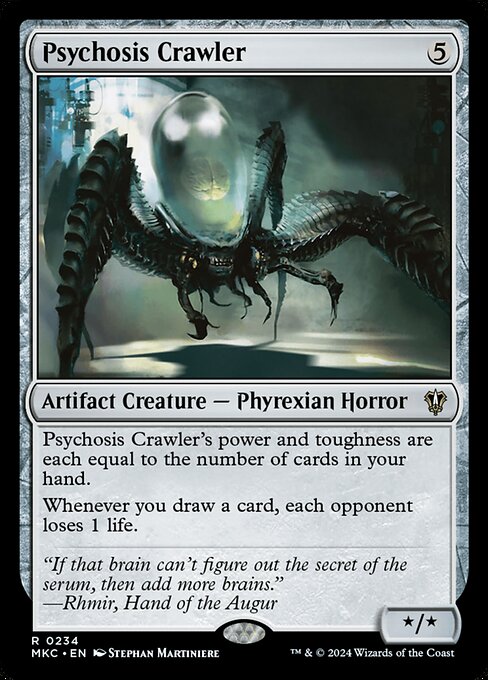
The drain kill. Stack the payoffs that trigger on each card drawn, the ones that fire on your first card as well as your second. Psychosis Crawler pings each opponent for one on every single card you draw, and Teferi's Ageless Insight replaces every draw except the first one in each of your draw steps with two cards. Read that carefully, because it is the sharpest interaction on the page. On your own turn Teferi doubles your cantrips. On an opponent's turn you have no draw step, so even your first draw becomes two cards, which means a single cheap cantrip is your first and second card at once and triggers Kang with no other draw effect. Teferi raises your draw count, which fuels Psychosis Crawler and reaches the second draw faster. The trigger count itself stays capped at one a turn, since Kang, Gixian Puppeteer, and the Cube each fire once on the second card of the turn, no matter how many cards follow it. Add Gixian Puppeteer and the whole table's life total falls in chunks you can count out several turns ahead. This is the line that closes without combat.

The Cube clock. Construct a Cosmic Cube is the second-draw deck's hard finish. Every second draw drops a plan counter, and the seven come from table turns rather than your own upkeeps: Kang attacks on your turn for one, then a Visions of Villainy, a Frantic Search, and one more held-up instant each add a counter across the three opponents' turns, so the Cube climbs a counter a turn and reaches seven in about two laps without you spending a main phase on it. You sacrifice the enchantment and control an opponent during their next turn. That means you steer their whole turn for them, and they stay the active player the entire time, so you decide their attacks, their spells, and where their permanents point. You control the player, not their permanents, so use it to make their decisions: attack a rival, tap out their mana, point their own removal at their own board, or decline to block. Handing you a permanent needs a separate control-transfer effect, the Cube alone does not do that. The menacing Villain tokens the Cube made along the way keep Kang swinging as the counters climb.

Alandra, Sky DreamerThe flyer beatdown. Alandra, Sky Dreamer shares Kang's exact trigger and makes a 2/2 flying Drake on every second card each turn. In a deck built to hit that trigger on four turns a rotation, she assembles an evasive board that closes in the air, a creature finish the two spell-based lines cannot give you. Her second ability is the burst: whenever you draw your fifth card in a turn, Alandra and every Drake get plus X plus X until end of turn, where X is your hand size. On a heavy draw turn that turns a wide board of small flyers into lethal in one attack, and she is the clearest single card the old build was missing.

Read together, the three lines answer the power question. The drain and the flyers are your main kills, the Cube is the pressure valve that steals a turn when the drain is too slow, and none of them arrives without the enablers doing their job first. Build all three thinly rather than one thickly, because removal will take one of them and you want a second still standing.

There are three ways to win. One, the drain: Psychosis Crawler and Teferi make the table's life fall on every draw. Two, the Cosmic Cube: it counts up and lets you control an enemy's whole turn. Three, Alandra, Sky Dreamer: she makes a flying Drake each time you hit the trigger, so you can win with an army in the sky. Kang himself only drains a little, so you need these finishers to actually end the game.

A sample opening

Turn 1Land, then a one-drop or a mana rock. Nothing wants to be cast into open counters this early, so develop.
Turn 2A two-mana rock or a cheap connive source, so turn three has three or four mana available. Hold up a counter if you drew one.
Turn 3Construct a Cosmic Cube (three mana) so it starts counting, or Baron Strucker. Do not race ahead of your real mana; these plays assume a normal land drop plus one rock, with no fast mana.
Turn 4Kang (four mana), or Leader, Super-Genius. From here on, keep two mana up on opponents' turns: answer a threat, or fire an instant draw for a Kang drain when the coast is clear.
Turn 5Start the off-turn loop. Each instant-speed second draw is a drain and, with the Cube out, one plan counter. Count the triggers honestly: one Frantic Search plus one more off-turn draw is two counters this rotation, so seven is several laps away instead of turn five.

Mulligan priorities. Keep a hand with two or three lands, at least one cheap enabler or rock, and ideally one instant-speed draw so the trigger stays available on other turns. Mulligan a hand that is all lands, or all payoffs with nothing to draw the second card, since payoffs do nothing until an enabler turns on. A one-lander is a mulligan even with a perfect curve above it, because the deck wants to hold up mana every turn and cannot from a stumble. A good keep does not need Kang in it; the enablers and payoffs win the game, and the commander is support.

Three mistakes to avoid. First, dumping your hand on your own turns and leaving nothing for the opponents' turns, which throws away three quarters of the rotation. Second, attacking Kang into a board that can kill or chump him just to connive, when the connive is worth less than the commander. Third, spending an instant-speed draw on your own turn out of habit when you had already drawn once, since that same card drains the table if you hold it for an opponent's turn.

A good start: turn 1 build mana, turn 2 a mana rock, turn 3 drop the Cosmic Cube (three mana) so it starts counting, turn 4 play Kang (four mana) or Leader and keep two mana up, turn 5 begin the off-turn draws. These plays follow your real mana, no fast-mana tricks, and the Cube reaches seven counters over several turns instead of right away. Three mistakes: emptying your hand on your own turn, attacking Kang into a board that kills him, and drawing on your turn when holding it for someone else's turn would drain the table.

Snail Tip

This build is exactly where three of Snail's own principles earn their keep. His dead-draw audit asks two questions of every card, what does it accomplish and what does it synergize with, and the instant-speed enablers pass loudly because they do a job on all four turns of the rotation. His EDHREC Effect read tells you why the top-cards column is a signal and not a shopping list: the feedback loop props up staples regardless of fit, so favor the cards that still contribute on a turn Kang is dead. And his Rhystic Study video is the sharpest example, since he argues that card is actively bad for the table. It is not in the stock Doom Prevails list, so treat it as a popular pickup to skip rather than a card to cut.

We worked his dead-draw audit onto this whole box in full, in his own words: read the Doom dead-draws page, or see how he reads a commander page himself in his EDHREC method breakdown.

Salubrious Snail has a trick for picking cards: ask what each card accomplishes and what it works with. Cards that draw at instant speed and drain opponents pass. He also warns that popular websites can make weak cards look good, and he thinks one famous card, Rhystic Study, is bad for the whole table. See his tips on reading card sites here.

Snail's Kang changes

Here is the audit run on the actual stock deck, since a method is only worth as much as the swaps it produces. All three appear in the published Doom Prevails ninety-nine, and the audit gives them three different verdicts rather than one reflex cut. The cards that replace what leaves are engine pieces the precon does not ship.

Superior Foes of Spider-ManCut Superior Foes of Spider-Man. It is a red card, so it is illegal the moment Kang takes the command zone, and it never touches the trigger. The easiest cut in the deck.
Molecule ManMolecule Man, situational. It gives every nonland card in hand miracle zero, so your first draw each turn can be cast free, which saves the mana that then arms a second draw. That is real support, so it is a judgment call rather than an automatic cut. The knock is the six-mana body and the empty turns after a wipe.
Damocles Base, Sword of KangDamocles Base, Sword of Kang, situational. I called this a flat cut earlier and that was wrong. Its combat-damage villainous choice lets the defender hand you two cards, which reaches the second-draw trigger on the turns they take that option. It has flying and deathtouch, and Villain tokens can crew it. The catch is the opponent's choice and the need to connect, so it is conditional rather than core.

Superior Foes stays a straightforward cut because it is red. The other two show the audit doing its real job, splitting a stock card into a verdict rather than a reflex. The replacements come straight off the same audit: Leader, Super-Genius for the extra card before each connive, Construct a Cosmic Cube for the token engine and clock, and Visions of Villainy for an instant draw-two that fires on any player's turn. All three score among Kang's highest EDHREC synergy and none appear in the stock list, which is the gap the audit is built to find.

The real rule: five jobs

Before a nonland card makes the deck, ask which of five jobs it performs. The best cards do two of them.

The five jobs are: draw the second card, cash the second-draw trigger, turn a discard into value, protect Kang and the Cube or answer a threat, and close the game. The old shorthand, count your second draw and cut anything that does not touch it, sounds decisive and misses half the deck on contact. It treats interaction and recovery as suspects, and a Kang deck that cannot answer a threat or replay what it discards pays for that false purity. The five-job test fixes it. Frantic Search draws the second card, so it belongs. Moonstone turns a discard into value, so it belongs. Counterspell answers a threat, so it belongs. A card that does none of the five is the one fighting the plan, and a card that does two, an instant that both draws a card and answers a threat, or a Villain that both connives and drains, is the one you cut last.

Before you add a card, ask which of five jobs it does: draw the second card, reward that draw, use a discard, protect your stuff or answer a threat, or win the game. A card that does none of the five should be cut. A card that does two is a keeper.

Turning the Doom precon into a Kang deck

Doctor Doom, King of Latveria
Doctor Doom, King of Latveria, the Grixis face commander

Here is the concrete part the primer owes you, and it starts with color. The Doom Prevails precon is Grixis, because its face commander, Doctor Doom, King of Latveria, is blue-black-red. Kang, Temporal Tyrant sticks to blue-black. The moment you move Kang to the command zone, every red card and every red mana pip in the deck becomes illegal by color identity, so those are your first and easiest cuts, no judgment call required. Pull the red removal, the red beaters, and anything with a red hybrid or activated cost, and you have already opened ten or more slots. Fill them with the blue-black enablers and payoffs from the lists above, weighted toward instant-speed draw so the trigger works on all four turns.

What stays is the deck's blue-black spine: the connive sources, the Villain support the stock deck already runs like Baron Strucker and Moonstone, the discard payoffs, and the draw. Madame Masque is not in the stock list, so she comes in as an addition rather than a retained card. What leaves, beyond the red, is the sorcery-speed filler and the pure single-draw value the second-draw test already flags. Pulling the red opens the slots. The section below is what to put back.

The Doom deck is three colors, blue, black, and red, because its main leader Doctor Doom uses red. Kang only uses blue and black, so when you make Kang the leader, every red card has to come out. Those are your easy first cuts. Put blue and black draw and connive cards in their place.

What the 99 cards are doing

A deck tech should describe the shape of the whole list. The commander is the easy part, and the ninety-nine behind it are the real work. The ratios matter more than the exact cards, so here is a working skeleton for that ninety-nine. It runs a low curve, most of the deck costs one to three, which is what lets you develop and still hold up an instant on someone else's turn.

SlotCountWhat it buys
Mana base37A curve of blue-black lands, a few that also filter or draw
Trigger enablers15Connive sources plus instant-speed draw, several firing on opponents' turns
Second-draw payoffs10Puppeteer, Cube, Kid Loki, M.O.D.O.K. Evil Intellect, Madame Masque (Kang is the commander, not one of the 99)
Discard and recovery4Moonstone, Archfiend of Ifnir, the connive-activator M.O.D.O.K.
Interaction10Mostly instant, counters and spot removal plus a wipe or two
Protection3Keep Kang and the Cube alive through the seven-count
Ramp and rocks6Two-drop rocks so you hold up mana every turn; the sample list runs six, with a high land count covering the rest
Draw and refill12Overlaps the enablers, keeps the grind from stalling

These are target ranges, not a fixed spec, and the counts overlap on purpose, since a card like Madame Masque is an enabler and a payoff, and Frantic Search is draw and filtering that is mana-neutral after resolution, since you first pay three mana and then untap up to three lands, so it reads as draw first and only nets mana when three useful lands untap. The published ninety-nine below realizes these targets a little differently, roughly fourteen enablers, eight payoffs, three discard-and-recovery, and ten draw pieces, because the same overlap lets one card cover two rows. The point is the curve and the balance: enough cheap enablers that a second draw is available on every turn, enough interaction to reach the late game, and a land count on the low side because the spells are cheap.

A whole deck is 99 cards plus Kang. A good recipe: about 36 lands, 15 cards that help you draw the second card, 10 that reward it, 4 that use your discards, 10 answers, 3 protection cards, 6 mana rocks, and 12 more draw cards. Most cost only one to three mana, so you can play a card and still keep mana up on other turns.

Dead Draw Audit

Snail's method asks more than a card's headline job. It asks how often the card becomes useful, meaning how many cards in the ninety-nine feed its job, and whether it still earns its slot on a turn Kang is dead. Here is that audit as a fixed table: primary job, secondary synergy, support count in the deck, solo value without the commander, and a verdict. A verdict of core means build around it, supported means it earns its slot through the enabler package, situational means keep it lean and specific, and cut means it fights the plan.

Dead Draw Audit: eight Kang cards scored on job, support, solo value, and verdict.
CardPrimary jobSecondarySupport in the 99Value without KangVerdict
Construct a Cosmic CubeSecond-draw payoff, tokens and the seven-counter clockMenace bodies for defense and pressureHigh, the ~15 second-draw enablers all feed itGood, it triggers off any second draw, not off Kangcore
Leader, Super-GeniusEnabler, turns each connive into a draw then a conniveA free combat connive every turnHigh, every connive source in the deckGood, the free connive fires with Kang gonecore
Psychosis CrawlerPayoff, drains on every card drawnA body that scales with your handVery high, the whole ~27-card draw suiteFull, it drains in any blue-black draw deckcore
Baron Strucker, HYDRA OverlordEnabler, a Villain-entry connive plus a Villain cost cutGreases the Villain subthemeMedium-high, the ~12 VillainsGood, the cost cut and connive stand alonecore
Gixian PuppeteerPayoff, adds two to the second-draw drain (three with Kang)Recurs a small creature on deathHigh, the same ~15 enablers feed itMedium, it needs a second draw, which the enablers givesupported
Teferi's Ageless InsightMultiplier, replaces non-first draws with twoFuels Psychosis Crawler and off-turn triggersHigh, the whole draw suiteGood, it doubles draws in any deck, but adds no extra Kang triggerssupported
Kid LokiPayoff, grows himself on the second drawHexproof, but only for creatures you put a +1/+1 counter on that turnLow for the protection job, few other counter sourcesLow, on his own he only shields himselfsituational
Damocles Base, Sword of KangConditional enabler, its villainous choice can hand you two cardsFlying deathtouch body, crewed by Villain tokensLow but real, only when it connects and the foe picks the drawMedium, an evasive blocker even off-plansituational

The table is where a strong card gets an honest verdict. Kid Loki looks like a payoff and a protector, but his protection has almost no support in a deck with few other counter sources, and his solo floor is low, so he stays situational rather than core. Damocles Base reads situational once you read its text closely, since its villainous choice can hand you two cards and reach the trigger, which is more than a flavor pick even if the opponent controls the timing. Run every questioned card through these five fields before it earns a slot.

Five columns are the floor, and four deeper reads decide the close calls. Support strength beats support count: the same fifteen enablers feed Kid Loki's counter strongly and his hexproof barely, which is why he does not reach core. Independent routes raise a floor: Psychosis Crawler earns value through two unrelated systems, a drain on every card drawn and a body that scales with your hand, and Kid Loki has only one route, so a weak draw still leaves the Crawler doing work where Loki does none. A game-state read keeps the verdicts honest across a real game: the Crawler and the drain payoffs still tax the table when you are behind or at parity, the Cube is a pressure and finishing card, and the roughly ten interaction slots are the flexibility floor, the tools you do not cut for a sixteenth enabler no matter how much the second-draw count improves. Recount every one of these after your final swaps, since adding a payoff can lift an enabler and cutting draw can sink a retained card.

One declared exception is allowed for any genuine pet card. You may keep a card the audit would otherwise cut as an intentional flavor exception, as long as the deck says so out loud: state its weak states, its consistency cost, and the personal reason it stays, rather than dressing a thin-support card up as an engine piece.

This table grades each card five ways: what it does, what else it helps, how many other cards support it, whether it is good when Kang is gone, and a final verdict. Green core cards are the best, then supported, then situational, and red cut cards should come out. A famous card can still be a cut if nothing in the deck helps it work.

Beyond the Dead Draw Audit: the construction audit

The Dead Draw Audit above scores individual Kang cards against their support. This construction audit steps up one level and scores the whole ninety-nine. It asks whether the complete list holds the correct balance of enablers, payoffs, interaction, discard value, and finishing pressure. Kang needs enough second-draw effects to activate several rewards without burying the deck in redundant setup. Every revision should improve that balance rather than pad one package and leave the others fixed.

The Dead Draw Audit and this construction audit answer different questions. The first asks whether a single card earns its slot. The second asks whether the ninety-nine as a system reaches its plan on a normal draw. A card can pass the first and still fail the second, when the deck carries five cards doing its job and needs an answer instead. This section builds on Snail's dead-draw, fulcrum-card, support-strength, and independent-route methods and extends them to the level of the full list.

The first audit grades one card at a time. This second audit grades the whole 99-card deck. It checks that the deck has the right mix: enough cards that draw a second card, enough that reward it, enough answers, and enough ways to win. Adding one more of something you have plenty of is not an upgrade.

Published build accounting

The published ninety-nine below assigns every card to exactly one primary category, and the category totals add to ninety-nine with nothing hidden. Those mutually exclusive counts are the numerical authority for every claim on this page.

Primary categoryCountWhat it holds
Connive and draw enablers14Second-draw sources, several firing at instant speed on opponents' turns
Second-draw payoffs6Cosmic Cube, Gixian Puppeteer, Kid Loki, Alandra, M.O.D.O.K. Evil Intellect, Psychosis Crawler
Discard and recovery4Moonstone, Archfiend of Ifnir, Bone Miser, Containment Construct
Draw engines11Teferi's Ageless Insight, Skullclamp, Arena, Remora, and the rest of the draw suite
Interaction14Counters, spot removal, and a wipe or two, mostly at instant speed
Protection3Keep Kang and the Cube alive through the seven-count
Card-advantage creatures4Baleful Strix, Sea Gate Oracle, and other value bodies
Mana rocks6Two-drop rocks so you hold up mana every turn
Lands37A low blue-black base, a few that filter or draw
Total99The complete list, machine-checked for legality and singleton

A functional reading raises two of those numbers, and the difference is worth stating plainly so the two systems do not look like a contradiction. Counting secondary jobs, payoff coverage rises to eight, because Madame Masque sits primarily among the fourteen enablers and her second-draw token ability also pays off, and Teferi's Ageless Insight sits primarily among the eleven draw engines and its draw multiplication supports the payoff plan. Add those two cross-category cards to the six dedicated payoffs and you reach eight payoff-capable cards. The same move lowers the functional draw-engine count to ten, since Teferi now counts on the payoff side, and a narrower discard read counts three dedicated discard payoffs by assigning Containment Construct to recovery rather than discard value. All decklist totals use the mutually exclusive primary categories. The functional counts describe jobs; the decklist keeps the primary slot totals.

The deck is 14 enablers, 6 payoffs, 4 discard-and-recovery, 11 draw engines, 14 answers, 3 protection, 4 value creatures, 6 rocks, and 37 lands. That adds to 99. Two cards do double duty: Madame Masque and Teferi's Ageless Insight also work as payoffs, so if you count jobs instead of slots you can say eight payoffs. Both ways of counting describe the same deck.

Enabler and payoff balance

Fourteen dedicated enablers give about a 79.9 percent chance of seeing at least one among the first ten library cards, and about a 42.9 percent chance of seeing at least two. Eight payoff-capable cards give about a 58.7 percent chance of at least one in that same sample. A first-ten sample holding both an enabler and a payoff-capable card lands about 45.7 percent of the time, before Kang in the command zone adds his own reward.

At least one of 14 enablers in the first 1079.9%
At least two of 14 enablers in the first 1042.9%
At least one of 8 payoff-capable cards in the first 1058.7%
Both an enabler and a payoff in the first 1045.7%

Those figures back the enabler-heavy build. Kang himself supplies one payoff from the command zone, so the ninety-nine needs reliable activation more than another copy of his reward. An extra enabler still filters the hand, adds card advantage, or feeds the commander's trigger. An unsupported payoff does nothing until a card draws that second one. The ratio should stay close to fourteen enablers and eight payoff-capable cards, six of them dedicated. A seventh dedicated payoff should replace another payoff unless it also draws, protects the engine, or closes the game on its own. A fifteenth enabler should replace a weaker enabler unless it does a second job. That rule keeps the machine fed without letting setup crowd out answers and finishes.

There is a good chance you see an enabler in your first ten cards, and a decent chance you also see a payoff. Kang is himself a payoff, so the deck wants more cards that draw the second card than cards that only reward it. Keep about fourteen enablers and six to eight payoffs, and do not add setup by cutting your answers.

Enabler quality classes

The fourteen enablers split into three build labels. Opponent-turn enablers make the second draw outside your own turn. Repeatable enablers fire across several rotations without another card from hand. One-shot enablers hand you cards once and then leave. Frantic Search, Visions of Villainy, Chemister's Insight, Thirst for Discovery, Fact or Fiction, Forbidden Alchemy, and Thirst for Knowledge run at instant speed. Ledger Shredder and Merfolk Looter give repeatable access through a permanent. Chart a Course and Careful Study filter once on your own turn. Leader, Baron Strucker, and Madame Masque tie enabler duty to other packages.

The strongest enablers cover two classes at once. Ledger Shredder works repeatedly and reaches opposing turns. Visions of Villainy runs at instant speed and draws two off one spell. Baron Strucker cuts Villain costs and supplies a repeatable connive through creature entries. A future enabler should raise the weakest class rather than the raw total. The deck gains more from repeatable opponent-turn access than from another sorcery-speed cantrip. Cheap one-shot filtering stays welcome, and an expensive one-shot draw needs a second real job before it takes an established slot.

The 14 enablers come in three kinds: ones that work on other players' turns, ones you can use again and again, and ones that help you once. The best enablers do two of those jobs. When you add a new enabler, fix the weakest kind instead of adding another of the kind you already have.

The wider draw suite

The draw structure reaches past the fourteen dedicated enablers. Eleven draw engines carry Teferi's Ageless Insight, Skullclamp, Black Market Connections, Night's Whisper, Syphon Mind, Sign in Blood, Read the Bones, Phyrexian Arena, Mystic Remora, Windfall, and Brainstorm. These support raw volume, hand repair, selection, and second-draw activation by different routes, so they should not read as one undifferentiated draw count. Night's Whisper, Sign in Blood, and Read the Bones give immediate volume. Brainstorm gives cheap selection at instant speed. Phyrexian Arena and Black Market Connections give continuing cards each turn. Mystic Remora feeds on opposing spells and can draw several times in one rotation. Teferi's Ageless Insight doubles later draws, which raises volume and doubles as payoff support since a doubled draw reaches the second-card trigger faster.

Besides the 14 enablers, the deck runs 11 more draw cards. Some give a burst of cards, some give one a turn, some help you pick. Teferi's Ageless Insight doubles your draws, which also helps you hit that second card. They all do slightly different jobs, so count them as a suite rather than one lump.

The full ninety-nine, one legal build

A complete, legal Kang list, commander plus ninety-nine, every card verified blue-black or colorless on Scryfall by the card-fact gate (99 cards, machine-checked for legality and singleton). Treat it as one tuned build among many workable ones.

Show the 99-card decklist

Dedicated Kang, or Kang in the Doom box

EDHREC records about eighty-one Kang decks, read 2026-07-14, so this is the niche pick of a box that only released in June 2026. A number that small this early cannot prove the community thinks Kang belongs outside Doom, and it is worth being straight about that. Wizards put Kang in the official Doom Prevails list on purpose, and Doom's own discard-and-connive package feeds Kang's trigger, so he has a real home there. The honest read comes down to ratios between the two builds. Lean the list toward instant-speed draw and blue interaction and you get the dedicated second-draw control deck described above, draining the table on every turn of the rotation. Keep Doom at the helm and Kang is still one of the better draw payoffs in the ninety-nine.

So pick by the game you want. If you like holding up counters and grinding a slow engine that taxes the table a little every turn, build Kang dedicated and load the instant-speed draw. If you want to attack and discard fast, that is more Doom's lane, and Kang still contributes from inside it.

Only about 81 people have built Kang so far, and the set is brand new, so it is too soon to say he must leave Doom's deck. Wizards put him in the Doom deck on purpose and he works there too. If you want a slow control deck that drains everyone every turn, build Kang on his own with lots of instant-speed draw. If you want to attack fast, keep Doom in charge and let Kang help.

Sources. Card text and color identity via Scryfall (Marvel Super Heroes Commander), oracle text pulled 2026-07-14: Kang, Temporal Tyrant (color identity blue-black, trigger reads "your second card each turn"), Leader Super-Genius, Construct a Cosmic Cube (control an opponent during their next turn rather than taking an extra turn), Gixian Puppeteer, Kid Loki (hexproof only for creatures you put a +1/+1 counter on that turn), Baron Strucker HYDRA Overlord, M.O.D.O.K. Evil Intellect, the connive-activator M.O.D.O.K., Madame Masque, Visions of Villainy (instant), Frantic Search (instant), Ledger Shredder, Psychosis Crawler, Teferi's Ageless Insight (doubles draws except the first in each draw step, so it raises draw count without adding second-draw triggers), Moonstone Harsh Mistress, Archfiend of Ifnir, Superior Foes of Spider-Man (red), Molecule Man (colorless miracle), Damocles Base Sword of Kang (black Vehicle, its villainous choice can let the defender give you two cards), Alandra Sky Dreamer (blue, makes a Drake on your second card each turn), Black Market Connections (black, repeatable draw). Color-identity note: the Doom Prevails precon is Grixis via Doctor Doom, King of Latveria (blue-black-red), and Kang is blue-black, so red cards fall out of a Kang build. Doom Prevails stock-deck membership (Superior Foes, Molecule Man, Damocles Base, and Kang present; Leader, Cosmic Cube, Visions of Villainy absent) per the official Wizards Marvel Super Heroes Commander decklists. Multiplayer turn-cycle behavior of "each turn" draw triggers per Wizards' Marvel Super Heroes mechanics feature. Inclusion figures and the current-meta card list from the EDHREC Kang commander page (81-decks, rank #3,327, read 2026-07-14). The two-question audit is from Salubrious Snail's dead-draw video (YouTube zAtfawtYEw4), applied here to the box-alt build choice. Related: my EDHREC Marvel read, the Doom dead-draws audit, the Loki deck tech, and the Doom deck tech. Inspired by Salubrious Snail's published deckbuilding framework; neither Salubrious Snail nor EDHREC authored or endorsed it.