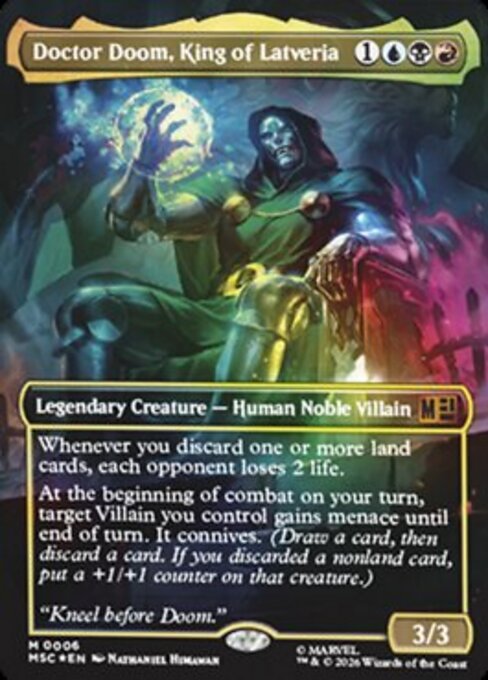
1. Situational Cards Belong Behind Doom’s Engine
2026 principle applied: Why Situational Cards Belong in Your Commander Deck
A deck has a pre-engine phase and a post-engine phase. Once your draw engine is online, a handful of situational cards stops hurting you. Bucket the nonland cards into premium enablers, situational cards, and general utility, and keep the situational count near five.
Doom Prevails is the one precon in the set with a real draw engine printed in the command zone. Doctor Doom connives when he attacks and drains the table on your land discards, so by the mid game you are seeing extra cards every turn. That is exactly the post-engine phase the video describes.
Sort the 99 into the three buckets. The premium enablers are Doom himself, Loki, and the discard outlets that feed the drain. The utility is your removal and ramp. That leaves room for about five situational cards, the pieces that only shine in the right spot.
The Marvel rankings already point at one of them. Cut Damocles Base, add Sundial of the Infinite, from the Draftsim Doom guide. Sundial is a textbook situational card, dead in a lot of hands and game-winning when it locks in a Loki copy. With Doom digging you toward it and past it, carrying four or five cards like that costs you almost nothing.
Fit: strong. Doom is the rare Marvel precon whose printed engine earns the situational slots the video is defending.
2. Loki as the Hidden Commander of Doom Prevails
2026 principle applied: Two Rules for Hidden Commander Success
A hidden commander is a build-around that lives in the 99 rather than the command zone. Two rules make it work. First, run analogs so the deck still functions when the hidden commander is gone. Second, minimize its footprint by using support pieces that are useful on their own.
The Marvel rankings literally spells out the plan: the Doom deck is built around Loki, the Deceiver, a card in the 99. That is a hidden commander by definition, so the video maps straight onto it. Loki copies your best non-legendary Villain into a swarm and swings.
Rule one, analogs. Loki will get removed or stranded in the library, so you want other copy and go-wide effects that do a similar job. The rankings adds Super-Adaptoid and Living Lies of Loki, both of which reproduce the copy-a-body line. Those are your redundancy, the second and third Loki.
Rule two, minimize footprint. You do not want ten cards that are dead without Loki. The Villains you most want him to copy, like Green Goblin, Revenant, are strong bodies on their own, so they earn their slot whether or not Loki ever hits the table. That is the low-footprint support the video asks for.
Fit: strong. This is the cleanest hidden-commander case in the set, and both rules point at real adds already on the rankings page.
3. The Marvel Set Is Exactly the One-Off He Warns About
2026 principle applied: Why Magic’s One-Set Blocks Feel Rushed
The current one-off set model feels rushed. A plane never gets to linger, so storylines feel disconnected and a mechanical theme cannot be iterated across several sets. Every idea has to arrive in one release.
This is meta commentary rather than a deckbuilding rule, so the honest application is to the release itself rather than to a swap list. The Marvel Super Heroes Commander set is precisely a one-off drop. Four precons, four themes, one release, no follow-up planned.
You can feel the compression the video describes. Doom villains, Fantastic Four spell-matters, Avengers counters, and Wakanda artifacts each get a single precon of depth and no room to iterate. A theme like the Villain-copy engine gets one pass at fifty new cards, then the release closes and says nothing more.
That is the cost he describes, applied to a product on the shelf. The strong ideas here would reward a second set that deepened them. In a one-off, the design has to say everything at once, which is why some of these precons feel like a sketch of a plane instead of a lived-in one.
Fit: this is a set critique rather than a deck change, and it holds up. The Marvel drop is the one-off model in a box.
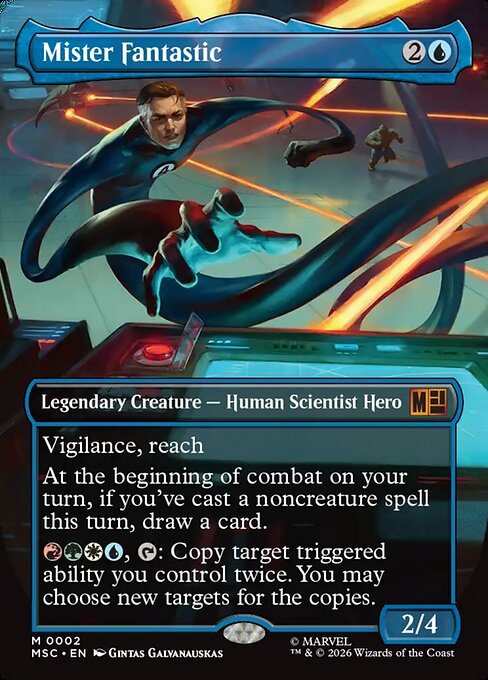
4. The Fantastic Four Has the Set’s Reliance-and-Mana-Base Problem
2026 principle applied: Planeswalker Reliance and Mana Base Issues (deck-tech lens)
His Lorehold review flags two faults: the deck leans too hard on a fragile commander, and the mana base is too thin, running 37 land cards and no early filtering, so it misses land drops in a lot of games.
Run the same two-part audit on the Fantastic Four. It is the only four-color deck in the set, with the highest ceiling and the most awkward sequencing. The reliance fault is softer here, since the faces are creatures rather than a planeswalker opponents can gang up on, so score that part as a partial match.
The mana base fault is a direct hit. Four colors on a greedy curve is the exact profile that punishes a thin, unfixed base, and the printed deck feels it first as color screw. The video says fix the base before anything else.
The rankings swaps go right at it. Cut Willie Lumpkin for Talisman of Creativity, and Mirage Mirror for Talisman of Conviction, from the Draftsim guide. Two fixing rocks on curve are the deck telling you where its consistency problem really lives, the same read his Lorehold review reaches.
Fit: strong on the mana base, partial on reliance. A four-color deck is the honest place in this set to apply his deck-tech checklist.
5. A Fulcrum Card for the Fantastic Four’s Two Halves
2026 principle applied: Using Fulcrum Cards to Expand Deck Synergies
A fulcrum card ties two subthemes together by rewarding one with the payoff of the other. Judge each one by its floor and its ceiling, and respect the deck space it demands, so you do not add a card that goes dead when the bridge is not there.
The Fantastic Four wants two things at once: it casts a noncreature spell each turn for the face triggers, and it still needs a creature board to win. Those are two subthemes that can pull apart. A fulcrum card is what fuses them.
Read a candidate by floor and ceiling the way the video teaches. Cut Into the Time Vortex, add West Coast Expansion, from the Draftsim guide. Its floor is plain ramp, useful in any hand, so it is never a dead draw. Its ceiling is ramp that scales with your Heroes, which pays the go-wide half from inside the spell-matters half.
That is the point of fusion the video is after. A weak fulcrum with a low floor, like a build-around that needs three other pieces, would eat space and strand you. West Coast Expansion earns the slot because it does a job even when the bridge never forms.
Fit: good. The floor-and-ceiling test picks the same add the guide does, and explains why it is safe to run.
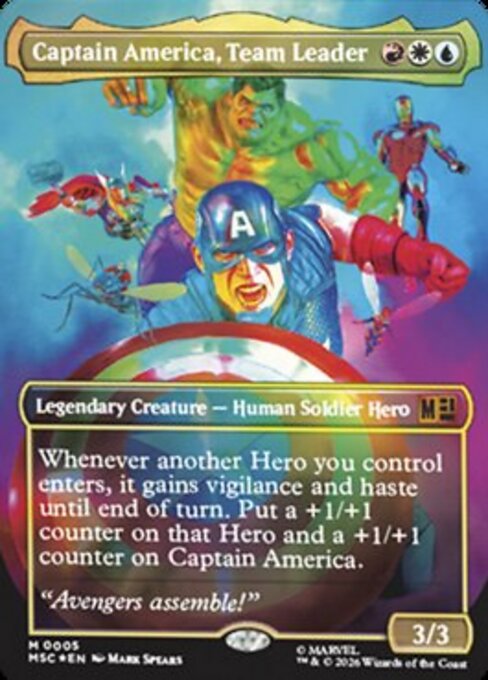
6. Keep Avengers Focused on Pressure, Not Value
2026 principle applied: Three Years Failing to Build an Aggro Commander Deck
A three-year failed aggro build teaches one lesson. A clear vision keeps you from diluting the deck. Every card added should serve the core play pattern, pressuring life totals, and tacked-on mechanics like initiative or value engines quietly wreck the plan.
Avengers is the set’s go-wide counters deck, the deck that actually wants to attack. Captain America hands haste and a +1/+1 counter to every Hero that enters, so the plan is simple: flood the board and swing before anyone stabilizes. That is a life-pressure deck.
The failure mode the video describes is the temptation to bolt on unrelated engines that feel powerful and dilute the aggression. In this deck that looks like slow value permanents and fiddly protection loops that do not push damage.
Applied as a cut, drop Gift of Immortality for Wave Goodbye, from the Gathering Games guide. Aging protection is a value loop that does not advance the clock. A tempo bounce keeps the pressure on. The discipline is refusing cards that are good in the abstract but off the one job the deck is built to do.
Fit: strong in spirit. Avengers is the closest thing to an aggro shell in the set, and the video is a warning against exactly the value creep that softens it.
7. The Sol Ring Already Sitting in Your Marvel Precon
2026 principle applied: Why Sol Ring Might Not Need a Ban
Sol Ring’s early burst is real, but its power falls off hard as the game goes long, and multiplayer politics let the table answer the player who spikes it. A ban needs both high power and a bothersome pattern, and Sol Ring’s pattern is not bothersome enough.
This one applies with no translation, because the card is right there. The Marvel precons ship with Sol Ring, so the video is a direct read on a card you already own in these decks.
His two-part test says keep it. In the greedy Fantastic Four, a turn-one Sol Ring smooths a brutal four-color curve, which is its best case. By turn eight it is a colorless rock you would rather have drawn as a spell, the diminishing return he describes.
The play-pattern half also holds at a Marvel kitchen table. A player who Sol Rings into a fast start becomes the table’s target, and the multiplayer politics balance the burst. So the honest verdict is his: keep the Sol Ring in the box, run it with your eyes open, and do not treat it as the deck’s ceiling.
Fit: direct. The video evaluates a specific card, and that card is printed in these precons, so there is nothing to approximate.
8. Does Doom Prevails Have a Ban-Worthy Card by His Own Test?
2026 principle applied: Why Rhystic Study Should Be Banned
His ban case has a clean two-part bar. A card must be both powerful and frustrating to play against. Rhystic Study clears both, because it generates advantage even when opponents pay and it punishes attempts to remove it.
Turn his own bar on the strongest thing this precon does, Loki copying your best Villain into a swarm and attacking. The rankings calls it the single strongest play in the set, so it clears the power half without argument.
The frustration half is where it separates from Rhystic Study. Loki is a sorcery-speed, one-big-turn play, and he stays on the board as a legendary creature. Opponents can remove him in response, hold a wrath, or block the swarm. The advantage is not passive and it is not tax-based, so it fails the bothersome-pattern half of his test.
That is the useful result. Running his exact criteria, Doom Prevails has a powerful centerpiece and no ban-worthy one, because power alone was never the standard. The lesson is the framework rather than a swap. Judge a card by its pattern as well as by its rate.
Fit: this is analysis rather than a build change. Applying his two-part test to the deck’s best line is the honest use of a ban-criteria video.
9. Reviewing Avengers the Way He Reviewed a Counters Precon
2026 principle applied: Blight Curse Counter Precon Review (deck-tech lens)
His Blight Curse review praised a commander that gives built-in card advantage off counter triggers, valued proliferate and mass counter placement as asymmetric advantage, and judged the mana base as serviceable without demanding immediate upgrades.
Avengers is the set’s +1/+1 counters deck, so his counter-precon checklist ports over cleanly. Where Blight Curse used minus-one counters for removal and draw, Avengers uses plus-one counters for a go-wide beatdown, the mirror strategy on the same axis.
The commander-engine question is the first check. Captain America counters every Hero but does not draw off it, so the deck lacks the built-in card advantage he praised in Anti-U. That is the honest gap, and it says the useful upgrades here should add reach and card flow rather than more bodies.
The synergy check is the bright spot. Proliferate and mass counter effects are the same asymmetric-advantage tools he valued. Cut Love on the Battlefield for Champions from Beyond, from the Gathering Games guide, adding Hero tokens that arrive already feeding the counter trigger. The mana base, like Blight Curse, is serviceable and not the priority.
Fit: strong. Same counters axis, same review checklist, and it surfaces a real weakness the printed deck has in card advantage.
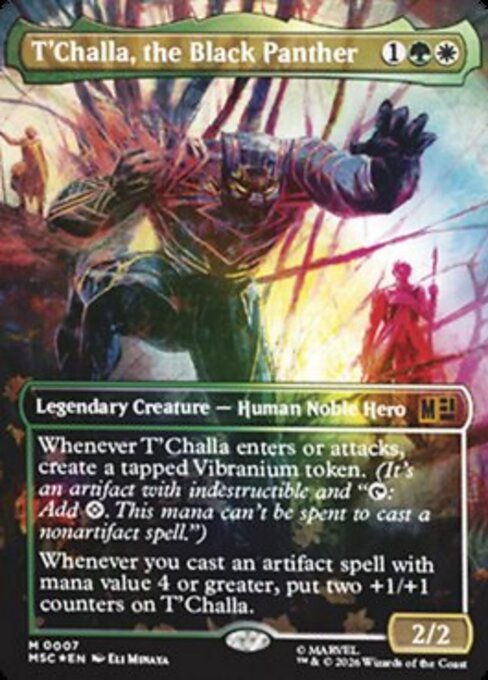
10. Fixing the Three Common Mistakes in Wakanda Forever
2026 principle applied: Common Commander Deckbuilding Mistakes and Solutions
Three faults sink most decks. Unfocused goals, fragility to hate, and no proactive win. The fixes are focus through specific payoffs and restraint, durability through haste, flash, and ramp, and a clear win condition the deck actually pursues.
Wakanda is the weakest precon out of the box and leans on filler, so it is the right patient for a mistakes-and-fixes video. Run the three checks in order.
Focus. The deck half-commits to Vibranium artifact tokens and half to +1/+1 counters. The fix is restraint, cutting cards that serve neither. Cut Coveted Jewel for Batterskull, from the Draftsim guide, dropping a card that fights your own plan and hands opponents value.
Durability and a win condition. T’Challa is the whole engine and dies to a removal spell, which is the fragility fault. Add haste and protection so the plan survives a wrath, and commit to one clear proactive line, the artifact-and-counters beatdown, rather than drifting into value. That is all three fixes on the deck that needs them most.
Fit: strong. The video is a triage list, and Wakanda is the precon in the set most in need of triage.
11. Counting Ramp in the Four-Color Fantastic Four
2026 principle applied: A Framework for Evaluating Ramp in Your EDH Deck
Ramp does two separate jobs: smoothing your curve in the first five turns and increasing total mana. Different decks need different amounts. Match ramp costs to your spell costs, prefer permanent ramp, and use a benchmark near eighteen sources for consistency.
The Fantastic Four is the deck in the set that most needs this framework, because its ramp has to do both jobs at once. It curves out through awkward four-color sequencing, and it wants extra total mana to deploy its expensive spell-matters payoffs.
Match costs to costs, as the video says. This deck wants two-mana rocks that fix and accelerate into the four and five drops, which is why the rankings fixes are Talismans rather than a five-mana rock that arrives too late to smooth anything.
Prefer permanent ramp and count toward the benchmark. Cut Into the Time Vortex for West Coast Expansion, from the Draftsim guide, trading a one-shot for lasting land ramp. Then tally your rocks, dorks, and land ramp against his roughly eighteen-source mark, and top up until a greedy four-color hand functions on time.
Fit: strong. A four-color, high-ceiling deck is the exact profile where his split of ramp into two jobs earns its keep.