A manabase is one of the most deceptively complicated things you build, mostly because it stays invisible. Nobody describes the Fantastic Four precon by its thirty-seven lands and its tapped-land rate. They describe it by Mister Fantastic copying his own triggers. The lands hold all of that up as the foundation, and a shaky foundation gives you a shaky deck. This precon feels the weight more than any of its three siblings, because it is the one deck in the set that asks for four colors of mana.
A manabase is the pile of lands that make your mana. It is boring, so nobody thinks about it, but every fun thing your deck does is built on top of it. The Fantastic Four deck needs four colors of mana at once, so its lands are the hardest part to get right. This page fixes them.

Start hereTwo jobs, one set of lands
It helps to think of a land base as covering two different goals at once. The first goal is covering your symbols. Lands exist to make the colors of mana you need to cast your spells. The second goal is covering total mana values, which mostly means hitting your land drops turn after turn so the deck keeps climbing its curve. Utility lands live in the gap between those two goals. If a deck wants thirty-seven lands to reliably hit its drops but only needs thirty-three to make an acceptable spread of colors, that leaves a few slots for colorless-producing utility lands.
Your lands have two jobs. Job one: make the right colors. Job two: give you a new land to play every turn so your deck keeps growing. When a deck needs more lands for job two than for job one, the extra lands can be fancy special lands. Simple.
For the Fantastic Four, that second goal is the easy one. It runs the standard high land count a four-color midrange deck wants, and hitting drops is rarely the thing that loses the game. The first goal is where the whole deck lives or dies, because four colors is a lot of colors, and this deck wants them early and often.
Symbols and timingWhich colors, and when
Covering symbols depends on three things at once: how many of each color you run, how intense each requirement is, and how early the deck needs it. A single colored pip you can pay late in the game asks very little of your mana. Two of one color demanded on turn three asks a great deal. Timing matters just as much as raw count, the same way a reactive spell you hold for later strains a manabase less than a threat you want to slam on curve.
Mister Fantastic's copy ability costs {R}{G}{W}{U}. One of every color, on the same turn, for the strongest button in the deck.
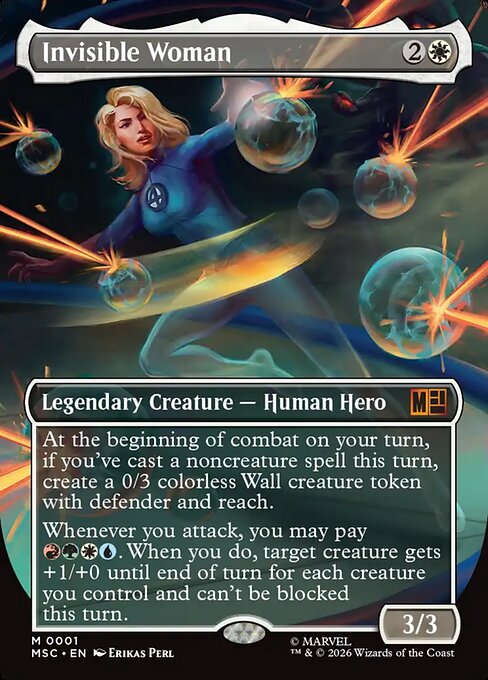
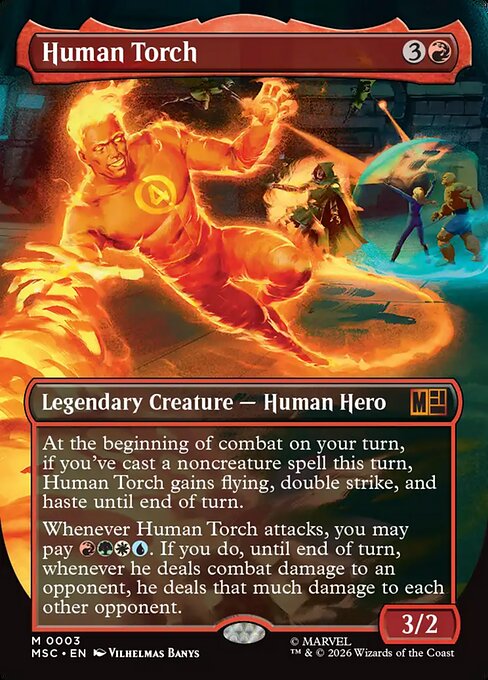
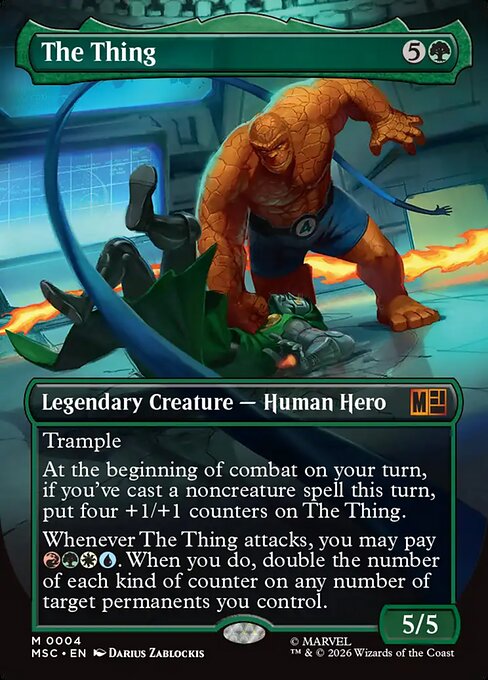
Read the four faces in that light and the demand curve is clear. Mister Fantastic at {2}{U} and Invisible Woman at {2}{W} are your early asks, so blue and white need to show up first. Human Torch at {3}{R} comes a turn later. The Thing at {5}{G} is your latest ask, so a stray green source turning up on turn five is fine, the way a six-drop commander can wait. The sharpest requirement belongs to Mister Fantastic's activated ability, {R}{G}{W}{U}, which wants one of every color at once. Build the mana so that button is castable, and the rest of the deck follows.
Not all colors are needed at the same time. Blue and white come up first, red next, green last. And Mister Fantastic's big power needs all four colors on one turn, so that is the hardest thing to pay for. If you can pay for that, you can pay for everything else.
The diagnosisIs the trouble fixing, or too few lands?
I built a free manabase tool with my brother Ian that scores a deck two ways: cast rate, meaning how often a card is castable on or before its mana value, and average delay, meaning how many turns you spend waiting on the right lands. The clever part is the test it runs on top of that. It tries adding one basic of each color, and it tries adding a single colorless "waste." If the waste alone drops your delay a lot, the deck is short on lands. If a colored basic helps far more than the waste, the deck is short on that color, and land count is fine.
Count the sources first. Across the thirty-seven lands plus Arcane Signet and Chromatic Lantern, and counting basic-fetchers and any-color pieces toward each color, this precon runs sixteen white sources, sixteen blue, fourteen red, and seventeen green. No single color is starved, so the failure is neither land count nor a missing color. The tax on a four-color deck is hitting two or three colors at once on the early turns, and cheap untapped fixing is what smooths that. That is exactly what the two Talismans add, two two-mana rocks that each cover two colors and never enter tapped. For the precise cast-rate and average-delay figures, run the list through my manabase tool; the counts here are what the swaps move.
I made a free tool that grades your lands. For this deck the color counts are close: about sixteen sources each of white and blue, fourteen red, and seventeen green. No color is missing, so the deck does not need more lands. What it needs is cheap fixing that makes two colors at once and comes in ready to use, which is what the two Talismans do.
Swap 1A cute legend for a fixing rock
 →
→

Swap 2Two Talismans is the deck confessing
 →
→

Swap 3The third swap upgrades your draw
 →
→

The budget trapTapped lands cost you the turns you care about
Every budget four-color deck relies on dual lands that enter tapped, and the tool is blunt about the cost. A land that comes in tapped is a turn you did not get to act. That matters more here than in most decks, because the Fantastic Four wants a noncreature spell down every single turn to keep all four faces awake. A hand full of tapped duals on turns two and three is a hand that missed two of its most important windows. The number to watch is how often each land actually enters untapped. Conditional lands vary wildly, from a battle land that needs two basics to a slow land that needs two other lands already down, so check that the cheap duals you add are really coming in untapped often enough to earn the slot.
Cheap lands often come into play tapped, which means you skip a turn of doing things. This deck wants to cast a spell every turn, so a tapped land really hurts it. Before you add a cheap land, check how often it comes in ready to use. If it is usually tapped, it is costing you your best turns.
Your callHow safe do you want to feel
I am careful not to hand you a single correct land count, because the right number depends on how much risk you enjoy. A lower land count means more action and more games where the mana lets you down. A higher count means fewer explosive draws and far fewer games lost to a missing color. The Fantastic Four belongs on the safe end of that choice for most tables. Its ceiling comes from Mister Fantastic once the four colors are online, and you only get there by making sure they arrive on time. Both goals of the land base, symbols and land drops, point the same direction for this deck: pay the fixing tax in full, and the ceiling takes care of itself.
There is no one right number of lands. Fewer lands means a faster deck that fails more often. More lands means a steadier deck. This deck wants to be steady, because its best plays only work when all four colors show up. So run enough lands and enough color, and the exciting stuff happens on its own.
The four-color mana is the tax you pay for the highest ceiling of the four by the published rankings. Pay it in color, and the deck stops stumbling on the turns it wants to break open.