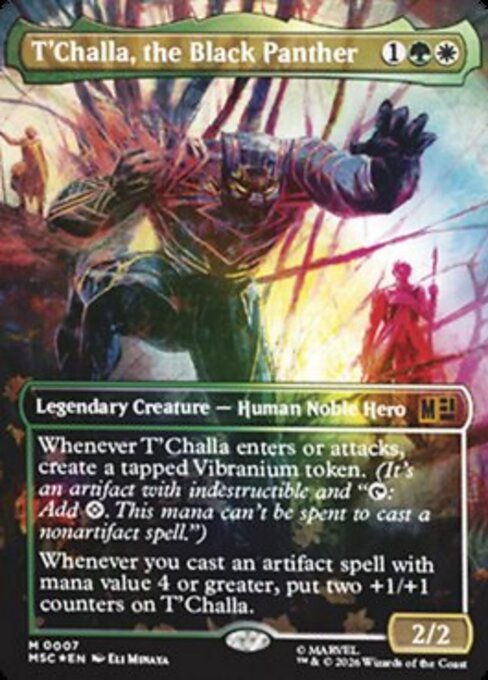
T'Challa, the Black Panther supports a few overlapping builds, and EDHREC files him under artifacts, +1/+1 counters, Equipment, and Voltron at once. Across the tag sample the artifact and counters builds are the crowd's real home, with Voltron a smaller branch inside them. This tech commits to that Voltron branch and tunes every slot for it. Whenever T'Challa enters or attacks he makes a tapped Vibranium token, an indestructible artifact whose mana pays for anything except casting a nonartifact spell. Whenever you cast an artifact spell with mana value four or greater, he gains two +1/+1 counters. He ramps himself, he counts as your growing threat, and he pays you for the exact artifacts you were going to cast anyway. The plan is to suit one Panther up until he wins, and the work is protecting that plan from the strong cards that pull against it.
T'Challa is a hero you load up with gear until he wins. He makes little metal tokens, and every big artifact you play makes him bigger with two +1/+1 counters. The deck plays artifacts, puts the good ones on him, and keeps him safe.
Fast answers
| Game plan | Make Vibranium, cast four-plus-mana artifacts to stack counters, suit one Panther up, and win with commander damage. |
| Ideal keep | Two or three lands, a mana rock or dork, at least one four-mana artifact, and a cheap protection spell if the hand offers one. |
| First real attack | Turn four or five, once he holds a piece of Equipment and you have a protection spell in hand to answer the removal. |
| Damage target | The opponent with the weakest blockers, the least instant-speed interaction, and the poorest recovery. Commander damage needs twenty-one from the Panther no matter their life, so a low life total only matters as a second, ordinary-damage route. |
| Power level | Casual. An upgraded-precon deck around bracket two to three, well short of cEDH. |
Quick version: make metal tokens, play big artifacts to grow T'Challa, put your best gear on him, and hit one player for 21. Keep a hand with a couple lands, some mana, a big artifact, and a way to protect him. Start swinging around turn four or five at the player who can block the least.
The token that fuels itself

Most voltron commanders start from zero every time they hit the board. T'Challa keeps his support, because his first trigger builds it for him. Each time he enters or attacks he makes a tapped Vibranium, an indestructible artifact whose mana can pay for anything except casting a nonartifact spell. That covers more than the words "artifact mana" suggest: it casts your artifacts, and it also pays equip costs, ability activations, and ward taxes, which is what a suited-up deck spends mana on. The tokens do three jobs at once. They ramp toward your next big artifact, they raise your artifact count for the payoffs, and being indestructible they survive the destroy-based board wipes that clear everyone else. A destroy-based wrath leaves them standing. Exile and sacrifice effects still remove them, so treat the tokens as durable rather than immune. A turn where T'Challa attacks makes next turn's Hammer or Gauntlet a mana cheaper, so the deck snowballs off the commander's own combat step.
Every time T'Challa shows up or attacks, he makes a metal token. The tokens give you extra mana for your artifacts and your gear, and normal "destroy everything" cards can't kill them. So attacking with him helps you play more gear next turn.
Grow him by doing what you wanted to do
The second trigger is where the deck earns its counters. Casting any artifact with mana value four or greater puts two +1/+1 counters on T'Challa, and a Wakanda deck is stocked with those artifacts. This is why the signature card is worth reading. Vibranium Strike Gauntlets, in about eighty-three percent of decks, is a four-mana Equipment with flash that attaches itself on entry, gives the Panther +3/+0 with trample, and draws a card whenever he connects. It triggers the counters because it costs four, it makes him hit harder, and it refills your hand off the damage. One card feeds all three parts of the plan.
When you cast a big artifact, T'Challa gets two +1/+1 counters. Wakanda decks are full of big artifacts, so he grows fast. The Vibranium Strike Gauntlets are the best one: they trigger the counters, make him stronger, and draw you cards when he hits.
Shuri wants the same artifacts

The deck's second face rewards the same artifact count the Vibranium tokens keep raising. Shuri, the Black Panther is a two-mana lifelinker who, on attack, draws you a card if you control three or more artifacts, and pumps your whole team plus two if you control six or more. In a build already making indestructible tokens and casting big Equipment, three artifacts arrives by turn three and six follows fast. The tokens that ramp T'Challa also turn Shuri into card draw and an anthem, and the two Panthers pull toward one identical shopping list. That overlap is the deck's consistency, since almost every good card does more than one thing.
Shuri is the other hero. When she attacks and you have enough artifacts, she draws you a card and makes your team bigger. The metal tokens count, so she and T'Challa both want the same artifacts.
How he actually closes
One number rules the plan: twenty-one. Commander damage ends a player at twenty-one from the same commander across the game, and T'Challa gets there quickly. He starts at 2 power, every four-drop artifact stacks two more counters, and the Gauntlets add three power on top. Three qualifying artifacts put him around eleven power with trample, which closes one opponent in two swings, and faster once Shuri's anthem is up. Trample matters here, since a chump blocker only eats the power it can absorb and the rest still counts toward the twenty-one.
One clarification the primers skip. Helm of the Host makes a copy that is explicitly not legendary, so a Helm token of T'Challa is not your commander. Its combat damage is ordinary damage and does nothing toward the twenty-one-count. The Helm still earns its slot, because the token attacks alongside the real Panther, triggers its own Vibranium on attack, and closes games through sheer extra bodies. Just do not bank the commander-damage kill on the copy. That clock is the reason the deck spends its slots on protection rather than a backup win: the counters are already lethal, they only need the Panther to keep connecting.
T'Challa wins by hitting one player for 21 damage total with the real commander, which is the commander rule. He grows two counters for every big artifact and gets +3 from the Gauntlets, so after a few artifacts he hits for eleven or more and can take a player out in two swings. Helm of the Host makes a copy of him, but the copy is not your commander, so its damage does not count toward the 21. It still helps by being an extra attacker. That is why you spend your cards keeping the real Panther safe.
What the 100 cards are doing
Before the swaps, here is the shape the average EDHREC list settles into across 2,112 decks, so you can see where each slot goes. The type split is about 37 lands, 26 artifacts, 22 other creatures, 6 instants, 5 sorceries, and 3 enchantments, plus the commander. The artifacts are the heart of it, since they are both the ramp and the counter fuel. The mana curve tells the same story from another angle.
| One-drops, mostly mana dorks and cheap rocks | ~6 |
| Two-drops, Shuri, ramp, cheap interaction | ~14 |
| Three-drops, value creatures and rocks | ~7 |
| Four-drops, the counter-trigger sweet spot | ~18 |
| Five-drops, payoff artifacts and bombs | ~9 |
| Six and up, top-end finishers | ~8 |
Read the bump at four. Eighteen cards land exactly on mana value four, which is no accident, since four is the floor for T'Challa's counter trigger and the deck wants to hit it every turn. When you tune the list, protect that four-slot density. A curve that drifts to twos and threes stops feeding the counters, and a curve that climbs past six stalls before the Panther gets suited up.
A full deck is 100 cards. About 37 are lands, 26 are artifacts, 22 are other creatures, and the rest are spells. The most common cost is four mana, because four is the magic number that grows T'Challa. When you build the deck, keep lots of four-cost artifacts.
When a good card is the wrong choice
Here is the part most deck techs skip. Salubrious Snail never covered this precon, so what follows applies his framework to the deck, not his review of it. The principle comes from his video on when good cards are the wrong choice, and the question is simple: a card can be powerful, mesh with your mechanics, and fix a weak spot, and still be the wrong include. A casual deck is casual on purpose, which means there are always stronger cards you are choosing not to run. The skill is deciding what to optimize for. For Wakanda that target is the Vibranium and counters identity, the actual reason to buy the box, and three strong cards fight it. So they come out even though the stat line says keep them.
Some good cards are still the wrong pick. Coveted Jewel gets stolen if someone hits you, so swap it for Batterskull, which also grows T'Challa and makes its own attacker. The Sword of the Animist makes extra mana; you can trade it for Verdurous Gearhulk, which grows T'Challa by six counters instead. Slow mana rock Gilded Lotus becomes Reprieve, a cheap way to protect your hero.
Priority adds
T'Challa is a box commander with no upgrade list of his own, so the honest add list is what the 2,112 real decks on EDHREC have already settled into, filtered by the Vibranium-and-counters test. Percentages are the share of recorded T'Challa decks running the card, read 2026-07-13.
Counter fuel and payoffs
- Hammer of Nazahn 82%
- Vibranium Strike Gauntlets 83%
- Helm of the Host 77%
- Shuri, the Black Panther 81%
- Zuri, Warrior of Wakanda 78%
- Metalwork Colossus 67%
- W'Kabi, Shield of the Nation 65%
Ramp, draw, removal
- Dispatch 80% removal
- The Great Mound 81% tokens
- Beast Within 72% removal
- Solemn Simulacrum 71%
- Mind's Eye 69% draw
- Generous Gift 63% removal
Notice the split. The left column is the counter engine, and every card there either clears the mana-value-four bar or cashes the counters into damage. The right column is the support the voltron plan cannot skip: Dispatch is a one-mana exile that turns on once you control three artifacts, which this deck reaches quickly through Vibranium and Equipment, and Beast Within and Generous Gift are the green-white answers to the blocker or bomb that stands between the Panther and a lethal swing. Zuri is worth a careful read, since the meta files her next to the payoffs. She runs her own trigger rather than a copy of T'Challa's, putting a +1/+1 counter on each creature you control whenever you cast a four-or-greater artifact. So one qualifying artifact stacks three counters on the Panther, his two plus her one, and a counter on everything else you control.
The best cards to add are the ones most real T'Challa players already run, kept only if they help the Vibranium-and-counters plan. Counter fuel: Hammer of Nazahn, the Gauntlets, Helm of the Host, Shuri, Zuri. Support: Dispatch for removal, The Great Mound for more tokens, Solemn Simulacrum for ramp, and Mind's Eye for card draw. Zuri runs her own power that grows your whole team, rather than a copy of T'Challa's.
Interaction and protection, the half that keeps the Panther alive
A one-threat deck lives or dies on whether that threat survives, so protection carries as much weight as the counters here. Treat it as the deck's second engine. The instinct to load only counters and gear is the exact trap: a Path to Exile on your eleven-power Panther is a major tempo loss, wiping the accumulated counters and adding two to his commander tax, though the Vibranium and Equipment stay on the board to rebuild. The meta already backs a wall of insurance, and these are the pieces to prioritize.
Set a target and count to it: run eight to ten protection and interaction pieces in the ninety-nine, split across instant saves (Heroic Intervention, Teferi's Protection, Reprieve), equipment-style guards (Swiftfoot Boots, Lightning Greaves), and one or two recovery tools for the turn after a wipe. Below that count, a one-threat deck folds to the first removal spell. The tell is that most of your protection wants to be instant and cheap, the same shape as your removal. Hold up two mana on other turns, and use it to answer a threat, save the Panther, or pass. The board wipe question answers itself once the Vibranium tokens are in play: a destroy-based wrath leaves your tokens and your indestructible Hammer-equipped Panther standing, so the wraths that scare this deck are the exile and sacrifice ones. Teferi's Protection is the card that beats those, by phasing your whole board out of the effect. Heroic Intervention covers the far more common destroy-based wraths and every targeted removal spell, so the two answer different threats and you want both.
Because the deck puts everything on one hero, you have to keep him alive. Heroic Intervention makes your whole team unkillable for a turn. Swiftfoot Boots give him hexproof and let him attack right away. Teferi's Protection saves your whole side from a big blowup. Keep two mana open on other turns so you can protect him or remove a blocker.
The add-and-cut test
Run every card through one question: does it feed the Vibranium-and-counters plan, cash it into damage, or keep the Panther alive. If it does none of the three, it is filler here no matter how strong it looks in the abstract. This is the standard behind the swaps. For the exact named list, ten in and ten out, jump to the upgrade package in the next section.
Lean toward adding
- Four-mana artifacts that clear the counter bar
- Artifact creatures that pay their own way, like Metalwork Colossus
- Cheap instant protection: Heroic Intervention, Reprieve, boots
- Cheap instant removal: Dispatch, Beast Within, Generous Gift
- Indestructible or token-making artifacts for wipe insurance
- Ramp that fixes toward the four-drops, like Solemn Simulacrum
Lean toward cutting
- Cards that steal wins from you on contact, like Coveted Jewel
- Slow mana rocks with no body, like Gilded Lotus, if ramp is fine
- Two-cost value that never touches the counter trigger
- Vanilla beaters with no artifact or counter role
- High-cost bombs that stall the curve past six
- A backup win condition the counters already make redundant
Use one test on every card: does it grow T'Challa, turn his counters into damage, or keep him safe? If not, cut it. Add four-cost artifacts, cheap protection, and cheap removal. Cut slow mana rocks, plain attackers, cards that get stolen, and expensive cards that clog your early turns.
The exact upgrade package
The category audit above is the theory. Below are the named packages themselves, and the point to notice is the right-hand column. Each swap answers one of Snail's own principles rather than the Draftsim guide's raw list. The wrong-choice cuts pull good cards that fight the deck's identity, the EDHREC-Effect read keeps cards that still do work on a turn T'Challa is gone, and the dead-draw test drops cards that only do one thing. These are built from Draftsim's cut and add pools, then re-paired and reordered through our Voltron audit. Draftsim presents its own version as fixed one-to-one swaps; the pairings and the priority here are ours, so read this as Draftsim's card candidates organized by Snail's framework rather than Draftsim's exact packages. One card is a straight page substitution: Swiftfoot Boots replaces Draftsim's Michiko's Reign of Truth in the budget ten, for the protection and artifact count. Prices are current Scryfall market, read 2026-07-13. Start with the budget ten. Add the second ten when you want the focused Voltron build.
Budget build, about $19
| Cut (10) | Add (10) | Snail read |
|---|---|---|
| Coveted Jewel | Batterskull | wrong-choice: steals your own win |
| Sword of the Animist | Verdurous Gearhulk | dead-draw: Sword misses the trigger, Gearhulk double-counters |
| Gilded Lotus | Reprieve | vibe: protect the one threat over slow mana |
| Divine Visitation | Steel Seraph | on-plan: splashy off-plan combo out, counter-trigger flyer in |
| King Solomon's Frogs | Jhoira's Familiar | dead-draw: symmetric durdle out, cost-cut flyer in |
| Ancestral Communion | Thought Vessel | on-plan: ramp that also raises artifact count |
| Loyal Guardian | Avacyn's Pilgrim | curve: cheaper ramp toward the four-drops |
| Heart-Shaped Herb | Harrow | dead-draw: narrow lifegain out, ramp and fixing in |
| Overwhelming Stampede | Swiftfoot Boots page pick, not Draftsim's | vibe: protect the threat over a win-more overrun |
| Trading Post | Mystic Forge | on-plan: card advantage off your artifacts |
Budget ten: about $19 total for the adds. Counted from the actual precon list, the stock deck runs 28 artifact cards on 38 lands, not the twenty-six of the EDHREC average. Seven of the ten budget adds are artifacts against a few artifact cuts, so the budget build sits at 29 artifact cards, holding the precon's density while upgrading its quality; the focused twenty pushes it to 34. Shuri and Dispatch's metalcraft stay live throughout. Power level: solid upgraded precon, bracket two to three. This alone fixes the wrong-choice cards and tightens the curve toward the four-drop counter bar.
Focused Voltron build, add these ten more, about $80 more
| Cut (10) | Add (10) | Snail read |
|---|---|---|
| Everett K. Ross, Hapless Attaché | Terrasymbiosis | on-plan: ramp toward the payoffs |
| Nakia, Wakandan Operative | Brightglass Gearhulk | on-plan: a four-mana artifact payoff |
| M'Baku, Jabari Chieftain | Altar of the Goyf | on-plan: cheap artifact for the count |
| Fleecemane Lion | Shadowspear premium ~$29 | raw power: Snail's wrong-choice test, optional |
| Royal Talon Fighter Jet | Swordsman's Steel premium ~$27 | raw power: same test, optional |
| Forest | Darksteel Citadel | manabase: a land that also counts as an artifact |
| Forest | Rogue's Passage | manabase: pushes the Panther through |
| Forest | War Room | manabase: card advantage land |
| Plains | Branchloft Pathway | manabase: fixing |
| Plains | Thornglint Bridge | manabase: fixing |
Focused twenty: the second ten adds two Voltron swords, more artifact-creature payoffs, and a five-card manabase fix that also feeds the artifact count (Darksteel Citadel is an artifact land). Full twenty runs about $100, or roughly $45 if you skip the two premium swords, which are about $56 of the total.
The Snail asterisk on the two premium swords. Shadowspear and Swordsman's Steel are the strongest cards on the whole list, and by Snail's own wrong-choice principle that is exactly the reason to pause. They are raw power over identity. Swordsman's Steel is a four-mana artifact, so casting it does stack T'Challa's two counters, while Shadowspear at one mana sits below the mana-value-four line and does not. A casual Wakanda table does not need a $56 upgrade to have its fun. Run them if you want the Panther to punch through a grindy pod, and leave them in the box with a clear conscience if the deck is for kitchen-table nights. The rest of the package carries the plan without them.
These are the real finished build, counted card by card from the EDHREC Wakanda Forever precon decklist with Scryfall card types, read 2026-07-13, then the twenty swaps applied. Not the EDHREC average.
| Total cards, including the commander | 100 |
| Artifact cards (26 noncreature, two of them artifact lands, plus 8 artifact creatures) | 34 |
| Artifact spells at mana value four or greater, the counter fuel (14 exactly four) | 26 |
| Lands | 38 |
| Protection and interaction pieces (the recommended target) | 8 to 10 |
| Add cost, full twenty (or ~$45 without the two premium swords) | ~$100 |
That is thirty-four artifact cards on a thirty-eight-land base, with twenty-six of them heavy enough to fire T'Challa's counters, so the six-artifact Shuri threshold and Dispatch's metalcraft are rarely in doubt. Power level: upper casual, bracket three. Layer the protection package above on top of either build, and hold to the eight-to-ten protection count so the one-threat plan survives contact. These are role totals for the finished build rather than a locked card-for-card list: the eight-to-ten protection and interaction slots are yours to fill from the pool named in the pre-engine and post-engine table below (Heroic Intervention, Teferi's Protection, Swiftfoot Boots, Reprieve, Dispatch, and the removal suite), and a card added there wants a matching cut so the total holds at one hundred.
If you want a ready deck, here is the plan. Cheap version, about $19: swap out Coveted Jewel, Sword of the Animist, Gilded Lotus, Divine Visitation, King Solomon's Frogs, Ancestral Communion, Loyal Guardian, Heart-Shaped Herb, Overwhelming Stampede, and Trading Post. Put in Batterskull, Verdurous Gearhulk, Reprieve, Steel Seraph, Jhoira's Familiar, Thought Vessel, Avacyn's Pilgrim, Harrow, Swiftfoot Boots, and Mystic Forge. Want it stronger? Add ten more swaps with two big swords and better lands, for about $80 more. Then make sure you have eight to ten cards that protect your hero.
Dead draw audit
Snail's dead-draw test asks a card three things: what it accomplishes, what supports it, and whether that support turns up often enough to matter. A narrow payoff with too few enablers is a dead draw no matter how strong its ceiling. For T'Challa, three support numbers decide it, all counted from the finished list: twenty-six artifact spells at mana value four or greater that trigger the counters (twenty-three already in the stock precon), eight to ten protection and interaction pieces, and roughly two dozen cards that still function on a turn the Panther is gone. Here is the audit on the swaps that most need it, verdicts colored core, supported, situational, and cut.
| Card | Primary job | Support behind it | Works without T'Challa? | Verdict |
|---|---|---|---|---|
| Batterskull MV5, artifact | Recurring lifelink body, and casting it stacks two counters | Self-contained, brings its own Germ | Yes, own body with lifelink | core |
| Verdurous Gearhulk MV5, artifact | Two counters on cast plus four on enter | Any board, no setup | Yes, a 5/5 trampler that pumps | core |
| Vibranium Strike Gauntlets MV4, artifact | Suit up and draw on connect | Every Panther attack, plus 26 MV4 artifacts | Weak, wants a real body to hold it | core |
| Mystic Forge MV4, artifact | Card advantage off the top of the deck | The deck's 26-plus artifacts | Yes, casts artifacts on its own | supported |
| Zuri, Warrior of Wakanda MV2 | Team-wide counter on each big artifact cast | The 26 MV4 artifacts | Partial, idle until you cast a qualifier | supported |
| Helm of the Host MV4, artifact | Stamps a token attacker each combat | Wants a strong creature to copy | Partial, copies whatever is best | supported |
| Heroic Intervention MV2 | Board-wide indestructible and hexproof | Your whole board | Yes, protects any team | situational |
| Teferi's Protection MV3 | Phase the board out of a wrath or combo | Self-contained | Yes, saves any board | situational |
| Shadowspear MV1, artifact | Raw stats and strips hexproof off blockers | Any attacker | Yes, but off the counter identity | situational |
| Coveted Jewel MV6, artifact | Draw three and burst mana | None that helps, it invites attacks | Yes, but hands an opponent your win | cut |
Read the verdict column as the honest floor. The core cards earn their slot even on a dead turn, because Batterskull and the Gearhulk both bring a body and both advance the counters. The supported cards are strong only because the twenty-six-artifact base is there to feed them, so they rise and fall with that count. The situational cards are the protection package: no immediate board impact, justified by the single-threat structure that would fold without them. Coveted Jewel is the textbook cut, a powerful card whose support package is negative, since its whole design rewards the opponents for attacking the deck that most wants to be attacked.
Beyond the count. Support quantity is the weakest signal, so read four things past it. Game state: the core cards hold up across development, parity, and rebuilding, the situational protection earns its slot only when the board is worth saving, and the finisher swords matter only once you are ahead. Independent routes: Batterskull and the Gearhulk each reach relevance through more than one system, a body plus the counters plus lifelink, so no single missing package switches them off, which is why they floor higher than a card that needs the commander and one subtheme together. Finished list, not averages: these counts come from the proposed ninety-nine after the swaps above, not the EDHREC average, and adding the counter payoffs raises Zuri and Shuri in turn, so rerun the counts against your own cuts. Flexibility floor: the artifact density never crowds out the eight-to-ten answers and the ramp, because a deck that only does one thing loses to the first disruption. Declared exception: the two premium swords stay only as a stated power choice rather than a core piece, with their off-identity cost visible above.
Pre-engine and post-engine count
The three-job test filters for identity. This second count filters for timing, since a card that only turns on once you are ahead can clog the opening hand. Count these buckets separately on your finished list, and keep protection distinct from removal, because a removal spell still does work during development while a protection spell needs something already worth saving.
| Bucket | What counts | Healthy target | Timing |
|---|---|---|---|
| Cheap acceleration | One and two-mana rocks and dorks that reach the four-drops early | ~10 | pre-engine |
| Card selection | Draw, filtering, and looting that trade weak cards for live ones | 6 or more | pre-engine |
| Four-drop artifact fuel | Mana-value-four artifacts that stack counters | the curve's peak | engine |
| Removal | Dispatch, Beast Within, Generous Gift, spot answers | 6 to 8 | any turn |
| Dedicated protection | Heroic Intervention, Teferi's, boots, Reprieve | 4 to 6, inside the 8-to-10 total | reactive |
| Late situational | Finishers and win-more that want an established board | keep it in single digits | post-engine |
The one hard line is the last row. Snail's warning is that situational cards turn into dead draws once they cross into double digits without enough selection to dig past them, so if the late-situational bucket climbs toward ten, either raise the card-selection count to compensate or trim the finishers. The premium swords, the second copy effects, and any splashy top end all live in that bucket, and the deck's low card-selection base means it cannot carry many of them.
Snail's test for every card: what does it do, what helps it work, and does that help show up enough. For T'Challa the three numbers that matter are about 26 big artifacts, 8 to 10 protection cards, and about two dozen cards that still work when T'Challa is gone. Batterskull and Verdurous Gearhulk are core because they bring a body and grow him. Protection cards are situational, but you still need them. Coveted Jewel is a cut because it gets stolen and helps your opponents.
A sample opening
| Turn 1 | Land, then a mana dork or a one-mana rock. You want to reach the four-drops a turn early, so develop mana before anything else. |
| Turn 2 | Shuri, or a two-mana ramp piece. Shuri banks the card-draw engine the moment your artifact count climbs; ramp sets up the double-spell turn. |
| Turn 3 | T'Challa. Even without an attack, his enter trigger makes a Vibranium and starts the artifact count for Shuri and Dispatch. Hold a mana up if you drew Reprieve. |
| Turn 4 | The first four-drop artifact. Hammer or the Gauntlets stacks two counters and starts suiting the Panther up. Attack only into a board where he survives; the counters matter more than one connect. |
| Turn 5 | Second four-drop plus a held-up protection or removal spell. Now the Panther is around eight to eleven power with trample, the counters are climbing every turn, and you keep two mana open to save him. |
Two mistakes end this start early. The first is casting T'Challa into an open board and swinging him bare, since a single removal spell before he has protection is a heavy tempo hit, wiping the counters he had accumulated even though the gear and tokens remain. How far it sets you back depends on the timing and the mana you have to rebuild. The second is over-ramping past the four-drops: a hand of rocks with no four-mana artifact makes zero counters, so hold a couple of payoff cards rather than dumping mana. Keep the curve pointed at four, and keep two mana up once the Panther is worth killing.
A good start: turn 1 play mana, turn 2 play Shuri or ramp, turn 3 play T'Challa so he starts making tokens, turn 4 play your first big artifact to grow him, turn 5 grow him again and keep mana open to protect him. Do not attack with a bare Panther into removal, and do not play all your mana rocks with no big artifact to grow him.
What the meta is actually building
Pulling T'Challa's live EDHREC page, about 2,112 decks at rank 1,045, the crowd builds him mostly as artifacts and counters, with Voltron as one branch inside that. The tag sample tells the split: artifacts leads by a wide margin, counters is close behind, and Equipment and Voltron are the smaller, more focused sub-tags. Describe the data as broad support for the artifact build with a real Voltron branch, rather than one settled artifact-voltron consensus. Inside that support the redundancy for the commander's trigger is the signal worth reading. Zuri, Warrior of Wakanda, in seventy-eight percent of decks, runs her own counter trigger alongside T'Challa's, so a four-mana artifact grows your whole team. The Great Mound makes more Vibranium and draws cards. Foundry Inspector, in about twenty-seven percent of decks, is the one that makes your artifacts cost a mana less. Ingenious Smith, in about thirty-six percent, does something different: it digs for an artifact on enter and grows itself once each turn when your artifacts enter. The removal of choice is Dispatch at eighty percent, a one-mana tap that exiles once you control three artifacts, which this deck reaches quickly through Vibranium and Equipment.
One caution before you copy that list. In his EDHREC Effect video Snail warns the site runs a feedback loop that inflates already-popular cards and overrates synergy pieces that only shine when the commander is alive. A voltron deck is close to the case he means, though it pays to count rather than guess. Roughly the six to eight Equipment pieces go quiet the moment the Panther is exiled. The thirty-odd other artifacts, the Vibranium tokens, the ramp rocks, the removal, Shuri, and the alternate artifact attackers all still work, so it is closer to a third of the deck that stalls than half. Treat the percentages as a popularity signal, and keep enough of that resilient third that a turn without T'Challa is a setback rather than a loss.
Looking at real decks, about 2,112 people build T'Challa, mostly as an artifacts-and-counters deck, and Voltron is one way to build inside that. Zuri grows your whole team, The Great Mound makes more tokens, Foundry Inspector makes artifacts cheaper, Ingenious Smith finds artifacts and grows, and Dispatch is cheap removal that works because you have lots of artifacts. Just remember, popular websites can make weak cards look better than they are.
Optimize, only for the vibe
Snail calls himself an optimizer and admits that running weaker-looking cards fights every instinct he has. His fix is to keep optimizing and change the target. Stop optimizing for raw power in a vacuum, and start optimizing for the game the deck is supposed to give you. For Wakanda that means every slot should push the Vibranium and counters plan or guard the pieces that carry it. A win that comes from the deck's own hardware, the Panther grown on his own artifacts, is the game the box is selling, and a stolen Coveted Jewel or a slow Gilded Lotus is not. Build toward the counters and toward keeping the Panther alive long enough to swing them.
Keep optimizing. Just aim it at the deck you actually wanted to play instead of the one raw ratings would build for you.
Snail loves the best cards, and he picks them for fun over raw power. Every card should help T'Challa's plan or keep him safe. Winning with your own gear feels better than winning with a card that fights the deck.
Snail Tip
The idea of leaving a strong card in the box is one of Snail's own, and it is worth hearing in his framing. His When Good Cards Are the Wrong Choice video supplies the principle behind the Coveted Jewel cut, that a card can be powerful and still cost you the game you wanted to play. The specific Coveted Jewel and Batterskull cards come from Draftsim's pool, and Snail's contribution is the reasoning behind the cut rather than the card selection. His EDHREC Effect video is why the meta list above is a starting point rather than a decklist. We applied his wrong-choice framework to this precon in full: read the Wakanda wrong-choice page.
The idea that a strong card can be the wrong pick comes from Salubrious Snail. Here is his video on it, and here is our page that uses it on this deck.